

Check Valve: Swing, Lift & Dual Plate
Check Valve
What Is a Check Valve?
Definition: A check valve (non-return valve) is an automatic protection device that allows fluid to flow in one direction only and prevents backflow that could damage upstream equipment such as pumps and compressors. It requires no external power or actuation to operate.
The principle is straightforward: forward flow pushes the internal element (disc, ball, or piston) off its seat; when flow stops or reverses, the element returns to its seat and blocks backflow. No handle, no stem, no external power; the line pressure does all the work.

The three basic mechanisms are:
| Mechanism | How It Works |
|---|---|
| Swing | A disc hinged at the top swings open with forward flow and swings shut under gravity or spring assist |
| Ball / Lift / Piston | A ball, disc, or piston lifts vertically off the seat; gravity or a spring returns it when flow stops |
| Dual Plate | Two spring-loaded half-discs pivot open from the centre; springs snap them shut on flow reversal |
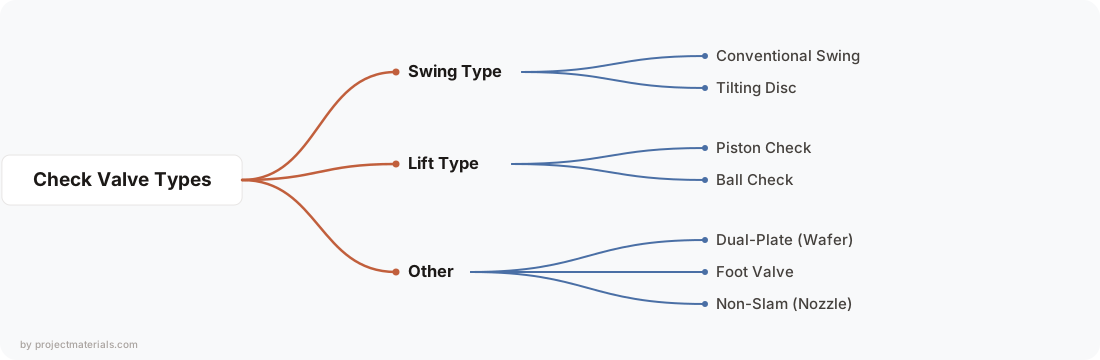
Check valves appear wherever backflow could damage equipment or compromise process integrity: downstream of pumps, on compressor discharge, in potable water systems, and at tie-in points between high- and low-pressure headers.
A few practical points worth remembering. Check valves do not regulate flow; they are binary (open or shut). They can slam (water hammer) if the disc is still open when reverse flow hits. And any debris caught on the seat means a leak. These are protection devices, not throttling devices.
Cast steel valves are available with flanged and butt weld ends. Forged, small-size, valves are available with threaded and socket weld connections.
These valves are represented by the following symbol in piping P&ID diagrams: 
How to Select a Check Valve
The selection comes down to five questions:
- What is the line size and orientation? Swing checks are the workhorse for NPS 2+ horizontal lines. For vertical-up flow, use piston, lift, or spring-loaded dual plate types. For tight spaces, wafer dual plates fit between flanges.
- How fast does flow reverse? If the system is prone to rapid flow reversal (pump trip, compressor surge), pick a fast-closing type (dual plate or tilting disc) to avoid water hammer.
- What is the fluid? Viscous or solids-laden fluids need a full-bore swing check. Clean gas or steam services work well with piston or lift types.
- What are pressure and temperature? Match body and trim materials to American Standard B16.34 pressure-temperature ratings. Above Class 900, consider pressure-seal bonnet construction.
- What end connection? Flanged or butt-weld for cast steel (BS 1868, API 6D). Threaded or socket-weld for forged small-bore (API 602).
| Type | Best For |
|---|---|
| Swing Check Valves | Larger pipe diameters and low-pressure drop applications |
| Ball Check Valves | Viscous fluids or applications with varying flow rates |
| Lift Check Valves | High-pressure systems where tight sealing is required |
| Wafer Check Valves | Space-constrained applications, compact design |
| Dual Plate Check Valves | Quick closing to prevent water hammer in liquid systems |
Each type is discussed in greater detail below.
Applicable Specifications (BS, API, American Standard)
The key specifications for check valves, organized by issuing body:
British Standards (BS)
| Standard | Scope |
|---|---|
| BS 1868 - Steel Check Valves | Steel check valves with flanged and butt-welding ends, DN 50 to DN 600. Covers body materials, pressure-temperature ratings, and testing for petroleum and petrochemical service. |
| BS EN 12334 - Check Valves of Metallic Materials | Non-steel metallic check valves for general industrial use. Covers nominal sizes, pressure designations, design, testing, and marking. |
American Petroleum Institute (API)
| Standard | Scope |
|---|---|
| API 6D - Pipeline and Piping Valves | Pipeline check valves: design, materials, testing, and documentation for petroleum and natural gas service. |
| API 594 - Check Valves: Flanged, Lug, Wafer, and Butt-Welding | The dedicated check valve standard. Type A (single plate) and Type B (double plate). Covers design, materials, face-to-face dimensions, P-T ratings, and testing. |
| API 598 - Valve Inspection and Testing | Testing methods and acceptance criteria for pressure testing of all valve types, including check valves. |
| API 602 - Forged Steel Gate, Globe, and Check Valves | Covers forged check valves in small bore sizes. |
American Society of Mechanical Engineers
| Standard | Scope |
|---|---|
| American Standard B16.34 - Valves: Flanged, Threaded, and Welding End | Materials, pressure-temperature ratings, dimensions, and markings for gate, globe, check, ball, and butterfly valves. |
| American Standard B16.10 - Face-to-Face and End-to-End Dimensions | Dimensional standard that governs interchangeability of valves, including check valves. |
| American Standard B16.25 - Buttweld Ends | Butt-welding end dimensions and weld prep geometry. |
Check Valve Types

Swing Check Valve
The swing check valve is the most common check valve in oil & gas and petrochemical plants. A disc hinged at the top of the body swings open under forward flow pressure and drops shut by gravity when flow stops or reverses.
| Component | Function |
|---|---|
| Body | Outer casing: cast iron, carbon steel, stainless steel, or alloy depending on service |
| Disc | Door-like element on a hinge pin; swings open with flow and returns to seat under gravity |
| Seat | Sealing surface (integral or replaceable) against which the disc closes |
| Hinge / Shaft | Pivot for the disc; some designs add a lever-and-weight or spring to accelerate closure and reduce water hammer |
The main advantage is a full-bore, low-restriction flow path; when the disc is fully open, pressure drop is minimal. Few moving parts mean high reliability and low maintenance. The main weakness is slam: if the disc is still open when reverse flow starts, it shuts hard and creates a pressure surge. For that reason, swing checks are not suited to pulsating flow (reciprocating compressor discharge, for example) and should carry dampers or counterweights on larger sizes.
Swing check valves must be installed horizontally or in lines that slope slightly. They will not work in vertical-up lines because gravity cannot return the disc to its seat.

Stop Check Valve
A stop check valve is a hybrid: part check valve, part globe valve. Left alone, it functions as a normal check valve: forward flow lifts the disc, reverse flow seats it. But an operator can also screw down the stem via a handwheel to force the disc onto the seat, shutting the valve regardless of flow direction. This gives you backflow prevention and positive isolation in one body.

| Component | Function |
|---|---|
| Body | Globe-style outer casing |
| Disc | Lifts off seat with forward flow; can also be forced closed by the stem |
| Stem | Connected to handwheel or actuator; provides manual override to close |
| Seat | Sealing surface for both automatic and manual closure |
| Bonnet | Houses stem packing |
You will see stop check valves on boiler feedwater lines, power plant steam headers, and anywhere the piping engineer needs both non-return protection and the ability to isolate a branch for maintenance. They are standard on high-pressure boiler drum nozzles per American Standard Boiler & Pressure Vessel Code requirements.
Ball Check Valve
In a ball check valve, a free-floating ball rests on a contoured seat. Forward flow lifts the ball off the seat; when flow stops or reverses, the ball drops back and seals. Some designs add a spring to speed closure in horizontal installations where gravity alone may not be enough.

Ball check valves belong to the “lift valve” family and share a seat geometry similar to globe valves. They handle viscous fluids and slurries well because the ball’s rolling action tends to dislodge particles, a self-cleaning effect you do not get with a hinged disc. Common services include wastewater, sewage, chemical processing, and pump discharge protection.
The piston check valve is a close variant: instead of a ball, a precision-guided piston moves within a cylinder. The tighter guidance gives a faster, more repeatable closure, which matters in high-pressure services where flow can reverse suddenly and forcefully.
Both ball and piston check valves work in horizontal and vertical (flow-up) orientations.
Dual Plate Check Valve
The dual plate check valve (also called double door or wafer check valve) is the go-to choice when weight and space matter. Two spring-loaded half-discs pivot from a central hinge pin. Forward flow pushes them open; when flow drops or reverses, the springs snap them shut before the fluid column can build up momentum. That spring-assisted closure is why dual plates cause far less water hammer than conventional swing checks.

| Component | Function |
|---|---|
| Body | Wafer-style, sandwiched between flanges with through-bolts, no separate flange drilling needed |
| Plates (Discs) | Two lightweight semi-circular plates on hinge pins |
| Springs | Torsion springs on each plate; accelerate closure and allow any-orientation installation |
| Seat | Integral or replaceable sealing ring |
| Hinge Pins | Central pivot for both plates |
A 10-inch dual plate check valve weighs roughly a quarter of an equivalent swing check. It is also much shorter (face-to-face per API 594). These valves work in horizontal lines, vertical-up, and even vertical-down because the springs do not depend on gravity. You will find them throughout oil & gas, water treatment, HVAC, and chemical plants.
The trade-off is that the springs are a wear item. On critical services, keep spare spring kits on-site.
Tilting Disc Check Valve
The tilting disc check valve splits the difference between a swing check and a dual plate. The disc pivots on an off-centre axis so that a small amount of forward pressure tilts it open, and it snaps shut faster than a conventional swing disc because the travel distance is shorter. The result is a valve with low pressure drop when open and fast closure when flow decelerates, exactly what you need on large-diameter water transmission mains or power plant feedwater lines where water hammer is the primary concern.
 titling disc check valve
Tilting disc checks are common in cooling water systems, condensate pump discharge, and municipal water distribution. They offer longer service life than swing checks in high-cycle applications because the disc movement is shorter and more controlled, reducing seat wear.
Foot Check Valve
A foot check valve sits at the bottom of a suction line, submerged in the source liquid (well, tank, or sump). It serves two purposes: it keeps the suction line flooded so the pump stays primed, and its built-in strainer screen keeps debris out of the pump.
 foot check valve
The internal mechanism is usually a ball, disc, or flap. When the pump runs, suction pressure pulls fluid through the strainer and lifts the element off the seat. When the pump stops, the element drops back and prevents the water column from draining back into the source.
Foot valves are standard on above-grade centrifugal pumps drawing from wells, cisterns, irrigation canals, and drainage sumps. Material is typically cast iron or bronze for water, stainless steel or PVC for chemical service. Size the strainer mesh to catch debris without starving the pump, and remember that because these valves are submerged, access for cleaning is limited, so specify generous screen area.
Pressure Seal Check Valve
Above Class 900 (roughly 1500 psi at ambient), a conventional bolted-bonnet check valve becomes impractical because the number and size of body-bonnet bolts grows unwieldy. The pressure seal bonnet solves this. Instead of bolts clamping a gasket, the bonnet is held in place by a segmented thrust ring, and line pressure itself compresses a flexible-graphite or metal gasket against the bonnet. The higher the pressure, the tighter the seal, the opposite of a bolted joint, which tends to relax.

| Component | Function |
|---|---|
| Body | Heavy-wall forged or cast body in carbon steel, alloy steel (WC6, WC9), or stainless |
| Bonnet | Self-energising seal, retained by thrust ring, sealed by line pressure |
| Pressure Seal Gasket | Flexible graphite (high temperature) or metal ring (extreme pressure) |
| Disc | Swing or piston type, depending on size |
| Seat | Integral or replaceable, Stellite-faced on most high-temperature services |
You will find pressure seal check valves in power plant steam and feedwater systems, high-pressure oil & gas production, and any application exceeding roughly Class 900 / 1000 degF (538 degC). They are more compact than bolted-bonnet equivalents at the same rating, but maintenance is more involved since the bonnet must be pressed out rather than unbolted.
Duckbill Check Valve
A duckbill check valve is simply a flexible rubber or elastomer flap shaped like a duck’s bill. Forward pressure opens the bill; back-pressure flattens it shut. No moving metal parts, no springs, no hinge pins; just an elastomer body. They are virtually maintenance-free and commonly used in wastewater outfalls, stormwater discharge, and low-pressure drainage where simplicity matters most.
 Duckbill Valve
In-Line Check Valve
An in-line (or “nozzle”) check valve is a compact, cylindrical body that drops directly into the pipeline (threaded, socket-weld, or flanged). The closure element is typically a spring-loaded disc or piston inside the cylinder. The short body length makes these valves popular in hydraulic systems, pneumatic circuits, instrument tubing, and any application where space between flanges is tight.
 Inline Check Valve
The spring gives fast response regardless of orientation (horizontal, vertical, or angled), so in-line checks work well in locations where a swing or dual plate valve would be awkward to install. Pressure drop is generally low because the flow path is axial.
Sump Pump Check Valve
A sump pump check valve sits on the discharge pipe of a sump pump and prevents the water column above the valve from draining back into the pit when the pump cycles off. Without it, every time the pump shuts down, water falls back into the sump, the float rises, the pump kicks on again, and you get rapid short-cycling that burns out the motor.
The construction is simple: a PVC, plastic, or brass body with either a flapper or a ball inside. The pump’s discharge pressure pushes the element open; gravity closes it when the pump stops. Threaded, slip-on, or barbed connections suit residential and light commercial pipe sizes.
Used in basements, crawl spaces, and outdoor drainage systems wherever sump pumps manage groundwater or stormwater. Match the valve diameter to the discharge pipe and pick a material compatible with the water quality. If the sump collects sediment-heavy groundwater, a flapper with a larger seat opening is less prone to fouling than a ball type.
Check Valve Materials (American Standard, API)
Body and trim materials follow the same American Standard and API standards as other valve types. The governing document is American Standard B16.34, which defines pressure-temperature ratings for every listed material group. API 600 and API 602 (primarily gate valve standards) also specify materials that apply to check valves in the same size and pressure ranges.
Common Materials for Check Valves
| Material | Typical Grade | Typical Service |
|---|---|---|
| Carbon Steel | ASTM A216 WCB (cast), A105 (forged) | General hydrocarbon and water service, -29 to 425 degC |
| Stainless Steel | ASTM A351 CF8M (cast), A182 F316 (forged) | Corrosive fluids, clean service, cryogenic to 550 degC |
| Alloy Steel | ASTM A217 WC6 / WC9 (cast), A182 F22 (forged) | High-temperature steam and hydrogen service |
| Bronze / Brass | B62, B148 | Low-pressure water, marine, and instrument service |
| Ductile Iron | ASTM A536 | Water utility and fire-protection service (lower cost than steel) |
Material selection comes down to three factors: compatibility with the process fluid (corrosion), pressure-temperature rating (strength at operating conditions), and external environment (atmospheric corrosion, insulation requirements). For hydrocarbon service, most check valves are carbon steel with Stellite-faced trim; for corrosive or high-purity service, move to stainless or alloy as required by the piping material class.
Check Valve Trim
“Trim” means the internal wetted parts that do the actual sealing work: disc (or ball), seat, stem (if any), and spring (if any). On a check valve, trim takes more of a beating than on a gate or globe valve because every flow fluctuation causes the disc to move. The disc and seat slam together hundreds or thousands of times over the valve’s life.
Trim Components
| Component | Function |
|---|---|
| Disc or Ball | Movable sealing element; must resist erosion and impact wear |
| Seat | Stationary sealing surface, integral to body or replaceable ring |
| Stem | Present only on lift and stop-check types; guides the disc |
| Spring | On dual plate, piston, and in-line types; assists closure speed |
Trim Materials
| Trim Material | Typical Use |
|---|---|
| 13Cr (ASTM A182 F6a) | Standard trim for carbon steel check valves in non-corrosive hydrocarbon service |
| Stellite overlay | Hard-facing on disc and seat for high-cycle, high-temperature, or erosive service; the industry default for Class 300+ |
| 316 SS | Corrosive or clean service, cryogenic applications |
| Alloy steel (F22, F91) | High-temperature steam service, matched to body alloy |
| NACE-compliant trims | Sour service per MR0175; typically 316 SS or Stellite 6 |
The trim number system (Trim 1, Trim 2, Trim 5, Trim 8, etc.) follows the same conventions as gate and globe valves per API 600 / BS 1868. Always cross-check the trim designation against the piping material class datasheet; specifying the wrong trim on a sour-service check valve is an expensive mistake to discover during commissioning.
Check Valve GA Diagram
Below NPS 2, check valve bodies are forged steel: ASTM A105 (standard), A350 LF2 (low-temperature), or A182 F304/F316 (corrosive service). NPS 2 and above are cast steel: ASTM A216 WCB (standard), A351 CF8 / CF8M (stainless).

Standard Materials for Check Valves
| Part | Denomination | Carbon Steel | Alloy Steel | Stainless Steel |
|---|---|---|---|---|
| 1 | Body | ASTM A216 WCB | ASTM A217 WC9 | ASTM A351 CF8M |
| 3 | Cover | ASTM A105 | ASTM A182 F22 | ASTM A182 F316 |
| 6 | Seat Ring | ASTM A105+Stellite | ASTM A182 F22+Stellite | ASTM A182 F316+Stellite |
| 8 | Disc | ASTM A216 WCB+Stellite | ASTM A217 WC9+Stellite | ASTM A351 CF8M+Stellite |
| 17 | Pressure Seal Gasket | Compressed & Braided Graphite | Compressed & Braided Graphite | Compressed & Braided Graphite |
| 17A | Gasket | AISI 304 + Graphite | AISI 304 + Graphite | AISI 316 + Graphite |
| 18 | Disc Nut | ASTM A182 F6A | ASTM A182 F6A | ASTM A182 F316 |
| 19 | Plug | ASTM A105 | ASTM A182 F6A | ASTM A182 F316 |
| 19A | Hinge Pin Cover | ASTM A515 Gr70 | ASTM A182 F22 | ASTM A182 F316 |
| 25 | Hinge | ASTM A216 WCB | ASTM A217 WC9 | ASTM A351 CF8M |
| 27 | Hinge Pin | ASTM A182 F6A | ASTM A182 F6A | ASTM A182 F316 |
| 28 | Cover Stud | ASTM A193 B7 | ASTM A193 B7 | ASTM A193 B7 |
| 28A | Hinge Pin Cover Stud | ASTM A193 B7 | ASTM A193 B7 | ASTM A193 B7 |
| 69 | Disc Washer | ASTM A182 F6A | ASTM A182 F6A | ASTM A182 F316 |
| 129 | Cover Nut | ASTM A194 2H | ASTM A194 2H | ASTM A194 2H |
| 129A | Hinge Pin Cover Nut | ASTM A194 2H | ASTM A194 2H | ASTM A194 2H |
| 132 | Spacer Ring | ASTM A105 | ASTM A182 F22 | ASTM A182 F316 |
| 133 | Gasket Retainer | ASTM A105 | ASTM A182 F22 | ASTM A182 F316 |
| 134 | Cover Retainer | ASTM A515 Gr70 | ASTM A515 Gr70 | ASTM A515 Gr70 |
| 198 | Roll Pin | ASTM A182 F6A | ASTM A182 F6A | ASTM A182 F316 |
| 198A | Cotter Pin | AISI 304 | AISI 304 | AISI 316 |
Frequently Asked Questions
How do I select the right type of check valve?
Selection depends on size, flow characteristics, and installation: swing check valves are the default for horizontal lines NPS 2 and above (low pressure drop, full-bore flow). Dual plate (wafer) check valves are used where space and weight are limited ; they fit between flanges without extra bolting. Piston/lift check valves are used for small bore and high-pressure applications. Tilting disc check valves offer fast closure to prevent water hammer in high-flow pipelines.
What causes water hammer with check valves and how to prevent it?
Water hammer occurs when a check valve slams shut after sudden flow reversal ; the kinetic energy of the fluid creates a pressure surge. Prevention methods: use non-slam check valves (spring-assisted or nozzle check valves) that close before flow reversal begins; install dual plate check valves (lighter discs close faster); avoid oversizing check valves (creates low flow velocity and delayed closure); consider damper mechanisms or dashpots on large swing check valves.
Can check valves be installed in vertical pipelines?
It depends on the type. Swing check valves work only in horizontal lines (they rely on gravity to close the disc). Piston/lift check valves can work vertically with upward flow. Spring-loaded dual plate check valves work in any orientation (horizontal, vertical up, vertical down) because the spring assists closure regardless of gravity. Always check the manufacturer's installation guidelines for the specific model.
What is the difference between a full-bore and a reduced-bore check valve?
A full-bore check valve has an internal passage equal to the connecting pipe diameter, minimizing pressure drop ; preferred for pigging operations and low-restriction flow. A reduced-bore check valve has a smaller internal passage, which increases flow velocity and helps the disc respond faster to flow changes, reducing slam. Reduced bore is common for lift and piston check valves.
Leave a Comment
Have a question or feedback? Send us a message.