

Butterfly Valve: Lug, Wafer & Offset
Butterfly Valve
What Is a Butterfly Valve
Definition: A butterfly valve is a quarter-turn device that uses a rotating disc to isolate or regulate flow. Lighter and cheaper than gate or ball valves for large sizes, butterfly valves are available in concentric (rubber seat, low pressure), double offset, and triple offset (metal seat, high pressure/temperature) designs.
A butterfly valve uses a rotating disc mounted on a shaft inside the valve body. Turn the shaft 90° and the disc swings from fully open (parallel to flow) to fully closed (perpendicular). That quarter-turn action makes butterfly valves fast to operate (comparable to ball valves) but with one key difference: the disc stays in the flow path even when fully open, so there’s always some pressure drop.
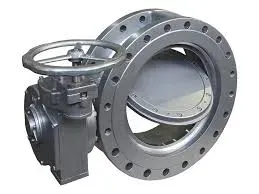 triple eccentric butterfly valve
Why butterfly valves get specified so often: they’re significantly lighter and cheaper than gate or ball valves in large sizes (above 8-10 inches, the weight and cost difference becomes dramatic). A 24” Class 150 triple-offset butterfly valve weighs roughly 40-60% less than an equivalent gate valve and costs considerably less.
The trade-off is that butterfly valves cannot match gate valves for zero pressure drop, and concentric designs are limited to low-pressure, non-critical service. But with the introduction of double and triple offset designs, butterfly valves now compete directly with gate and globe valves in oil & gas and process applications.
Butterfly valves are classified by:
- Design: concentric, double offset (eccentric), triple offset (eccentric)
- End connection: wafer, lug (semi or full), flanged, double flanged
- Seat: soft (EPDM, PTFE, Buna, Viton) or metal-to-metal (SS316, Stellite, Inconel)
- Body/disc material: cast iron through to super duplex and nickel alloys
- Actuation: manual (lever, gear, worm gear), pneumatic, electric, hydraulic
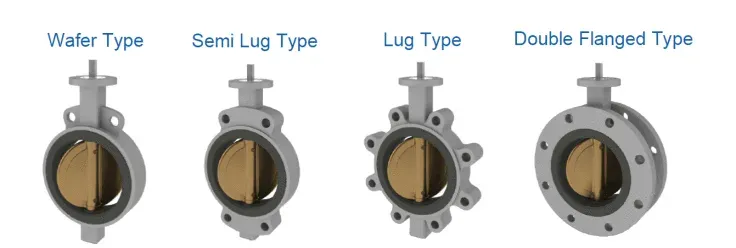
Butterfly Valve Parts
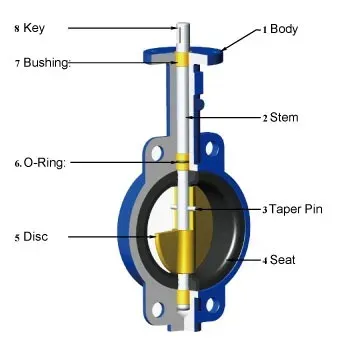
| Part | Function | Typical Materials |
|---|---|---|
| Body | Outer casing; connects to piping via flanges or wafer/lug ends | Cast iron, ductile iron, carbon steel, stainless steel, PVC |
| Disc | Rotating element that blocks or allows flow | Carbon steel, SS316, duplex, nickel alloy; must be compatible with process fluid |
| Stem (shaft) | Connects disc to actuator; transmits torque | SS 17-4PH, SS316, Monel |
| Seat | Sealing surface the disc closes against | Soft: EPDM, PTFE, Viton, NBR. Metal: SS316, Stellite, Inconel |
| Actuator | Rotates the disc: manual (lever/gear) or automated (pneumatic/electric/hydraulic) | - |
| Bushings | Reduce stem friction and wear | PTFE, bronze, graphite |
| Packing | Prevents stem leakage | PTFE, graphite, Viton |
| End connections | Wafer, lug, flanged, or butt-weld | Matched to body material |
For valves above about 8-10 inches, manual lever operation becomes impractical because the torque is too high. These valves use gearboxes (worm gear) or actuators. On large butterfly valves (24”+), always verify actuator sizing with the valve manufacturer; operating torque can double under differential pressure.
How a Butterfly Valve Works
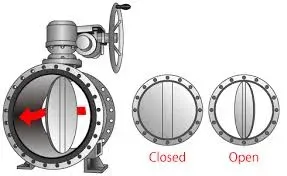
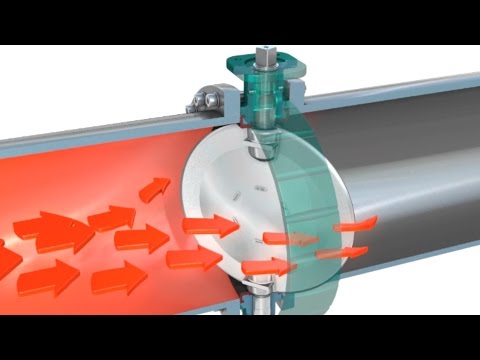
The disc sits at the pipe centerline and rotates 90° between open and closed. In the open position the disc is parallel to flow; in the closed position it’s perpendicular, blocking the bore. Intermediate positions allow throttling, though butterfly valves don’t throttle as precisely as globe or control valves. At low opening angles (10-30%), dynamic torque is high and cavitation can occur.
Unlike a ball valve, the disc remains in the flow stream at all times. Even fully open, it creates some pressure drop and turbulence. This is the main functional disadvantage compared to full-bore ball or gate valves.
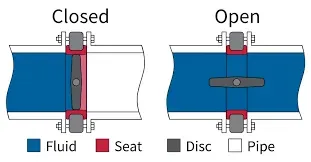
(Source: GEMU Group Youtube Channel)
Pressure Drop
Because the disc stays in the flow path, butterfly valves have a higher pressure drop than full-bore gate or ball valves. The magnitude depends on disc position (fully open = minimal, partially closed = significant), flow rate, and fluid properties.
The pressure drop is estimated using the valve’s flow coefficient (Cv):
ΔP = Q² / Cv²
Where Q is the flow rate in US GPM and Cv is the flow coefficient at the given opening position. Valve manufacturers publish Cv values for each size and opening angle.
In practice, the pressure drop of a fully open butterfly valve is small enough that it rarely governs valve selection for on/off service. Where it does matter is throttling applications: operating a butterfly valve at 10-30% open creates substantial pressure drop and turbulence that can cause cavitation and vibration problems.
Applicable Standards
| Standard | Coverage |
|---|---|
| API 609 | The primary butterfly valve specification. Covers design, materials, FTF dimensions, P-T ratings, and testing for wafer, lug, and double-flanged types. Category A = concentric/soft seat; Category B = double/triple offset, higher pressure |
| American Standard B16.34 | Pressure-temperature ratings, shell material categories, testing. Triple-offset butterfly valves are often designed to B16.34 |
| American Standard B16.10 | Face-to-face dimensions, critical for interchangeability |
| American Standard B16.5 | Flange dimensions and ratings (up to 24”) |
| American Standard B16.47 | Large-diameter flange dimensions (26”+) |
| MSS SP-67 | Butterfly valve requirements (design, dimensions, testing), widely used alongside API 609 |
| MSS SP-68 | High-pressure butterfly valves with offset design |
| ISO 5211 | Part-turn actuator attachments; standardizes the actuator mounting interface |
Types of Butterfly Valves
By Design: Concentric vs. Eccentric Butterfly Valves
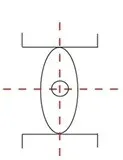
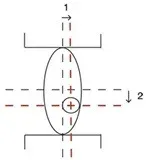
Concentric butterfly valve (left), double offset butterfly valve (center), triple offset butterfly valve (right)
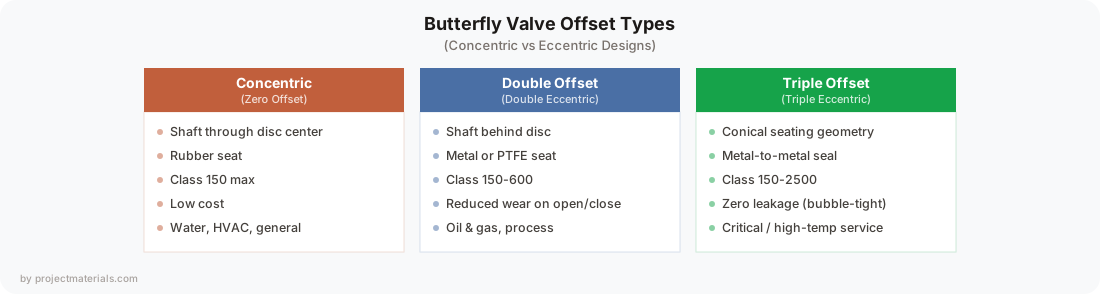
Concentric (Zero Offset) Butterfly Valves
The stem passes through the center of the disc, and the disc is centered in the bore. The disc rubs against the resilient seat (rubber or PTFE) through the full 90° rotation, which limits concentric butterfly valves to low-pressure, low-temperature service where seat wear is acceptable.
Typical applications: water treatment and distribution, wastewater, fire protection systems, HVAC, natural gas supply, pumping stations, and aeration systems. The concentric butterfly valve dominates the water industry because it’s cheap, reliable, and bubble-tight with a soft seat.
Double Offset (High-Performance) Butterfly Valves
Two offsets: the shaft is moved behind the disc plane (first offset) and to one side of the pipe centerline (second offset). This “cam” action lifts the disc off the seat immediately on opening, so the disc only contacts the seat at the moment of closure. The result is dramatically reduced seat wear and lower operating torque compared to concentric designs.
Double offset butterfly valves compete directly with gate valves in large sizes: they’re lighter, cheaper, and for underground water mains they reduce excavation work. They handle higher pressures and temperatures than concentric designs, and work with both soft and semi-metallic seats.
Triple Offset Butterfly Valves
The third offset is the conical geometry of the seating surface. This means the disc contacts the metal seat only at the final point of closure, with no friction during rotation at all. The result is a metal-to-metal seal capable of bubble-tight shutoff at temperatures up to 700°C and pressures up to Class 2500.
Triple offset butterfly valves (TOV) have gained significant market share in oil & gas and process industries. They compete with gate and ball valves in critical isolation service but weigh 40-60% less. Materials range from stainless steel and duplex to super duplex and nickel alloys.
By End Connection: Lug vs. Wafer Butterfly Valves
Lug Butterfly Valves
The body has threaded lugs (bolt holes) so the valve bolts directly to each flange independently. This allows removal of downstream piping without affecting the upstream side; the lug valve can hold pressure on one side with the other flange removed. Required for dead-end service.
Wafer Butterfly Valves
The valve body sits between two flanges and is held in place by the through-bolts connecting the flanges. More compact and cheaper than lug type, but cannot be used for dead-end service. Both flanges must be in place and bolted for the valve to seal.
By Seat Type: Soft vs. Metal Seated
Rubber-lined (soft-seated) butterfly valves use EPDM, Viton, NBR, PTFE, or Buna-N seats. They provide bubble-tight shutoff and low operating torque, but are limited by the seat material’s temperature and chemical resistance.
Metal-seated butterfly valves (typically double or triple offset) use SS316, Stellite, or Inconel seats. They handle higher temperatures and abrasive media, but may not achieve zero-leakage shutoff. They’re designed to meet acceptable leakage rates per API 598 or FCI 70-2.
Double Offset vs. Triple Offset Butterfly Valve
| Feature | Double Offset | Triple Offset |
|---|---|---|
| Offsets | Shaft behind disc + off-center | Shaft behind disc + off-center + conical seat geometry |
| Seat type | Soft (PTFE, rubber) or semi-metallic | Metal-to-metal (SS316, Stellite, Inconel) |
| Disc-seat contact | Cam action reduces friction, but disc still rubs seat briefly | Zero contact during rotation; only at final closure point |
| Max pressure | Typically up to Class 600 | Up to Class 1500-2500 |
| Max temperature | Limited by seat material (PTFE ~260°C) | Up to 700°C with metal seats |
| Shutoff class | Bubble-tight with soft seat | Bubble-tight with metal seat (zero-leakage) |
| Typical service | Water, HVAC, light chemical, moderate-pressure process | Steam, high-pressure oil & gas, critical shutdown, fired heater isolation |
| Seat life | Good, but soft seats wear and need replacement | Very long; no friction during cycling |
| Cost | Moderate | Higher (2-3× double offset for same size) |
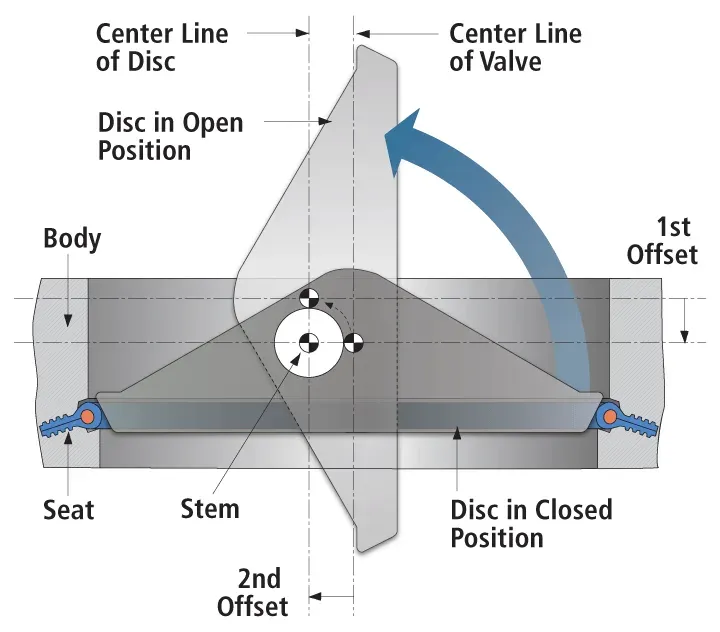 .
. 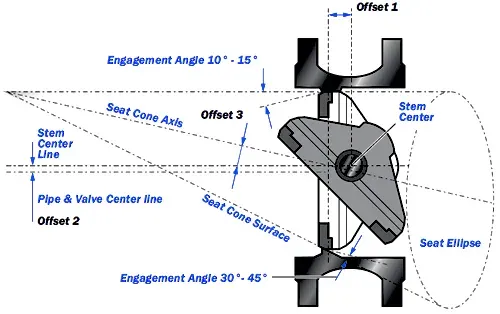
The images show the design difference between a double and a triple eccentric butterfly valve (respectively at the left and right side of the diagram).
Butterfly Valve Body Materials
The body/disc material is selected based on the process fluid, pressure, temperature, and corrosion environment. Here are the main material groups used for butterfly valve bodies (all are cast grades):
| Material | Cast Grades | Typical Service | Key Consideration |
|---|---|---|---|
| Cast iron | ASTM A126 | Water/wastewater, HVAC, low-pressure air | Cheapest option; limited to ~200°C and low pressures |
| Ductile iron | ASTM A536 | Water distribution, gas supply, higher-pressure water | Stronger and more ductile than cast iron; dominates water industry |
| Carbon steel | ASTM A216 WCB, LCC | Oil & gas, power generation, general process | WCB for high-temp, LCC for low-temp; poor corrosion resistance without lining |
| Stainless steel | CF8 (304), CF8M (316), CF3M (316L) | Chemical, pharmaceutical, food & beverage, seawater | 316/316L for chloride environments; 304 for general corrosion resistance |
| Duplex | A890 Gr. 4A (S31803/S32205) | Offshore, desalination, aggressive chemicals | Higher strength than austenitic SS; excellent chloride resistance |
| Super duplex | A890 Gr. 5A/6A (S32750/S32760) | Subsea, sour service, concentrated chloride environments | Best combination of strength + corrosion resistance in stainless steels |
| Nickel alloys | Inconel 625, Hastelloy C-276, Monel 400 | Sour gas (H₂S), strong acids, high-temperature corrosion | For conditions where stainless and duplex steels fail; expensive |
| Titanium | Gr. 2 (pure), Gr. 5 (Ti-6Al-4V) | Chlorine gas, seawater, hot brines | Exceptional chloride resistance; very expensive; limited availability |
| Nickel aluminium bronze | C95800 | Seawater systems, marine applications | Resists biofouling (unlike stainless steel); good for seawater valves |
| Bronze | C83600, C95400 | Marine, desalination | Traditional seawater material; lower cost than NAB |
| Aluminium | - | Air handling, vacuum, dry bulk | Lightweight; low-pressure only |
| PVC/CPVC/PP/PE | - | Water treatment, chemical dosing, irrigation | Low cost; limited to low pressure and moderate temperatures |
Carbon steel (WCB) with PTFE lining is the workhorse combination for most oil & gas butterfly valve applications; it gives acceptable corrosion resistance at a fraction of the cost of stainless or alloy steel bodies.
Butterfly Valve Seat Materials
Soft Seat Materials
Soft-seated butterfly valves provide bubble-tight shutoff and require low operating torque. They are the standard choice for concentric butterfly valves and most double offset designs. The seat material must be compatible with the process fluid and within its temperature range. Exceeding the temperature limit destroys the seat.
| Seat Material | Max Temp | Chemical Resistance | Typical Service |
|---|---|---|---|
| EPDM | ~120°C | Water, dilute acids/alkalis, steam; poor with hydrocarbons | Water/wastewater, HVAC, steam condensate |
| NBR (Buna-N) | ~100°C | Hydrocarbons, oils, fuels; poor with ozone and strong acids | Oil & gas, fuel handling, hydraulic oil |
| Viton (FKM) | ~200°C | Hydrocarbons, acids, solvents; poor with ketones | High-temperature chemical service, oil & gas |
| PTFE | ~260°C | Nearly universal chemical resistance | Chemical processing, pharmaceutical, food & beverage |
| Reinforced PTFE | ~260°C | Same as PTFE with improved wear resistance | High-cycle applications where pure PTFE deforms under load |
Metal Seat Materials
Metal-seated butterfly valves handle higher temperatures and abrasive media but don’t achieve the same zero-leakage shutoff as soft seats. Leakage is rated per API 598 or FCI 70-2. They’re standard on triple offset butterfly valves.
| Seat Material | Typical Application |
|---|---|
| SS 316 | General process, water treatment, food & beverage |
| Stellite overlay | Severe service: high wear, high temperature, power generation |
| Inconel 625 | High-temperature corrosion, oxidizing environments |
| Hastelloy C-276 | Aggressive acids (H₂SO₄, HCl), chlorine gas |
| Monel 400 | Seawater, caustic soda, HF acid |
| Titanium | Chloride brines, seawater, wet chlorine |
| Aluminium bronze | Seawater systems |
Seat Coatings and Treatments
| Coating | Purpose |
|---|---|
| PTFE coating | Chemical resistance + low friction on metal seats |
| Electroless nickel | General corrosion protection, uniform coverage |
| Ceramic coating | Extreme hardness for abrasive slurry service (mining) |
| Chrome plating | Surface hardness and wear resistance |
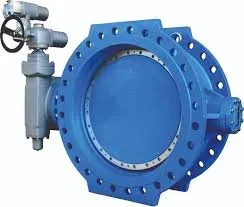 .
Double offset and triple offset butterfly valve (metal seated)
.
Double offset and triple offset butterfly valve (metal seated)
Watch the Video
Frequently Asked Questions
What is the difference between concentric, double-offset, and triple-offset butterfly valves?
A concentric (zero-offset) butterfly valve has the shaft centered on the disc and the seat ; the disc rubs against the seat during the full rotation, limiting it to low-pressure, non-critical service. A double-offset design moves the shaft behind and to one side of the disc center, reducing friction and seat wear. A triple-offset design adds a conical seating geometry for metal-to-metal contact, enabling bubble-tight shutoff at high pressures (up to Class 2500) and high temperatures.
Can butterfly valves be used for throttling service?
Yes, with limitations. Double-offset and triple-offset butterfly valves can throttle flow reasonably well. However, at partially open positions (especially 10-30%), the disc experiences high dynamic torque and the flow creates turbulence and cavitation. For precise throttling, a control valve is preferred. For coarse flow control (e.g., cooling water regulation), butterfly valves with positioners work adequately and are much more economical than globe-type control valves.
What is a triple-offset butterfly valve used for?
Triple-offset (TOV) butterfly valves provide metal-to-metal sealing without the friction problems of concentric designs. They are used for high-temperature service (up to 700°C with metal seats), high-pressure isolation (up to Class 2500), and critical on/off applications where zero leakage is required ; e.g., fired heater isolation, steam systems, and offshore platform shutdown valves. They compete directly with gate and ball valves but weigh 40-60% less.
What is the maximum pressure rating for butterfly valves?
Concentric butterfly valves (API 609 Category A) are typically limited to Class 150-300. Double-offset butterfly valves (API 609 Category B) reach Class 600. Triple-offset butterfly valves are rated up to Class 1500-2500 depending on the manufacturer, with some designs certified for American Standard B16.34 Class 2500 service. The pressure rating depends on body material, seat type, and temperature.
Leave a Comment
Have a question or feedback? Send us a message.
Previous Comments
Buy Butterfly Valves for Effective & Regulated Fluid Flow.
Hi,Dear Sales Manager, How are you ? So glad your can open my email.We hope it is a good chance for both of us open the business cooperation. Tianjin Fortis valve co., LTD. Was set up in 2000, is located in Tianjin in northern of China. We have the advanced machining equipment and coating processing line, We have our own Machining shop, painting shop and assembled shop. We can ensure you the best price and delivery. We export to UK,Italy, Turkey, Russia, HK,Korea etc. Product Range: Butterfly Valves (wafer Type/ Lugged Type/ Double Flanged/Double eccentric and triple eccentric type) Dual Disc Check Valves Gate valves( soft seat ) Standard: DIN PN10/PN16, ANSI150,BS 10,TABLE E, JIS 10K etc. Material: Ductile Iron, Cast Iron, CF8(SS304),CF8M(SS316),2207/2507,Aluminum bronze ,Carton Steel etc. Thanks for your time again and Really hope we can have the chance to do business the basis of equality and mutual benefit. Best Regards, Alice Summer Mobile/Whatsapp+8615522861153 Email:[email protected] Tianjin Fortis Valve Co., Ltd.
AIV BFV10 Model Butterfly Valve incorporates the optimum design features to provide long trouble free service in the field. This general purpose soft seated Butterfly valve has a fully rubber lined single piece body with centric disc construction and is available in wafer type body pattern. http://amcovalves.com/products/butterfly-valves-pn-10/
Looking for Double eccentric butterfly valve Body in doube flanged Duplex St st Disc in Duplex st st Shaft in Duplex st st sizes 300 mm to 1200 mm PN 16 medium is seawater
Hi Sr. I am looking for a 4 inch normally closed flange butterfly fire safe valve with independent hydraulic actuator (internal storage and manual reset) 12,5 Bar. This is for a fuel loading skid, as a fire protection. What do you recommend: Flanged? Double offset? Triple offset?