

Pipe vs Tube vs Tubing: Differences, Sizing, Standards
Pipe vs Tube vs Tubing
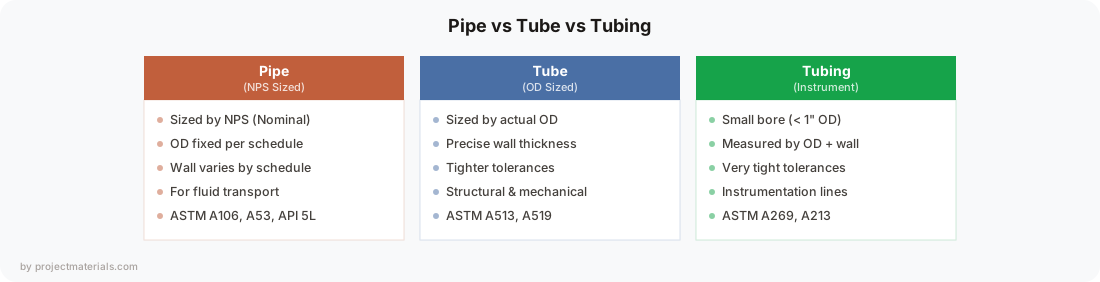
These three terms get confused constantly, but in engineering and procurement they mean different things. Mixing them up on a purchase order leads to wrong materials showing up on site.
Pipe
- Shape: Cylindrical hollow section
- Purpose: Transporting fluids, gases, and/or solids
- Dimensions: Specified by nominal size (NPS) + schedule. American Standard B36.10 and American Standard B36.19 define standard sizes
- Customization: Circular cross-sections only
- Material: Steel, nickel alloys, non-ferrous (copper), PVC
- Application: Oil & gas, water distribution, plumbing, HVAC, process piping
Tube
- Shape: Round, square, rectangular, and oval hollow sections
- Purpose: Structural/mechanical applications, also fluid conveyance
- Dimensions: Exact OD and WT in inches or mm
- Customization: Multiple shapes and custom sizes
- Material: Metal, plastic, and glass
- Application: Construction, automotive, aerospace, instrumentation
Tubing
- Purpose: Flexible or small-diameter applications, instrumentation
- Measurement: OD and wall thickness, often associated with flexible materials
- Customization: Can be bent or fitted around structures as needed
- Material: Soft metals, plastics, rubber
Key Takeaway While pipe is defined by nominal sizes and schedules (NPS/SCH) for fluid transport, tube and tubing emphasize precise engineering dimensions and material flexibility (OD/WT). “Tube” pertains to structural and mechanical applications with exact size specifications, whereas “tubing” suggests a broader, sometimes more flexible, application.
Comparison Table
Pipe, tube, and tubing differ across every engineering parameter, from sizing method to cost:
| Parameter | Pipe | Tube | Tubing |
|---|---|---|---|
| Sizing method | NPS (Nominal Pipe Size) or DN + Schedule | Exact OD + WT (inches or mm) | Exact OD + WT (fractional inches or mm) |
| Wall thickness designation | Schedule (SCH 5S, 10S, 40, 80, 160, XXS) | Inches/mm or BWG/SWG gauge number | Inches/mm or BWG gauge |
| Cross-section shapes | Round only | Round, square, rectangular, oval | Round only |
| Typical size range | NPS 1/8” to 80”+ | OD 1/4” to 12”+ (round); larger for structural | OD 1/8” to 1” (instrumentation); up to 2” (hydraulic) |
| OD tolerance | Loose (per American Standard B36.10/B36.19) | Tight (per ASTM product specification) | Very tight (per ASTM A269, A213) |
| WT tolerance | +/- 12.5% (standard) | +/- 10% or tighter | +/- 10% or tighter |
| Key material standards | ASTM A106, A53, A335, API 5L, A312 | ASTM A179, A192, A213, A269, A519 | ASTM A269, A213 (SS); A179 (CS) |
| Primary applications | Fluid/gas transport, process piping | Heat exchangers, boilers, mechanical/structural | Instrumentation, hydraulic, sampling lines |
| End connections | Beveled, plain, threaded (NPT/BSP) | Plain, expanded, flared | Compression fittings (ferrule type) |
| Typical cost (per kg) | Lower | Higher | Highest |
| Delivery lead time | Shorter (stock items) | Longer (often made to order) | Moderate (standard sizes stocked) |
Inside Diameter vs Outside Diameter
Inside diameter (ID) and outside diameter (OD) measure different cross-sectional dimensions of a pipe or tube:
| Dimension | Definition | Primary Use |
|---|---|---|
| Inside Diameter (ID) | The measurement of the diameter of the inner surface of a cylindrical object, representing the distance across the widest part of the inner circular cross-section. | Determines the flow capacity of a pipe or tube, as it directly affects the volume of fluid or material that can pass through the conduit. |
| Outside Diameter (OD) | The measurement of the diameter of the outer surface of a cylindrical object, representing the distance across the widest part of the outer circular cross-section. | Used to specify the size and dimensions of pipes or tubes, providing a reference for fitting, joining, or connecting the conduit with other components. |

In practical terms: pipe ID determines how much fluid can flow through, while pipe OD determines which fittings and flanges will fit around it. For tubes, OD is the primary ordering dimension because it determines fit into tube sheets, compression fittings, and support clamps.
Sizing Standards: NPS/DN for Pipes vs OD/WT for Tubes
One of the most critical distinctions between pipe and tube is how they are sized and ordered. Getting this wrong is the single most common procurement error in piping projects.
Pipe Sizing: NPS and DN
Pipes are specified by Nominal Pipe Size (NPS) in North America or Diametre Nominal (DN) in metric systems, combined with a schedule that defines wall thickness.
Key points about pipe sizing:
- NPS is not a physical measurement. For sizes below NPS 14, the NPS number does not correspond to either the inside or outside diameter. For example, a 4-inch NPS pipe has an OD of 4.500 inches, not 4.000 inches.
- NPS 14 and above: the NPS value equals the actual outside diameter in inches.
- The OD is constant for a given NPS, regardless of schedule. A 6-inch Schedule 40 pipe and a 6-inch Schedule 160 pipe both have an OD of 6.625 inches; only the wall thickness (and therefore ID) changes.
- Schedule determines wall thickness: higher schedule = thicker wall = smaller ID = higher pressure rating.
Tube Sizing: Exact OD and WT
Tubes are specified by their actual outside diameter and wall thickness, both expressed as exact measurements in inches or millimeters.
Key points about tube sizing:
- The OD is the true outside diameter. A 1-inch OD tube measures exactly 1.000 inches on the outside.
- Wall thickness is stated in decimal inches, millimeters, or gauge numbers (BWG or SWG).
- There is no “schedule” system for tubes. You simply specify the OD and WT you need.
- ID is calculated: ID = OD - (2 x WT).
What Is a Pipe?
The word “steel pipe” refers to round hollow sections to convey fluids and gases, including oil & gas, propane, steam, acids, and water.
The most important dimension for a steel pipe is the inside diameter (“pipe ID”), which indicates the rough (not the exact) fluid conveyance capacity of the tubular. The ID is expressed in “NPS” or “DN” (nominal pipe size, or bore size).
For pipes of a given NPS, the pipe outside diameter is fixed, whereas the pipe inside diameter decreases by increasing schedule values (pipe wall thickness). The most important mechanical parameters for pipes are the pressure rating, the yield strength, and the ductility.
Standard combinations of pipe nominal diameter and wall thickness (schedule) are defined in the American Standard B36.10 and American Standard B36.19 specifications (for carbon/alloy pipes and stainless steel pipes, respectively).
Pipe Inside Diameter Calculator
Because the outside diameter of pipes of a specific NPS is constant, the inside diameter (ID) changes depending on the pipe schedule. To calculate the pipe ID, deduct the pipe wall thickness multiplied by 2 from the pipe OD (the WT can be taken from the schedule).
Example: for a 12 NPS pipe (DN 300 mm), schedule 40, the pipe outside diameter and the wall thickness are 12.75 inches (324 mm) and 0.406 inches (10.4 mm). Therefore, the pipe ID (internal diameter) is 12.75 inches - 2 x 0.406 inches = 11.94 inches, or Pipe ID = 324 mm - 2 x 10.4 mm = 303.2 mm.
This calculation is theoretical only, since pipes have a wall thickness tolerance of +/-12.5% per American Standards. The actual ID of a given pipe may differ by +/- 12.5% from the calculated value.
What Is a Tube?
The word “tube” refers to round, square, rectangular, and oval hollow sections used for pressure equipment, for mechanical applications, and for instrumentation systems.
Tubes are designated by their outside diameter and wall thickness, which are exact measures in inches or millimeters. For tubes, the difference between the outside diameter and the wall thickness, multiplied by two, defines the inside diameter of the tube.

Key physical properties of steel tubes are hardness, tensile strength, and low manufacturing tolerances.
Manufacturing Methods: Pipe vs Tube
How pipes and tubes are manufactured is fundamentally different, and these differences directly affect cost, lead time, and available sizes.
Pipe Manufacturing
Pipes are produced using high-volume, continuous processes optimized for output:
- Seamless pipe: A solid steel billet is heated and pierced using a rotary piercing mill (Mannesmann process), then elongated and sized through a series of rolling stands. See Types of Pipes: Seamless and Welded for details.
- Welded pipe (ERW): Flat steel coil (skelp) is formed into a cylinder and the longitudinal seam is welded using high-frequency electric resistance. Common for NPS 1/2” through 24”.
- Welded pipe (LSAW/DSAW): Steel plates are formed into a “U” then “O” shape and seam-welded with submerged arc welding. Used for large-diameter line pipe (24” and above).
- Production volume: Pipe mills run continuously, producing thousands of tons per day. Standard sizes are stocked by distributors worldwide.
Tube Manufacturing
Tubes require more controlled, lower-volume processes to meet tighter tolerances:
- Seamless tubes: Similar rotary piercing as pipe, but followed by cold drawing or cold pilgering to achieve precise OD, WT, and surface finish. Multiple drawing passes may be needed.
- Welded tubes: Formed from strip and welded (TIG, laser, or ERW), then often cold-drawn to final dimensions. The weld seam may be heat-treated and/or ground flush.
- Cold finishing: Most tubes undergo cold drawing or cold pilgering as a final step, which improves dimensional accuracy, surface finish, and mechanical properties.
- Inspection intensity: Every tube typically receives 100% non-destructive examination (eddy current testing, ultrasonic testing, or hydrostatic testing).
Material Standards: Pipe vs Tube
ASTM and API standards draw a clear line between pipes and tubes. The specification printed on a material test certificate immediately tells you which product you are dealing with.
Common Pipe Standards
| Standard | Description | Material |
|---|---|---|
| ASTM A106 | Seamless carbon steel pipe for high-temperature service | Carbon steel (Gr. A, B, C) |
| ASTM A53 | Seamless and welded carbon steel pipe | Carbon steel (Gr. A, B) |
| API 5L | Line pipe for oil & gas transmission | Carbon/HSLA steel (Gr. B through X80) |
| ASTM A335 | Seamless alloy steel pipe for high-temperature service | Alloy steel (P5, P9, P11, P22, P91) |
| ASTM A312 | Seamless and welded austenitic stainless steel pipe | Stainless steel (304/L, 316/L, 321, 347) |
| ASTM A790 | Seamless and welded duplex stainless steel pipe | Duplex/super duplex (S31803, S32750) |
Common Tube Standards
| Standard | Description | Material |
|---|---|---|
| ASTM A179 | Seamless cold-drawn carbon steel tubes for heat exchangers | Carbon steel |
| ASTM A192 | Seamless carbon steel boiler tubes for high-pressure service | Carbon steel |
| ASTM A213 | Seamless alloy and stainless steel tubes for boilers/superheaters | Alloy & stainless steel (T5, T9, T11, T22, TP304, TP316) |
| ASTM A269 | Seamless and welded austenitic stainless steel tubing | Stainless steel (TP304/L, TP316/L) |
| ASTM A519 | Seamless carbon and alloy steel mechanical tubing | Carbon & alloy steel |
| ASTM A789 | Seamless and welded duplex stainless steel tubing | Duplex (S31803, S32205, S32750) |
Pipe vs Tube: 10 Basic Differences

| # | PIPE VS TUBE | STEEL PIPE | STEEL TUBE |
|---|---|---|---|
| 1 | Key Dimensions (Pipe and Tube Size Chart) | The most important dimension for a pipe is the inside diameter (ID), expressed in NPS (nominal pipe size) or DN (nominal diameter), which defines its fluid conveyance capacity. The NPS does not match the true inside diameter, it is a rough indication | The most important dimensions for a steel tube are the outside diameter (OD) and the wall thickness (WT). These parameters are expressed in inches or millimeters and express the true dimensional value of the hollow section. |
| 2 | Wall Thickness | The thickness of a steel pipe is designated with a “Schedule” value (the most common are Sch. 40, Sch. STD., Sch. XS/XH, Sch. XXS). Two pipes of different NPS and same schedule have different wall thicknesses in inches or millimeters. | The wall thickness of a steel tube is expressed in inches or millimeters. For tubing, the wall thickness is measured also with a gage nomenclature (BWG, SWG). |
| 3 | Types of Pipes and Tubes (Shapes) | Round only | Round, rectangular, square, oval |
| 4 | Production range | Extensive (up to 80 inches and above) | A narrower range for tubing (up to 5 inches), larger for steel tubes for mechanical applications |
| 5 | Tolerances (straightness, dimensions, roundness, etc) and Pipe vs. Tube strength | Tolerances are set, but rather loose. Strength is not the major concern. | Steel tubes are produced to very strict tolerances. Tubulars undergo several dimensional quality checks, such as straightness, roundness, wall thickness, and surface, during the manufacturing process. Mechanical strength is a major concern for tubes. |
| 6 | Production Process | Pipes are generally made to stock with highly automated and efficient processes, i.e. pipe mills produce on a continuous basis and feed distributors stock around the world. | Tube manufacturing is more lengthy and laborious |
| 7 | Delivery time | Can be short | Generally longer |
| 8 | Market price | Relatively lower price per ton than steel tubes | Higher due to lower mill productivity per hour, and due to the stricter requirements in terms of tolerances and inspections |
| 9 | Materials | Various materials available | Tubing is available in carbon steel, low alloy, stainless steel, and nickel alloys; steel tubes for mechanical applications are mostly of carbon steel |
| 10 | End Connections | The most common are beveled and plain ends | Threaded and grooved ends are available for quicker connections on-site |
When to Use Pipe vs Tube in Oil & Gas
In oil and gas projects, both pipes and tubes serve critical but distinct roles. Selecting the wrong product for a given service can result in safety incidents, failed inspections, or costly rework.
Use Pipe When:
- Transporting fluids in process piping systems: from wellhead to separator, through processing units, and to export. Governed by American Standard B31.3 (process piping) or American Standard B31.4/B31.8 (pipeline transport).
- Building pipeline infrastructure: cross-country and subsea pipelines use line pipe per API 5L with NPS/schedule sizing.
- Connecting equipment with flanged or butt-welded joints: all standard pipe fittings (flanges, elbows, tees, reducers) are manufactured to match NPS pipe dimensions.
- Fire protection and utility systems: firewater, potable water, drain, and vent systems use pipe.
Use Tube When:
- Heat exchangers: shell-and-tube heat exchangers use tubes expanded or welded into tube sheets. Tight OD tolerances are necessary for proper tube-to-tubesheet fit.
- Boilers and superheaters: boiler tubes per ASTM A192 or A213 must withstand high temperatures and pressures with precise wall thickness control.
- Condensers and coolers: condenser tubes require excellent heat transfer, corrosion resistance (often copper-nickel, titanium, or stainless steel), and consistent wall thickness.
- Structural and mechanical applications: support frames, handrails, and mechanical assemblies where strength-to-weight ratio and dimensional precision matter.
Use Tubing When:
- Instrumentation systems: impulse lines from process taps to transmitters, analyzer sample lines, and pneumatic signal tubing. Typically 1/4”, 3/8”, or 1/2” OD stainless steel per ASTM A269, connected with ferrule compression fittings.
- Hydraulic control systems: high-pressure hydraulic lines on BOP stacks, subsea trees, and control modules.
- Chemical injection: small-bore tubing for injecting corrosion inhibitors, methanol, and other chemicals into process streams.
- Sampling systems: sample transport lines from process taps to analyzer shelters.
Heat Exchanger Tubing
Heat exchangers are the single largest consumer of tubes in the oil and gas industry.
Why Tubes, Not Pipes?
Heat exchangers use tubes rather than pipes for several critical reasons:
- Tight OD tolerances: tubes must fit precisely into drilled holes in the tube sheet. A typical tube sheet hole is drilled to the tube OD + 0.2 mm. Pipe OD tolerances are too loose for this.
- Controlled wall thickness: heat transfer calculations depend on exact WT. The tube WT tolerance of +/- 10% (vs +/- 12.5% for pipe) allows more accurate thermal design.
- Surface finish: smoother internal surfaces reduce fouling and improve heat transfer coefficient.
- 100% NDE: every tube is tested (eddy current or hydrostatic) before shipment. Pipe inspection is typically sampling-based.
Common Heat Exchanger Tube Specifications
| Service | Standard | Typical Material | Common Sizes (OD) |
|---|---|---|---|
| General process | ASTM A179 | Carbon steel | 3/4”, 1” |
| High-temperature | ASTM A213 | T11, T22 alloy steel | 3/4”, 1”, 1-1/4” |
| Corrosive service | ASTM A213 | TP304L, TP316L stainless | 3/4”, 1” |
| Seawater coolers | ASTM B111 | CuNi 90/10 (C70600) | 3/4”, 1” |
| Highly corrosive | ASTM B338 | Titanium Gr. 2 | 3/4”, 1” |
Tube wall thickness for heat exchangers is commonly specified using the BWG (Birmingham Wire Gauge) system. Typical gauges are 14 BWG (0.083”, 2.11 mm) and 16 BWG (0.065”, 1.65 mm) for 3/4” OD tubes.
Instrumentation Tubing
Instrumentation tubing is a specialized subset of tubing used throughout oil and gas facilities for connecting process instruments, transmitters, control valves, and analyzers.
Key Characteristics
- Small diameters: Most instrumentation tubing is 1/4” OD, 3/8” OD, or 1/2” OD. Larger sizes (3/4” and 1”) are used for some hydraulic and sampling applications.
- Material: 316/316L stainless steel is the standard choice (ASTM A269). For sour service or highly corrosive environments, alloy 625 (UNS N06625) or alloy C-276 is specified.
- Wall thickness: Common wall thicknesses are 0.035” (0.89 mm) and 0.049” (1.24 mm) for standard pressure ratings, and 0.065” (1.65 mm) for high-pressure service.
- Connections: Instrumentation tubing uses compression fittings (ferrule type), not pipe threads or flanges. The two most common brands are Swagelok and Parker A-LOK. See Ferrule Compression Fittings for a detailed guide.
- Seamless vs welded: Both are acceptable per ASTM A269, but seamless tubing is preferred for critical and high-pressure applications.
Instrumentation Tubing vs Small-Bore Pipe
A common question on construction sites: can you use 1/2” NPS pipe instead of 1/2” OD tubing for instrument connections? The answer is no. Here is why:
| Parameter | 1/2” OD Tubing | 1/2” NPS Pipe (Sch 80) |
|---|---|---|
| Outside diameter | 0.500” (12.70 mm) | 0.840” (21.34 mm) |
| Wall thickness | 0.049” (1.24 mm) | 0.147” (3.73 mm) |
| Fitting type | Compression (ferrule) | Threaded (NPT) or socket weld |
| Bend radius | Tight bends possible with tube bender | Requires fittings for direction changes |
| Weight | Light, easy to route | Heavier, rigid |
Practical Selection Guide
Use this decision framework when specifying pipe or tube for a given application:
Step 1: What is the primary function?
- Fluid transport in process piping → Pipe
- Heat transfer in exchangers/boilers → Tube
- Instrument/hydraulic/sampling connections → Tubing
- Structural support → Tube (mechanical)
Step 2: What sizing system does the design use?
- NPS and schedule on the drawing → Pipe
- Exact OD and WT (or BWG gauge) → Tube/Tubing
Step 3: What fittings are specified?
- Flanges, butt-weld fittings, socket-weld fittings → Pipe
- Compression fittings (ferrule type) → Tubing
- Tube-to-tubesheet expansion → Tube
Step 4: What ASTM/API standard is called out?
- A106, A53, A335, A312, API 5L → Pipe
- A179, A192, A213, A269, A519 → Tube/Tubing
Standards Reference Table
Frequently referenced standards for pipes, tubes, and tubing:
| Category | Standard | Title / Scope |
|---|---|---|
| Pipe sizing | American Standard B36.10 | Welded and seamless wrought steel pipe (carbon/alloy) |
| Pipe sizing | American Standard B36.19 | Stainless steel pipe |
| Tube sizing | TEMA (Tubular Exchanger Manufacturers Association) | Heat exchanger tube dimensions and tolerances |
| Carbon steel pipe | ASTM A106 | Seamless CS pipe for high-temperature service |
| Carbon steel pipe | ASTM A53 | Seamless and welded CS pipe (general service) |
| Line pipe | API 5L | Line pipe for oil & gas pipeline transport |
| Alloy pipe | ASTM A335 | Seamless ferritic alloy steel pipe (P-grades) |
| Stainless pipe | ASTM A312 | Seamless & welded austenitic SS pipe |
| Duplex pipe | ASTM A790 | Seamless & welded duplex SS pipe |
| CS heat exchanger tube | ASTM A179 | Seamless cold-drawn CS tubes |
| Boiler tube | ASTM A192 | Seamless CS boiler tubes |
| Alloy/SS tube | ASTM A213 | Seamless ferritic and austenitic alloy steel tubes |
| SS tubing | ASTM A269 | Seamless & welded austenitic SS tubing |
| Mechanical tube | ASTM A519 | Seamless CS & alloy mechanical tubing |
| Duplex tube | ASTM A789 | Seamless & welded duplex SS tubing |
| Tube gauge | BWG / SWG | Birmingham Wire Gauge / Standard Wire Gauge |
| Pipe fittings | American Standard B16.9 | Factory-made wrought butt-welding fittings |
| Tube fittings | - | Proprietary (Swagelok, Parker, Hoke) per manufacturer specs |
Bottom Line
The core distinction is simple: pipe is sized by NPS and schedule (nominal dimensions for fluid transport), while tube is sized by exact OD and wall thickness (precise dimensions for structural/mechanical use). When ordering, always be explicit about which system you are using. A “2-inch” pipe and a “2-inch” tube are physically different products that will not interchange.
Frequently Asked Questions
What is the difference between pipe and tube?
Pipe is sized by nominal pipe size (NPS) and schedule for fluid transport; tube is sized by exact outside diameter (OD) and wall thickness (WT) for structural, mechanical, or heat-transfer applications. A 2-inch NPS pipe has an OD of 2.375 inches, while a 2-inch OD tube measures exactly 2.000 inches. Pipes use butt-weld and flanged connections; tubes use expansion joints, compression fittings, or flared ends.
What ASTM standards apply to pipes vs tubes?
Common pipe standards are ASTM A106 (seamless carbon steel), ASTM A53 (seamless and welded), and API 5L (line pipe). Common tube standards are ASTM A179 (heat exchanger), ASTM A192 (boiler), and ASTM A213 (seamless alloy and stainless steel tubes). For stainless steel, pipes use ASTM A312 while tubes use ASTM A269. The standard on the material test certificate is the quickest way to confirm whether a product is pipe or tube.
Can pipe and tube be used interchangeably?
No. Pipe and tube are not interchangeable because they follow different sizing systems, have different dimensional tolerances, and use different fittings. Pipe fittings (flanges, elbows, tees) are designed around NPS dimensions, while tube fittings (compression fittings, flare fittings) are designed around exact OD. Mixing them causes fit-up failures, potential leaks, and safety hazards, especially in hydrocarbon or toxic service.
What is tubing in piping?
Tubing refers to small-diameter tubes, typically 1/8" to 1" OD, used for instrumentation, hydraulic, and sampling systems in process plants. Tubing is connected with compression fittings (ferrule type, such as Swagelok or Parker) and is sized by actual outside diameter and wall thickness, not NPS. Common materials include 316 stainless steel (ASTM A269) and nickel alloys for corrosive service.
Why are tubes more expensive than pipes?
Tubes cost more per unit weight because they require tighter manufacturing tolerances (OD, WT, straightness, ovality, surface finish), additional cold-finishing steps (cold drawing or cold pilgering), and 100% non-destructive examination (eddy current or ultrasonic testing on every tube). Pipe mills produce at high volume with looser tolerances and sampling-based inspection, resulting in lower unit costs. The added tube cost is justified by the precision needed for heat exchanger tube sheets, instrument fittings, and mechanical assemblies.
Leave a Comment
Have a question or feedback? Send us a message.
Previous Comments
With the help of this article I have clearly understood the difference between a Stainless Steel Pipe and a Stainless Steel Tube
Well written article! also visit our page:Stainless steel pipes supplier