

Casting vs Forging: Steel Processes
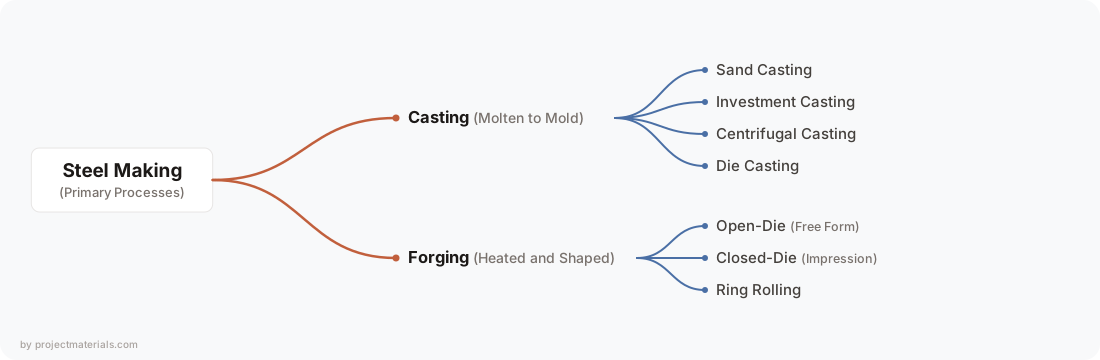
Steel Forging vs. Casting
Basic Definitions
Steel casting and forging are two fundamental manufacturing processes for forming steel into finished products. Each method produces parts with distinct mechanical properties and geometries, so the choice between them depends on the application’s strength requirements, shape complexity, and production volume.
Steel Casting
Steel casting involves melting steel to a liquid state and pouring it into a mold, where it solidifies into a specific shape. The process excels at producing complex geometries and components that would be difficult or impossible to manufacture by other methods. Cast steel products range from simple gears and valves to intricate heavy machinery and automotive assemblies.
Common casting applications include automotive, mining, aerospace, and construction, basically any industry where complex shapes or specialized alloy compositions are needed.
Steel Forging
Forging involves heating solid steel blocks (ingots or billets) and deforming them under high pressure or impact to achieve the desired shape. The process can be performed at different temperatures, yielding classifications of cold forging, warm forging, and hot forging.
Steel forging dominates in industries that demand high-strength components: automotive and aerospace for gears, shafts, and levers, as well as critical fasteners and valves.

Both manufacturing processes require high temperatures applied to steel raw materials (to liquefy or make it malleable) and CNC machining at the end of the process to produce the final product.
Final products may also undergo surface finish treatments such as painting, powder coating, polishing, zinc plating, or wear protection/hardening (tungsten carbide overlay).
Cast and forged parts may be assembled, welded, brazed, and hard-faced before being shipped as final products.
The products from casting and forging differ in surface porosity (generally better for forged vs. cast products), grain structure (finer for forged products), tensile strength (generally superior for forged products), and fatigue resistance.
These manufacturing processes are therefore suited for different circumstances and applications.
Choosing Between Cast & Forged Products
| Decision Factor | Casting | Forging |
|---|---|---|
| Design complexity | Complex shapes, internal cavities | Simpler shapes (complex = expensive) |
| Size | Virtually unlimited | Limited by press capacity |
| Material properties | Wide alloy selection | Superior strength/toughness |
| Production volume | Better for small-medium batches | Better for large runs |
| Initial cost | High mold cost, lower unit cost at volume | High tooling cost, efficient at scale |
| Integrity | May have porosity | No voids, consistent properties |
When to choose CASTING:
- Parts too complex or expensive to forge (e.g., large valve bodies)
- Parts with internal cavities
- Very large parts with no practical size limit
- Special alloys difficult to forge (high Ni/Mo content)
- Small lot production where forging dies aren’t justified
When to choose FORGING:
- Maximum strength, toughness, and fatigue resistance required
- Parts subject to high impact and mechanical stress
- Zero tolerance for porosity, voids, or gas pockets
- High wear resistance needed
- High-end applications where quality and integrity outweigh cost/time
- Critical pressure-containing components
The evolution of casting technologies has reduced the gap between the physical properties of cast vs. forged products making modern cast products very competitive in terms of quality, strength, and wear resistance: however, in many fields, steel forging remains, still, the preferred manufacturing option (example: small sized valves, i.e. forged valves, or high-pressure valves).
Read about forging steel on Wikipedia.
Fields of Application
Steel casting and forging produce parts and products for many sectors:
- petrochemical plants (for example forged valves, forged fittings, flanges, etc)
- power generation and waste processing
- mining and mineral processing
- agriculture and livestock handling
- water treatment
- aeronautics
- automobile industry (pulleys and gear wheels)
- materials handling
- brickworks
- asphalt plants
- stormwater parts
- rendering plants
- railways
Steel Casting
Definition
Steel casting is a manufacturing process in which steel is melted to a liquid state, poured into a mold, and allowed to solidify into the desired shape. The method produces parts with complex geometries and detailed features that other processes cannot easily replicate.
 cast valve body
Molds can be sand, metal, or ceramic, depending on the required precision, surface finish, and reuse cycle. Steel castings serve the automotive, aerospace, construction, and energy sectors because of their flexibility in shape and size, combined with the ability to tailor material properties through alloy selection and post-casting heat treatment.
The process is particularly valuable for components that demand high strength, durability, and resistance to wear and corrosion.
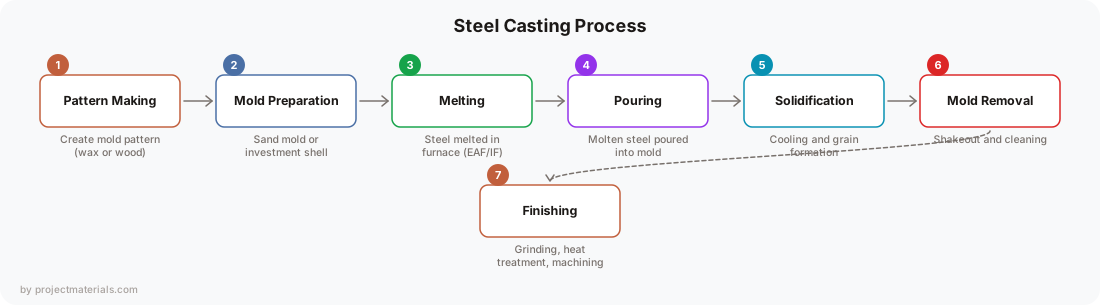
Steel Casting Process
The steel casting process transforms raw steel into precisely shaped components through a sequence of well-defined steps.
Casting Process: Pattern Making → Mold Making → Melting & Pouring → Solidification → Mold Removal → Cleaning & Finishing → Inspection & QC
| Step | Operation | Details |
|---|---|---|
| 1 | Pattern Making | A pattern representing the final shape is created from wood, plastic, or metal, slightly oversized to account for shrinkage. |
| 2 | Mold Making | Molding material (sand with binders) is packed around the pattern. When the pattern is removed, the cavity matches the part shape. Complex parts use two-half molds (cope and drag) with cores for internal cavities. |
| 3 | Melting and Pouring | Steel is melted at >1600 °C (2900 °F) with controlled alloy composition, then poured into the mold carefully to fill all sections and avoid defects. |
| 4 | Solidification and Cooling | Steel cools and solidifies in the mold. Cooling rates affect microstructure; directional solidification minimizes stresses and defects. |
| 5 | Mold Removal | Sand molds are broken away; metal molds are opened and reused. |
| 6 | Cleaning and Finishing | Residual mold material is removed, gates/runners cut off. Parts undergo grinding, machining, and heat treatment to reach final properties. |
| 7 | Inspection and QC | Dimensional accuracy and material properties are verified. NDT methods (X-ray, ultrasonic) detect internal defects. |
Advantages/disadvantages Of Cast Steel
Advantages
Cast steel combines design freedom with strong mechanical performance. The casting process itself and the intrinsic properties of steel create a set of practical benefits.
1. Design Flexibility
Cast steel allows production of complex shapes and intricate designs that are difficult or impossible to achieve through forging or machining. Engineers can incorporate internal cavities, contours, and complex external geometries in a single piece, eliminating assembly or welding of multiple parts.
2. Material Properties
Steel casting works with a broad range of alloys, so the composition can be adjusted to optimize strength, ductility, wear resistance, impact resistance, or corrosion resistance. Post-casting heat treatments provide additional control over mechanical properties.
3. Large Component Production
The casting process handles large components that would be prohibitively expensive to forge or machine from solid billet. This matters in mining, construction, maritime, and energy, where oversized, durable parts are standard.
4. Cost-Effectiveness
For small to medium production volumes, casting is often more economical than alternative methods, especially for complex shapes that would require extensive machining or multi-part assembly. Near-net-shape production reduces material waste and secondary processing.
5. Surface Finish and Detail
Cast steel achieves a good surface finish and fine detail directly from the mold, which limits the need for post-processing. This benefits parts with tight dimensional requirements or aesthetic constraints.
6. Reliability
Steel castings undergo rigorous quality control and testing. Non-destructive testing (NDT) techniques (X-ray, ultrasonic, and magnetic particle inspection) detect internal or surface defects before the part enters service.
7. Speed to Market
The casting process moves quickly from design to production, especially for prototypes or limited runs. This short turnaround cuts lead time for new products and components.
The combination of design freedom, tunable material properties, and economical production makes cast steel a practical choice across industrial applications, from heavy machinery and automotive components to architectural elements.
Disadvantages
Cast steel has well-known limitations that engineers must weigh against its advantages.
1. Cost
Specialized molds can be expensive to manufacture, particularly for intricate designs or low production volumes. Alloyed steels used in casting for enhanced properties add further material cost.
2. Surface Finish and Tolerances
Cast steel typically has a rougher surface finish than forged or machined parts, requiring additional finishing. Tight dimensional tolerances are harder to hold, especially on complex shapes or large components, and often demand further machining.
3. Porosity and Defects
The casting process can introduce porosity (tiny holes or voids) that reduces mechanical strength and pressure integrity. Castings are also susceptible to shrinkage cavities, cold shuts, and inclusions. All of these require rigorous inspection and quality control to detect.
4. Material Limitations
Some alloy compositions are not suitable for casting because of their melting behavior or reactivity with mold materials. There are also practical limits to the size and weight of cast components, driven by foundry equipment capacity and the difficulty of maintaining uniform heat dissipation across large sections.
5. Environmental Considerations
Melting and casting steel consumes significant energy. The process also generates waste (spent molds, excess metal from gates and risers, and defective castings) that must be managed and recycled where possible.
Types of Steel Casting Processes
| Process | Best For | Size/Volume |
|---|---|---|
| Sand Casting | Large parts, versatile shapes | Large, small-medium runs |
| Investment (Lost Wax) | Complex details, tight tolerances | Up to 100kg, 1.5m max |
| Centrifugal | Cylindrical parts (pipes, rings) | Any cylindrical shape |
| Continuous | Basic shapes for further processing | Billets, blooms, slabs |
| Shell Molding | Better finish than sand | Medium-high volume |
| Vacuum | High-integrity, defect-free | Aerospace, power generation |
| Die Casting | High-volume small parts | Primarily non-ferrous metals |
Sand Casting
Sand casting is the oldest casting method. Liquid metal is poured into binders that resist the molten steel (such as clay bonded/green sand, hard bonded/resin, thermosetting resin sand, and shell).

This is the most common and versatile method, using sand molds to create steel parts. The sand can be shaped into complex forms, making it suitable for automotive frames, heavy machinery components, and decorative pieces.
Investment Casting (Lost Wax Casting)
Investment casting uses precision molds formed by injecting liquid metal into a metal die and applying a ceramic coating. The mold material can be hard wax, lost wax, lost foam, or similar. This method is preferred for parts with fine detail and small parts where traditional sand casting would be too costly.

A wax model is coated with refractory material to create a mold. After the wax is melted out, molten steel is poured into the cavity. The result is excellent surface finish and dimensional accuracy, well suited for small, complex components with tight tolerances: turbine blades, medical equipment, and firearm components.
Centrifugal Casting
Molten steel is poured into a rotating mold, producing parts with cylindrical shapes. The centrifugal force pushes the molten steel against the mold walls, creating a dense and uniform casting. This method is used for components requiring high material integrity: pipes, cylinders, and rings.
Continuous Casting
A highly efficient process where molten steel solidifies in a continuous strand through a mold, then is cut into desired lengths. This method significantly reduces the need for further processing. It primarily produces basic shapes (billets, blooms, and slabs) which are then rolled or otherwise processed into finished steel products.
Shell Molding
Similar to sand casting, but uses a resin-coated sand that bonds to form a shell around the pattern. Shell molding offers a better surface finish and tighter dimensions than traditional sand casting. It suits medium to high-volume production of small to medium-sized parts such as valve components and gear housings.
Vacuum Casting
Molten steel is poured into a mold under vacuum. The vacuum reduces defects and improves casting quality by minimizing turbulence and gas entrapment. This process is used for high-integrity components that must be free of pores and voids, particularly in aerospace and power generation.
Die Casting
Die casting is predominantly used with non-ferrous metals because of steel’s high melting point, but specialized high-pressure die-casting processes can handle steel alloys. The method suits high-volume production of small, precise components that need a good surface finish.
Steel Forging
Definition
Steel forging is a manufacturing process that shapes metal using localized compressive forces. Steel is heated to a high temperature to become pliable, then hammered, pressed, or rolled into the desired shape.
The process can be performed at different temperatures (hot forging, warm forging, and cold forging), each producing distinct results in terms of ductility and finished-part properties.
Steel forging originated in ancient China for producing metal products.
The methods and equipment have evolved from traditional anvils, hammers, and manual labor to modern automated machinery like hydraulic presses, but the fundamental process remains the same: heating solid steel blocks and shaping them into finished products through mechanical force.

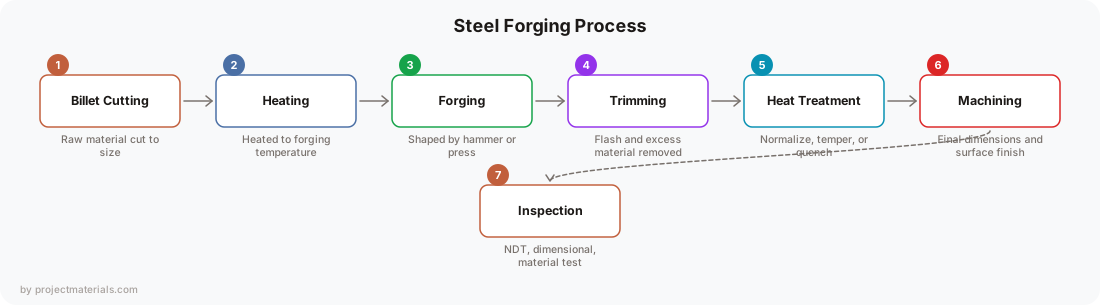
Forging Process
The steel forging process transforms steel into strong, durable components through force and heat:
Forging Process: Material Selection → Heating → Forging → Shaping → Trimming → Heat Treatment → Finishing → Inspection & Testing
| Step | Operation | Details |
|---|---|---|
| 1 | Material Selection | Steel grade chosen based on required strength, ductility, wear resistance, and corrosion resistance. Common grades: carbon steel, alloy steel, stainless steel, tool steel. |
| 2 | Heating | Steel is heated to 950-1250 °C (1742-2282 °F) to become pliable. Temperature varies by steel type and forging method (hot, warm, or cold). |
| 3 | Forging | Steel is shaped by hammer forging (repeated hammer strikes for precise shapes), press forging (hydraulic/mechanical press applies gradual pressure, with better control, suited for large production), or rolled forging (steel passes through rolls to decrease thickness and increase length, typically for cylindrical shapes). |
| 4 | Shaping | Internal grain structure deforms to conform to the part shape, increasing strength and toughness. |
| 5 | Trimming | Excess material (flash) is removed while hot or after cooling. |
| 6 | Heat Treatment | Annealing, normalizing, quenching, or tempering adjusts hardness and ductility while relieving internal stresses. |
| 7 | Finishing | Machining, grinding, and polishing achieve final surface finish and dimensions. |
| 8 | Inspection & Testing | Dimensional checks, visual inspection, and NDT methods (ultrasonic, magnetic particle) verify quality. |
The resulting products possess high strength, impact toughness, and wear resistance. These properties come from the metallurgical changes (specifically recrystallization and grain refinement) that occur during the thermal and mechanical treatments of the forging process.
The video below shows how steel forging works:
Advantages/disadvantages Of Forged Steel
Forged steel is a preferred material for many industrial applications because of its strength and reliability. Like any manufacturing process, however, forging has trade-offs worth understanding.
Advantages of Forged Steel
1. Superior Strength and Toughness
Forging refines the grain structure and aligns it with the part’s shape. This grain refinement makes forged parts stronger and more resistant to impact and fatigue than cast or machined equivalents.
2. Improved Reliability
The forging process produces parts with consistent material properties and no internal voids, cracks, or other defects. This uniformity delivers high reliability, especially in critical applications.
3. Reduced Material Waste
Modern forging techniques are highly efficient, generating less scrap than casting or machining. This efficiency translates to cost savings in high-volume production.
4. Versatility in Materials
Steel forging works with a broad range of alloys, allowing production of parts with properties tailored to the application, whether high-temperature resistance, corrosion resistance, or wear resistance.
5. Cost-Effective for Large Production Runs
Initial setup and tooling costs are significant, but forging becomes more economical than other processes at high volumes due to material efficiency and reduced secondary processing.
Disadvantages of Forged Steel
1. Higher Initial Costs
Setup and die costs are substantial, especially for complex shapes. This makes forging less economical for small production runs.
2. Limitations on Shape Complexity
Forging handles a range of shapes, but extremely complex or intricate designs may require additional machining or alternative manufacturing steps.
3. Size Limitations
Forging size is constrained by press and hammer capacity. Very large components may be impractical to forge and require alternative methods.
4. Need for Secondary Processing
Depending on the application, forged parts may require machining, heat treatment, or surface finishing to achieve final dimensions, properties, or surface quality.
5. Energy Intensive
Hot forging in particular requires large amounts of energy to heat the metal, which adds to the environmental footprint of the process.
Types of Steel Forging Processes
Steel forging processes vary by technique and application. They are categorized by temperature (cold, warm, or hot) and by the method of applying force (hammer or press).
By Temperature:
| Type | Temperature | Advantages | Best For |
|---|---|---|---|
| Hot Forging | 950-1250°C (1742-2282°F) | Easy shaping, less force needed, no strain hardening | Complex shapes, high strength parts (automotive, construction) |
| Warm Forging | 650-950°C (1202-1742°F) | Balance of formability and precision | Medium-complexity parts, cost-effective |
| Cold Forging | Room temperature | Excellent surface finish, work hardening strengthens part | Small precision parts (fasteners, bolts, screws) |
Hot forging allows steel to be shaped easily because the high temperature increases plasticity and reduces resistance to deformation. Complex shapes require less force and energy, and strain hardening does not occur during the process.
Cold forging is performed at or near room temperature. It yields a cleaner finish and stronger products through strain hardening. Parts have excellent surface finish and dimensional accuracy; the steel’s strength increases through work hardening.
Warm forging sits between hot and cold forging, combining reduced force requirements with better dimensional accuracy than hot forging.
4. Open-Die Forging
In open-die forging, steel is worked between two flat or simply contoured dies that do not enclose the workpiece, allowing material to flow outward as it is forged. The process is highly versatile, capable of producing very large parts, and allows repositioning of the workpiece during forging. It is used for large, simple shapes: shafts, bars, beams, and plates.
Open die forging involves shaping metal by pressing or hammering it between two dies that don’t entirely enclose the material. The piece of metal is worked upon through successive movements of the dies, which apply force to mold the metal into the desired shape. This technique is demonstrated in the action showcased in the video below:
5. Closed-Die Forging (Impression-Die Forging)
In closed-die forging, steel is compressed between two or more dies containing a precut profile of the desired part, producing a more precise and complex shape. The process yields close tolerances with minimal waste and suits high-volume production. Automotive, aerospace, and industrial components that require detailed features and high strength are typical applications.
Closed-die forging is a process where the dies close in on the workpiece, either completely enclosing it or partially. The process begins by placing a piece of heated raw material, roughly shaped or sized to match the final product, into the lower die. This process is demonstrated in the following video:
6. Seamless Rolled Ring Forging
Seamless rolled ring forging starts by piercing a hole in a thick, round piece of metal to create a donut shape, which is then rolled and stretched into a seamless ring. The process efficiently produces rings with excellent structural integrity and uniform properties. Typical products include bearings, flanges, gear rings, and wind turbine components.
Difference between Open-Die & Closed-Die Forging
| Feature | Open-Die Forging | Closed-Die Forging |
|---|---|---|
| Die configuration | Flat dies, workpiece not enclosed | Dies contain precut profile, enclose workpiece |
| Size capability | Very large parts possible | Limited by die size and press capacity |
| Precision | Lower - requires machining | High - close tolerances, minimal machining |
| Complexity | Simple shapes only | Complex geometries with details |
| Production volume | Low volume, one-offs | High volume, mass production |
| Material waste | Higher (less precise shape) | Lower (near-net shape) |
| Setup cost | Lower | Higher (complex dies) |
| Unit cost | Higher at volume | Lower at volume |
| Applications | Shafts, beams, large industrial parts | Gears, levers, fasteners, automotive/aerospace |

Related Steel Products
Structural Steel Sections
- Steel Plates - Hot-rolled plates for construction and manufacturing
- IPE/IPN Steel Beams - European I-beam profiles for structural applications
- HSS Hollow Sections - Square and rectangular tubular sections
- RSA Steel Angles - Equal and unequal angle sections
- UPN/UPE Channels - U-shaped channel sections
Material Properties
- Density of Metals - Reference table for metal densities
- CE Marking for Steel Products - European conformity requirements for construction products
Related quick answers: Cast vs Forged Steel | What Is Hardness Comparison?
Leave a Comment
Have a question or feedback? Send us a message.
Previous Comments
Thank you for sharing this useful blog. You have sharing very important information casting and Forged Steel. ACAST is a precision casting company. They do casting in metal steel iron alloys to customer specifications. Kindly contact us.
Hey, thank you for sharing this information. I've looking for a comprehensive explanation about the differences between the forged pipe and the cast pipe. I thought they are kind of similar because this method is rather old compared to the other methods, but turns out they are actually different. Very enlightening!
Superb blog to read really helpful information given keep sharing more thanks for it
This blog is so useful
Thank you for your appreciated comment. Should you need further information on some specific topics, kindly send us an email to [email protected]. To submit an RFQ for piping materials, please visit this page: https://projectmaterials.com/submit-rfq-mto. Best regards, Projectmaterials