

Gasket Selection Guide for Pipe Flanges
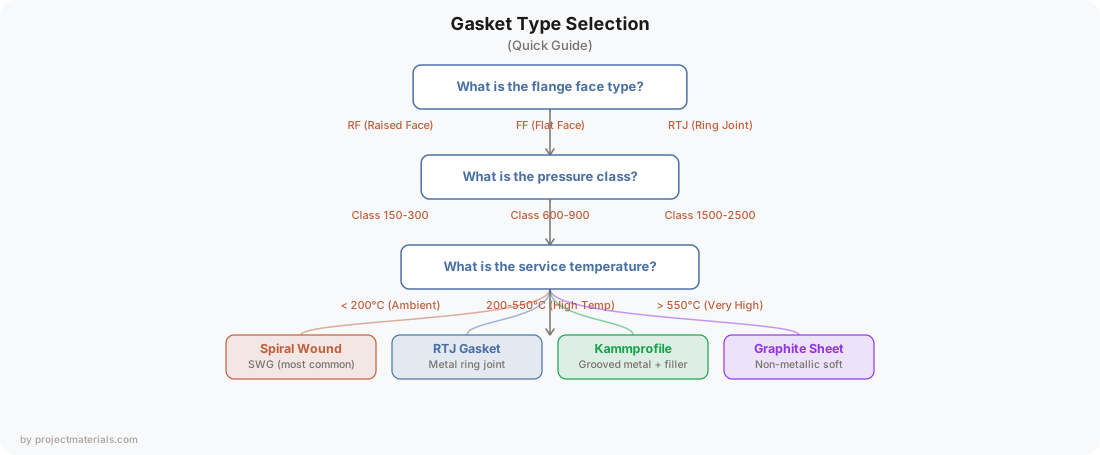
How to Select the Right Gasket
Piping engineers shall consider multiple factors when selecting the proper types of gaskets for a piping system, namely:
- the fluid to be conveyed in the system, or by the pipeline
- the operational parameters of the process (such as the temperature and the pressure)
- the flanges used in the design (type, sizes, ratings, material grades, and specifications)
- the Regulatory framework applicable in the country of installation (such as fugitive emissions and safety directives)
- other general aspects

Let’s now examine each of these factors that have to be considered when selecting the gaskets for a specific installation.
The Fluid to Be Conveyed
The first criteria to select the right type of gasket is, of course, the type of fluid conveyed by the pipeline, and, in particular:
- The Chemical Compatibility: Identify the chemical properties of the fluid being transported, including its corrosiveness, toxicity, and purity requirements. The gasket material must be compatible with the fluid to prevent degradation, which could lead to leaks or contamination.
- The max. Fluid Temperature: Consider the temperature range of the fluid. The gasket material must withstand the maximum and minimum temperatures without losing its sealing properties or degrading.
- The max. Pressure: Determine the system’s operating pressure. The gasket must maintain its integrity under the expected pressure conditions.
- Fluid contamination risks: For some applications, it is important to use gaskets that do not contaminate the fluid conveyed by the pipeline (for example; pharmaceutical and food applications, or gas pipelines)
- Toxic/Explosive Fluids: Toxic fluids require totally leakproof flanged joints to prevent soil contamination or threats to human life. As a consequence, tighter and stronger gaskets may be the natural choice for these types of applications (for example spiral wound gasket with outer ring instead of cheaper non-asbestos gasket)
Key Takeaway: Different fluids, and/or different piping applications, require different gasket materials to ensure long-lasting flanged joints. Understanding the properties of the fluid to be conveyed is therefore the first key element to consider when selecting gaskets for piping.
The chart reported below shows the max temperature, pressure, and creep resistance that can be withstood by different soft and metallic gasket materials:
Compressed Gaskets Chemical Resistance Chart
| Gasket Material | Max temperature (F) | Max Pressure (psi) | Gasket Thickness | Gasket Service Recommended |
|---|---|---|---|---|
| Butyl | -40 to 225 | 150 | 1/16 to 1/4 | Gases, inorganic acids & alkalis. Excellent weather/abrasion resistance. |
| EPDM | -40 to 212 | 150 | 1/16 to 1/4 | Water, steam, animal/vegetable oils, oxygenated solvents. Excellent weather resistance. |
| Natural (Pure Gum) | -20 to 140 | 100 | 1/32 to 1 | Acids, organic salts & alkalis. Non-toxic. Abrasion-resistant. Soft. |
| Neoprene | -20 to 170 | 150 | 1/32 to 2 | Oil/gasoline. Excellent weather resistance. |
| Neoprene - Cloth Inserted | -20 to 170 | 150 | 1/32 to 1/4 | Oil/gasoline. Excellent weather resistance. Handles movement. High tensile strength. |
| Nitrile (NBR, Buna-N) | -25 to 170 | 150 | 1/32 to 2 | Oil/Aromatic fuels, mineral, animal and vegetable oils, solvents, and hydraulic fluid. Available in commercial, premium, and FDA grades. |
| SBR (Red Rubber) | -20 to 170 | 150 | 1/32 to 1/4 | Air, hot/cold water. |
| SBR - Cloth Inserted | -20 to 170 | 150 | 1/16 to 1/4 | Air, hot/cold water, saturated/ low-pressure steam. Excellent for high compression loads. Handles movement. |
| Silicone | to 400 | 150 | 1/32 to 1/4 | High-temperature air or water (not oil or steam). Soft. Available in FDA grade. |
| Vinyl | 20 to 160 | 150 | 1/16 to 1/4 | Water, oxidizing agents. Excellent weather/abrasion resistance |
| Viton | to 400 | 150 | 1/32 to 1/4 | Oil/Aromatic fuels, mineral, animal and vegetable oils, solvents, and hydraulic fluid. |
Non-Asbestos Gasket Materials
| Gasket Material | Max Temp (F) | Max Pressure (psi) | Creep Relaxation (%) | Recommended Service |
|---|---|---|---|---|
| Non-Asbestos/EPDM | 800 | 1200 | 15 | Steam, oxygenated solvents, mild organic acids, alkalis. Excellent aging properties. |
| Non-Asbestos/Hypalon | 400 | 900 | 40 | Strong organic and inorganic acids, oils, aromatic hydrocarbons, oxidizing agents. |
| Non-Asbestos/Neoprene | 800 | 1200 | 15 | Fuel, oils. Good general-purpose material. |
| Non-Asbestos/Nitrile | 800 | 1500 | 15 | Steam, oil, fuel, solvent. Excellent general-purpose material with wide chemical resistance. |
| Non-Asbestos/Nitrile (metal insert) | 850 | 2500 | 15 | Hot gases, high load/stress environments. Available with galvanized steel foil or mesh insert. |
| Non-Asbestos/SBR | 800 | 1500 | 15 | Steam, industrial gases. Low pressure/temperature applications. |
PTFE Gasket Materials
| Gasket Material | Max Temp (F) | Max Pressure (psi) | Creep Relaxation (%) | Recommended Service |
|---|---|---|---|---|
| Pure PTFE | 500 | 800 | 35-55 | Excellent chemical resistance. Cold flow under load. |
| Filled PTFE | 500 | 1200 | 11-40 | Excellent chemical resistance. Better creep resistance than pure PTFE. |
| Filled PTFE (metal insert) | 500 | 2500 | 20 | Excellent chemical resistance. 316 SS perforated core for added strength. |
| Expanded PTFE | 600 | 3000 | 30 | Excellent chemical resistance. Highly compressible, conforms to flange irregularities. |
Graphite Gasket Materials
| Gasket Material | Max Temp (F) | Max Pressure (psi) | Creep Relaxation (%) | Recommended Service |
|---|---|---|---|---|
| Carbon/Graphite with Nitrile | 840 | 1900 | 20 | Excellent for steam. Good chemical resistance except for strong oxidizing agents. |
| Carbon/Graphite with SBR | 900 | 2000 | 14 | Excellent for steam. Good chemical resistance except for strong oxidizing agents. |
| Pure Flexible Graphite | 950 | 2100 | 5 | Excellent chemical resistance except for strong oxidizers. Available laminated or homogeneous. |
| Flexible Graphite (metal insert) | 950 | 2800 | 7 | Excellent chemical resistance. Available with 316 SS foil, mesh, or tang core. |
Metallic Gasket Materials
| Material | Max Temp (F) | Hardness (Brinell) | Recommended Service |
|---|---|---|---|
| Soft Iron / Low Carbon Steel | 1000 | 90-120 | Liquid hydrocarbons, non-corrosive environments. Will corrode in water. |
| Copper | 600 | 40-80 | Steam, water, oils. Good thermal conductivity. Not for ammonia or oxidizing acids. |
| Brass | 500 | 60-90 | Water, air, oils. Not for ammonia, acetylene, or high-temperature steam. |
| Stainless Steel 304 | 1000 | 160-190 | General-purpose corrosion-resistant applications. Non-magnetic, will not harden under heat. |
| Stainless Steel 316 | 1000 | 160-190 | More corrosion-resistant than 304, especially in chloride and chemical environments. |
| Stainless Steel 321 | 1600 | 160-190 | High-temperature applications requiring 304-like performance. Stabilized against carbide precipitation. |
| Stainless Steel 347 | 1600 | 160-190 | High-temperature, corrosive environments. More corrosion-resistant and harder than 321. |
| Stainless Steel 410 | 1200 | 200-250 | Mildly corrosive environments. Magnetic, hardens with heat treatment. “Chrome” stainless. |
| Stainless Steel 430 | 1400 | 160-190 | More corrosion-resistant than 410. Soft, does not harden with heat treatment. |
| Titanium | 1000 | 200-250 | Seawater, chloride solutions, bleaching chemicals. High strength-to-weight ratio. |
| Nickel 200 | 1400 | 100-150 | Caustic alkalis, high-purity water, food processing. Good corrosion/erosion resistance. |
| Monel 400 | 1500 | 130-180 | Seawater, marine, chemical processing. Nickel-copper alloy with excellent corrosion resistance. |
| Inconel 600 | 2000 | 150-200 | High-temperature oxidizing environments, heat treatment equipment. Nickel-chromium alloy. |
| Hastelloy C-276 | 2000 | 180-220 | Highly aggressive chemical environments, strong acids and oxidizers at elevated temperatures. |
| Grafoil | 800 | N/A | Excellent chemical resistance except for strong oxidizers. Available with 316 SS core. |
The Process Temperature and Pressure
A second factor to consider to selecting the right gasket material is the working temperature and pressure of the piping system.
In particular, the gasket material shall be able to withstand the highest temperature and pressures expected for the process (highest expected temperature pressure for high-temperature applications, and lowest temperatures for low-temperature applications).
The temperature-pressure ratings of the common gasket materials are shown in the image below as a general reference.
 Gaskets and temperature
The gasket should not creep at the highest temperature and pressure expected for the process, otherwise, the flanged joint would become ineffective generating leaks.
The flange gasket should be able to withstand the maximum pressure expected in the pipeline; this is often the test pressure, which can be at least 2 times the flange rating at ambient temperature.
The Piping System Design (Flanges and Bolts)
The piping engineer shall consider also the overall setup of the piping system when selecting the proper types of gaskets for an application, namely:
- Flange Types: The type of flanges used (e.g., raised face, flat face, ring-type joint) influences gasket selection. Each flange type has specific gasket requirements to ensure proper sealing and load distribution.
- Bolt Loading: Evaluate the flange bolting arrangement. The gasket must be able to compress and seal effectively under the available bolt load without being crushed or extruded out of the joint.
- Surface Finish: The condition and finish of the flange surfaces can affect gasket performance. Rougher surfaces may require softer gaskets that can conform to irregularities, while smoother surfaces can accommodate a wider range of gasket materials.
- Flange corrosion: Some flange materials, such as austenitic stainless steel, are subject to stress corrosion cracking, a factor to be considered in the gasket selection process
- Expected Pipeline vibration and oscillation: the gasket shall withstand the oscillations and the vibrations that may affect the pipeline
In addition to this, engineers shall also consider the financial implications of specific choices, such as:
- Life Cycle Costs: Consider the initial cost of the gasket and the potential costs associated with maintenance, downtime, and replacement. A more expensive gasket that offers a longer service life or reduced maintenance requirements may be more cost-effective in the long run.
- Ease of Installation: Choose gaskets that can be easily installed and replaced with the available tools and workforce. Complicated gasket installations increase the risk of improper sealing and subsequent leaks (adding also workmanship and costs)
- Availability: Consider the availability of the gasket materials. Standard materials and sizes are typically readily available, but custom or specialized gaskets may require longer lead times.
- Financial costs of system downtime: Despite gaskets representing a minor portion of the overall cost of piping materials, choosing inappropriate gaskets can lead to significant financial consequences. Attempting to cut costs in this area can be risky for both the contractor, who might face penalties and the end-user
- Past experience within the installation plant: If possible, review the performance of gaskets previously used in similar applications within the facility. Historical data on gasket performance can provide valuable insights into which materials and designs have been most effective.
Regulatory Considerations
Another important element to consider is the regulatory framework in the country of installation, in particular:
- Fugitive Emissions Laws: If the system is subject to regulations regarding fugitive emissions, select gaskets that meet the required standards for minimizing leaks of volatile organic compounds (VOCs) or hazardous air pollutants (HAPs).
- Safety Standards: Ensure the gasket selection complies with industry safety standards and guidelines, which may dictate specific materials or designs for certain applications.
As a general reference, the following table shows the recommended types of gaskets by service, pipeline temperature, pressure rating, and flange-facing types:
| Service | Pressure Class | Temp. °C | Flange Facing | Gasket Selection |
|---|---|---|---|---|
| General Hydrocarbon | 150, 300 | -196/+500 | RF | Tanged Graphite Sheet, Spiral Wound with Flexible Graphite, or Spiral Wound with Non-Graphite Filler |
| Steam/Condensate, Boiler Feed Water | 150, 300 | -196/+500 | RF | Tanged Graphite Sheet, Spiral Wound with Flexible Graphite, or Spiral Wound with Non-Graphite Filler |
| Steam/Condensate, Boiler Feed Water | 150, 300 | -196/+350 | RF | Spiral Wound with Non-Graphite Filler |
| General Utilities | 150, 300 | -40/+250 | RF | Nitrile Rubber Based Reinforced Sheet |
| General Hydrocarbon, Steam/Condensate, Boiler Feed Water | 600, 900 | -196/+500 | RF | Spiral Wound with Flexible Graphite |
| General Hydrocarbon, Steam, Boiler Feed Water | 1500, 2500 | As per flange material | RTJ | Metal Joint Ring |
| Hydrogen | 150, 300, 600 | -196/+500 | RF | Spiral Wound with Flexible Graphite |
| Hydrogen | 900, 1500, 2500 | As per flange material | RTJ | Metal Joint Ring |
| Chemical Oxidisers / HF Acid | 150 | -40/+200 | RF | PTFE (reinforced or envelope) |
| Chemical Oxidisers / HF Acid | 150, 300, 600 | -40/+200 | RF | Spiral Wound with PTFE Filler |
Factors Affecting Gasket Performance
The performance of the gasket is affected by several factors. All of these factors must be taken into consideration when selecting a gasket:
The Flange Load
All gasket materials must have sufficient flange pressure to compress the gasket enough to ensure a tight, unbroken seal. The flange pressure, or minimum seating stress, necessary to accomplish this is known as the “y” factor. This pressure must be applied uniformly across the entire seating area.
However, in actual service, the distribution around the gasket is not uniform. The greatest force is exerted on the area directly surrounding the bolts, while the lowest force occurs mid-way between two bolts. This factor must be taken into account by the flange designer.
Pressure in the Piping System
As soon as pressure is applied to the vessel, the initial gasket compression is reduced by the internal pressure acting against the gasket (blowout pressure) and the flanges (hydrostatic end force). To account for this, an additional preload must be placed on the gasket material.
An “m” or maintenance factor has been established by American Standard to account for this preload. The “m” factor defines how many times the residual load (original load minus the internal pressure) must exceed the internal pressure. Both normal pressure and test pressure should be taken into account.
Temperature in the Piping System
The effects of both ambient and process temperature on the gasket material, the flanges, and the bolts must be taken into account. These effects include bolt elongation, creep relaxation of the gasket material, or thermal degradation, which can result in a reduction of the flange load.
The higher the operating temperature, the more care needs to be taken with gasket material selection. As the system is pressurized and heated, different coefficients of expansion between the bolts, flanges, and pipe can result in forces that affect the gasket. The relative stiffness of the bolted joint determines whether there is a net gain or loss in the bolt load. Generally, flexible joints lose bolt load.
Fluid Type
The media being sealed is usually a liquid or a gas, with a gas being harder to seal than a liquid. The effect of temperature on many fluids causes them to become more aggressive; a fluid that can be sealed at ambient temperature may adversely affect the gasket at a higher temperature. The gasket material must be resistant to corrosive attack from the fluid and should chemically resist the system fluid to prevent serious impairment of its physical properties.
Gasket Geometry Factors
| Factor | Guideline |
|---|---|
| Outer Diameter | A larger OD withstands higher pressure for the same material and width; use as large as possible |
| Thickness | Thinner gaskets handle higher compressive stresses, but require better surface finish. Minimum: 4x the maximum surface roughness. Use thicker gaskets where vibration is unavoidable |
| Width | Narrower gaskets reduce the required bolt load. High-pressure gaskets tend to be narrow. Raised face flanges with narrow gaskets require less pre-load than full-face gaskets |
Gasket Surface Finish
The surface finish of a gasket governs the thickness and compressibility required to form a physical barrier between the flanges. A finish that is too fine may lack grip (causing extrusion), while a finish that is too deep requires higher bolt loads, making it difficult to seal.
Recommended groove depths: approximately 0.125 mm for gaskets more than 0.5 mm thick, and 0.065 mm for thinner gaskets. Fine machining marks applied tangent to the direction of applied fluid pressure are helpful. Under no circumstances should the flange-sealing surface be machined with tool marks extending radially across the gasket-sealing surface, as such marks could allow leakage.
Stress Relaxation
This factor is a measure of the material’s resiliency over time, normally expressed as a percentage loss per unit of time. All gasket material will lose some resiliency due to the flow or thinning of the material caused by the applied pressure. After some initial relaxation, the residual stress should remain constant.
Frequently Asked Questions
What factors determine gasket selection for flanges?
Gasket selection depends on four main factors: (1) the fluid type ; chemical compatibility, toxicity, and contamination risks; (2) operating temperature and pressure ; the gasket must withstand maximum expected conditions; (3) flange design ; flange type (RF, FF, RTJ), bolt loading, and surface finish; and (4) regulatory requirements including fugitive emission standards (e.g., TA-Luft, EPA Method 21).
Which gasket type is best for hydrocarbon service?
For hydrocarbon service, spiral wound gaskets with flexible graphite filler are the standard choice. They handle thermal cycling well, resist blowout, and tolerate minor flange misalignment. For Class 150-600 flanges with RF facing, use spiral wound with graphite. For Class 1500-2500 with RTJ facing, use metal ring joint gaskets.
Can gaskets be reused after disassembly?
No, gaskets should never be reused. Once compressed, gaskets take a permanent "set" and cannot seal properly again. Reusing gaskets is one of the most common mistakes in flange assembly and leads to leaks during commissioning or operation. Always install a new gasket during flange reassembly ; the small cost of a new gasket prevents expensive leak-related failures.
What is the difference between 'm' and 'y' factors in gasket selection?
The 'y' factor is the minimum seating stress (psi) required to initially compress the gasket and create a seal. The 'm' factor (maintenance factor) defines how many times the residual bolt load must exceed the internal pressure to maintain the seal during operation, per American Standard Appendix 2. Both factors are used in flange bolt load calculations to ensure adequate sealing force.
What gasket should I use for high-temperature steam service?
For steam and condensate at Class 150-300 up to 500°C, use tanged graphite sheet or spiral wound gaskets with flexible graphite filler. For Class 600-900, spiral wound with graphite is required. For Class 1500-2500 with RTJ flanges, use metal ring joint gaskets. Pure flexible graphite offers the best creep resistance (5%) at temperatures up to 500°C (950°F).
Leave a Comment
Have a question or feedback? Send us a message.
Previous Comments
Thanks for the great post on gasket
Informative… Thanks for update…
I'm looking for a gasket for a flange connection for natural gas up to 1,000 F (in closed proximity to burners)
Good to know about this. and thanks for sharing this informative blog.