

ASTM A335 Alloy Steel Pipes: Grades P5, P9, P11, P22, P91, P92
What Is Alloy Steel?
ASTM A335 Specification: Low Alloy Steel Pipes
General Info A335 Pipes
ASTM A335 is the primary specification for low alloy steel seamless pipes for high-temperature service. These pipes are commonly used in high-temperature and high-pressure applications such as power generation, oil refineries, and chemical plants.
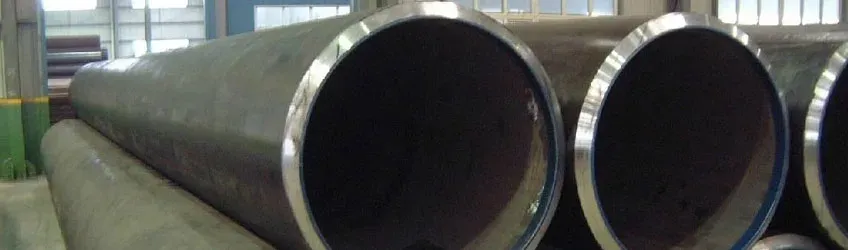 Alloy Steel Pipes ASTM A335Here are some key features of ASTM A335 alloy steel pipes:
| Feature | Description |
|---|---|
| Types | ASTM A335 specification covers seamless ferritic alloy-steel pipe for high-temperature service. The pipes are categorized into several grades based on their chemical composition and mechanical properties. Common grades include P1, P5, P9, P11, P22, P91, and P92, among others. Each grade has specific requirements regarding chemical composition, tensile strength, yield strength, and hardness. |
| Chemical Composition | The chemical composition of ASTM A335 alloy steel pipes varies depending on the grade. However, common alloying elements include chromium, molybdenum, vanadium, and sometimes nickel. The presence of these alloying elements enhances the high-temperature properties of the steel, such as creep resistance, oxidation resistance, and strength at elevated temperatures. |
| Mechanical Properties | ASTM A335 pipes undergo various mechanical tests to verify compliance with specified requirements. These tests may include tensile testing, hardness testing, impact testing, and flattening/flaring tests. Mechanical properties such as tensile strength, yield strength, elongation, and hardness vary depending on the grade and heat treatment condition. |
| Dimensions and Sizes | ASTM A335 pipes are available in various sizes and dimensions, ranging from 1/8 inch to 26 inches in nominal diameter. The wall thickness can vary depending on the nominal pipe size and grade. Standard pipe schedules such as SCH 40, SCH 80, SCH 160, and XXS are commonly available for ASTM A335 pipes. |
| Applications | ASTM A335 alloy steel pipes are widely used in high-temperature and high-pressure applications, such as: power generation (boiler tubes, superheater tubes, and reheater tubes in steam boilers and power plants), oil and gas industry (downhole tubular, production tubing, and piping systems in refineries and petrochemical plants), chemical industry (piping systems for corrosive environments and high-temperature chemical processes), and the energy industry for high-temperature and very low-temperature service (cryogenic), or for applications with very high pressures. |
| Welding | ASTM A335 pipes can be welded using conventional welding methods such as SMAW (shielded metal arc welding), GTAW (gas tungsten arc welding), and GMAW (gas metal arc welding). Preheating and post-weld heat treatment may be necessary to avoid cracking and maintain proper mechanical properties, especially for higher alloyed grades. |
When selecting ASTM A335 pipes for a specific application, consider factors such as grade, size, wall thickness, and end connections to match the operating conditions and design code requirements.
Why Chrome-Moly? The Case for Cr-Mo Alloy Steels
Standard carbon steel pipes (such as ASTM A106 Gr. B) begin to lose strength rapidly above approximately 425°C (800°F). In high-temperature piping systems, three degradation mechanisms drive the need for chrome-moly alloys:
Creep Resistance
Creep is the slow, time-dependent plastic deformation of metal under sustained stress at elevated temperatures. Carbon steel has poor creep resistance: its allowable stress at 500°C drops to a fraction of its room-temperature value. Chrome-moly steels resist creep through solid-solution strengthening (Mo) and carbide precipitation (Cr, V, Nb) that pin grain boundaries and impede dislocation movement.
Hydrogen Attack Resistance
In refinery environments, carbon steel exposed to high-temperature, high-pressure hydrogen undergoes hydrogen attack: atomic hydrogen diffuses into the steel and reacts with carbon to form methane (CH4) at grain boundaries. This internal decarburization causes irreversible loss of strength and ductility. The Nelson curve (API RP 941) defines safe operating limits for each alloy; chrome-moly grades progressively push the safe envelope to higher temperatures and hydrogen partial pressures.
Oxidation and Sulfidation Resistance
The chromium in Cr-Mo steels forms a protective chromium oxide (Cr2O3) layer on the surface, which resists both oxidation (reaction with oxygen at high temperatures) and sulfidation (reaction with sulfur compounds). Higher-chromium grades like P5, P9, and P91 are essential in refinery units processing sulfur-containing crude oil, such as hydrodesulfurization (HDS) units and fluid catalytic cracking units (FCCU).
Key Takeaway: Chrome-moly alloy steels solve the three critical failure modes of carbon steel at high temperatures: creep, hydrogen attack, and sulfidation. The choice of specific grade depends on the operating temperature, hydrogen partial pressure, and sulfur content of the process fluid.
Alloying Elements (Mo, Cr)
ASTM A335 pipes have superior features than standard carbon steel pipes due to the addition of high-value elements such as Molybdenum, Chromium, and other alloying materials.
The addition of Molybdenum (“Moly”) increases the strength of the steel and its elastic limit, enhancing the steel’s resistance to wear, impact qualities, and hardenability. It also improves the resistance to softening, makes chromium steel less prone to embrittlement, and prevents pitting.
Chromium, a key element also for stainless steel alloys, prevents steel oxidation at elevated temperatures and increases the resistance of steel to corrosion. It enhances the tensile, yield, and hardness properties of low-alloy pipes at room temperature.
Other alloying elements, present in various degrees in pipes of all grades are
| Alloying Element | Properties Conferred to Steel |
|---|---|
| Aluminum (Al) | Increases grain refinement and control, enhancing strength and toughness. Also improves corrosion resistance and acts as a deoxidizer. |
| Boron (B) | Enhances hardenability, allowing steel to achieve greater depth of hardness with less quench severity. |
| Cobalt (Co) | Improves strength at high temperatures, making steel more resistant to thermal fatigue and wear. |
| Manganese (Mn) | Increases hardenability, tensile strength, and wear resistance. Acts as a deoxidizer and improves toughness. |
| Nickel (Ni) | Enhances overall strength and toughness, especially at low temperatures. Improves corrosion resistance in certain environments. |
| Silicon (Si) | Strengthens steel and acts as a deoxidizer. In certain amounts, it can also increase magnetic properties and electrical resistivity. |
| Titanium (Ti) | Combines with carbon to form titanium carbides, preventing grain growth and enhancing strength at high temperatures. |
| Tungsten (W) | Significantly increases hardness and high-temperature strength, making steel more resistant to wear and deformation. |
| Vanadium (V) | Improves hardenability while retaining fine grain size, leading to better wear resistance and toughness, especially at high temperatures. |
Alloy Vs. Nickel-alloy Pipes
As previously explained, ASTM A335 alloy pipes distinguish themselves from standard carbon steel pipes by containing elevated levels of alloying elements such as Molybdenum (Mo), Chromium (Cr), and occasionally Nickel, among others.
These pipes are categorized as “low-alloy” due to the total concentration of alloying elements typically remaining below 5%. In contrast, a higher concentration of alloying elements would classify the steel as “higher-alloy,” resembling stainless steel, duplex, or even super-alloys like Inconel, Hastelloy, Monel, and others.
All ASTM A335 Grades and Temperature Limits
Each ASTM A335 grade is designed for a specific temperature range and process environment. The following table summarizes the key grades, their Cr-Mo designation, and recommended maximum continuous service temperature per American Standard code allowable stress data:
| Grade | Cr-Mo Designation | Max Service Temp | Typical Applications |
|---|---|---|---|
| P1 | 0.5Mo | ~475°C (885°F) | Moderate-temperature steam lines; no longer recommended for hydrogen service (API RP 941) |
| P2 | 0.5Cr-0.5Mo | ~480°C (900°F) | Moderate-temperature steam and hydrocarbon service |
| P5 | 5Cr-0.5Mo | ~595°C (1100°F) | Refinery heater tubes, FCCU transfer lines, sulfur-bearing hydrocarbon service |
| P5b | 5Cr-0.5Mo-Si | ~595°C (1100°F) | Same as P5 with improved oxidation resistance from higher silicon |
| P9 | 9Cr-1Mo | ~595°C (1100°F) | Refinery heater tubes, reformer effluent piping, sulfidation-resistant service |
| P11 | 1.25Cr-0.5Mo | ~510°C (950°F) | Power plant steam piping, superheater tubes, headers |
| P12 | 1Cr-0.5Mo | ~510°C (950°F) | Similar to P11 at slightly lower Cr, boiler components |
| P22 | 2.25Cr-1Mo | ~565°C (1050°F) | Main steam lines, hydrogen reformer piping, heavy-wall headers |
| P91 | 9Cr-1Mo-VNb | ~593°C (1100°F) | Ultra-supercritical power plants, main steam lines, hot reheat piping |
| P92 | 9Cr-0.5Mo-2W | ~620°C (1150°F) | Next-generation ultra-supercritical plants, highest temperature service |
Applications by Grade
P11 and P12 (1-1.25Cr-0.5Mo) are the workhorses of conventional power generation. They are used for superheater and reheater tubes, high-pressure steam headers, and interconnecting piping in coal, gas, and oil-fired power plants operating at steam temperatures up to 510°C.
P22 (2.25Cr-1Mo) is the standard grade for hydrogen reformer piping in refineries and ammonia plants, where its higher Mo content provides superior resistance to hydrogen attack. It is also widely used for main steam and hot reheat lines in power plants operating above 510°C.
P5 and P9 (5-9Cr) are primarily used in the petroleum refining industry where sulfidation resistance is critical. Typical applications include FCCU riser and transfer lines, coker heater tubes, vacuum distillation column transfer lines, and hydrodesulfurization (HDS) reactor piping.
P91 and P92 (9Cr-VNb/W) are advanced creep-strength-enhanced ferritic (CSEF) steels developed for ultra-supercritical (USC) power plants. P91 allows wall thicknesses approximately 50% thinner than P22 at equivalent temperatures, significantly reducing dead weight, thermal stresses during transients, and material cost. P92 extends this advantage further with tungsten additions for the most demanding USC applications.
A335 Properties
Chemical Composition
The types of alloy steel covered by the ASTM A335 / American Standard SA335 specification are designed with a “P” prefix, from P5 to P92. Grades P11/P22 and P91/92 are typically found in power stations, whereas grades P5 and P9 are more common for application in the petrochemical industry. Grades P9, and P91 are, in the list, the more expensive (a P91 seamless pipe may cost approx 5EUR per kg.).
| ASTM A335 Low-Alloy Steel (Grades) | UNS equivalent | C | Mn | P max | S max | Si | Cr | Mo |
|---|---|---|---|---|---|---|---|---|
| P1 | K11522 | 0.10-0.20 | 0.30-0.80 | 0.025 | 0.025 | 0.10-0.50 | — | 0.44-0.65 |
| P2 | K11547 | 0.10-0.20 | 0.30-0.61 | 0.025 | 0.025 | 0.10-0.30 | 0.50-0.81 | 0.44-0.65 |
| P5 | K41545 | 0.15 max | 0.30-0.60 | 0.025 | 0.025 | 0.50 max | 4.00-6.00 | 0.44-0.65 |
| P5b | K51545 | 0.15 max | 0.30-0.60 | 0.025 | 0.025 | 1.00-2.00 | 4.00-6.00 | 0.44-0.65 |
| P5c | K41245 | 0.12 max | 0.30-0.60 | 0.025 | 0.025 | 0.50 max | 4.00-6.00 | 0.44-0.65 |
| P9 | S50400 | 0.15 max | 0.30-0.60 | 0.025 | 0.025 | 0.50-1.00 | 8.00-10.00 | 0.44-0.65 |
| P11 | K11597 | 0.05-0.15 | 0.30-0.61 | 0.025 | 0.025 | 0.50-1.00 | 1.00-1.50 | 0.44-0.65 |
| P12 | K11562 | 0.05-0.15 | 0.30-0.60 | 0.025 | 0.025 | 0.50 max | 0.80-1.25 | 0.44-0.65 |
| P15 | K11578 | 0.05-0.15 | 0.30-0.60 | 0.025 | 0.025 | 1.15-1.65 | — | 0.44-0.65 |
| P21 | K31545 | 0.05-0.15 | 0.30-0.60 | 0.025 | 0.025 | 0.50 max | 2.65-3.35 | 0.80-1.60 |
| P22 | K21590 | 0.05-0.15 | 0.30-0.60 | 0.025 | 0.025 | 0.50 max | 1.90-2.60 | 0.87-1.13 |
| P91 | K91560 | 0.08-0.12 | 0.30-0.60 | 0.020 | 0.010 | 0.20-0.50 | 8.00-9.50 | 0.85-1.05 |
| P92 | K92460 | 0.07-0.13 | 0.30-0.60 | 0.020 | 0.010 | 0.50 max | 8.50-9.50 | 0.30-0.60 |
Mechanical Properties
| Grade | UNS Number | Yield Strength (ksi) | Tensile Strength (ksi) | Elongation (%) | Hardness Rockwell | Hardness Brinell |
|---|---|---|---|---|---|---|
| P1 | K11522 | 30 | 55 | 30 | — | — |
| P2 | K11547 | 30 | 55 | 30 | — | — |
| P5 | K41545 | 40 | 70 | 30 | — | 207 max |
| P9 | S50400 | 30 | 60 | 30 | — | — |
| P11 | K11597 | 30 | 60 | 20 | — | — |
| P12 | K11562 | 32 | 60 | 30 | — | 174 max |
| P22 | K21590 | 30 | 60 | 30 | — | — |
| P91 | K91560 | 60 | 85 | 20 | — | 250 max |
| P92 | K92460 | 64 | 90 | 20 | — | 250 max |
P91 Special Requirements
Grade P91 is a creep-strength-enhanced ferritic (CSEF) steel that demands far more careful handling than conventional Cr-Mo grades. Failures of P91 piping components, particularly at welds, have been widely documented in the power generation industry. The following requirements are critical.
Heat Treatment
P91 must be normalized at 1040-1080°C followed by tempering at 730-780°C. This produces a tempered martensitic microstructure with a fine dispersion of M23C6 carbides and MX carbonitrides. Deviations from these parameters (e.g., over-tempering above 790°C or under-normalizing below 1020°C) destroy the precipitate structure and permanently degrade creep strength, even if room-temperature hardness and tensile values appear acceptable.
PWHT Requirements
Post-weld heat treatment for P91 is mandatory and must be precisely controlled:
- Temperature: 730-770°C (the American Standard minimum is 730°C; many specifications target 760°C)
- Hold time: Minimum 2 hours (some codes require 1 hour per 25 mm of thickness)
- Heating/cooling rate: Maximum 80°C/hour above 400°C to prevent thermal shock
- Temperature uniformity: Within 30°C across the weld zone
Hardness Limits
- Base metal: 250 HB / 265 HV / 25 HRC maximum
- Weld metal and HAZ after PWHT: 250 HB maximum (some owner specifications require 248 HB maximum)
- As-welded: Typically 350-420 HV (this is why PWHT is mandatory)
Delta Ferrite Concerns
P91 weld metal must be free of delta ferrite, which forms if the composition balance pushes the weld into the two-phase (austenite + delta ferrite) field during solidification. Delta ferrite in P91 welds is a severe defect: it transforms to sigma phase during high-temperature service, creating brittle networks that initiate cracking. Controlling delta ferrite requires using filler metals with carefully balanced Cr, Ni, and Mn contents and keeping dilution low during welding.
Matching Fittings and Flanges
ASTM A335 alloy steel pipes must be paired with compatible fittings and flanges of the same chemical and mechanical grade. The following table maps pipe grades to their matching component standards:
| Pipe Grade (A335) | BW Fittings (A234) | Forged Fittings & Flanges (A182) | Cast Valve Body (A217) |
|---|---|---|---|
| P1 | WP1 | F1 | WC1 |
| P5 | WP5 | F5 / F5a | C5 |
| P9 | WP9 | F9 | C12 |
| P11 | WP11 | F11 | WC6 |
| P12 | WP12 | F12 | WC9 |
| P22 | WP22 | F22 | WC9 |
| P91 | WP91 | F91 | C12A |
| P92 | WP92 | F92 | — |
For a complete cross-reference of all piping material grades, see the ASTM Piping Materials Compatibility Table.
Welding Considerations for A335 Chrome-Moly Pipes
Welding chrome-moly alloy steels is more demanding than welding carbon steel. The higher alloy content increases hardenability, meaning the heat-affected zone (HAZ) transforms to martensite during cooling. Without proper preheat and PWHT, the weld is susceptible to hydrogen cracking and remains excessively hard.
Preheat Requirements
| Grade | Minimum Preheat Temperature | Notes |
|---|---|---|
| P1 / P2 | 100°C (200°F) | Low hardenability; moderate preheat sufficient |
| P5 / P9 | 200°C (400°F) | Higher Cr increases martensite risk |
| P11 / P12 | 150-200°C (300-400°F) | Standard for most power plant work |
| P22 | 200-250°C (400-480°F) | Higher Mo content demands more preheat |
| P91 | 200-300°C (400-570°F) | Must maintain interpass 200-300°C; never allow to cool below 200°C before PWHT |
| P92 | 200-300°C (400-570°F) | Same as P91; tungsten does not change preheat requirements |
Filler Metal Selection
| Pipe Grade | SMAW Electrode (AWS) | GTAW/GMAW Wire (AWS) | Notes |
|---|---|---|---|
| P11 | E8018-B2 | ER80S-B2 | 1.25Cr-0.5Mo filler matches base metal |
| P22 | E9018-B3 | ER90S-B3 | 2.25Cr-1Mo filler |
| P5 / P9 | E502 / E505 | ER502 / ER505 | 5Cr-0.5Mo / 9Cr-1Mo |
| P91 | E9015-B9 / E9018-B9 | ER90S-B9 | Modified 9Cr-1Mo-VNb; must match micro-alloying |
| P92 | E9015-B92 | ER90S-B92 | 9Cr-0.5Mo-2W filler |
PWHT Summary by Grade
| Grade | PWHT Temperature Range | Minimum Hold Time | Cooling Rate |
|---|---|---|---|
| P1 / P2 | 595-720°C | 1 hr per 25 mm | Furnace or controlled |
| P5 / P9 | 730-760°C | 1 hr per 25 mm | Furnace or controlled |
| P11 / P12 | 680-730°C | 1 hr per 25 mm | Furnace or controlled |
| P22 | 680-730°C | 1 hr per 25 mm | Furnace or controlled |
| P91 | 730-770°C | 2 hr minimum | Max 80°C/hr above 400°C |
| P92 | 730-770°C | 2 hr minimum | Max 80°C/hr above 400°C |
Comparison: P11 vs P22 vs P91
This is the most frequent selection question in high-temperature piping design. The three grades cover overlapping but distinct operating windows:
| Parameter | P11 (1.25Cr-0.5Mo) | P22 (2.25Cr-1Mo) | P91 (9Cr-1Mo-VNb) |
|---|---|---|---|
| Chromium | 1.00-1.50% | 1.90-2.60% | 8.00-9.50% |
| Molybdenum | 0.44-0.65% | 0.87-1.13% | 0.85-1.05% |
| Max service temp | ~510°C (950°F) | ~565°C (1050°F) | ~593°C (1100°F) |
| Yield strength | 30 ksi (205 MPa) | 30 ksi (205 MPa) | 60 ksi (415 MPa) |
| Tensile strength | 60 ksi (415 MPa) | 60 ksi (415 MPa) | 85 ksi (585 MPa) |
| Creep strength at 550°C | Low | Moderate | High (2-3x P22) |
| Wall thickness (relative) | Thick | Thick | Thin (~50% of P22) |
| Sulfidation resistance | Low | Moderate | High |
| Hydrogen attack resistance | Good | Very good | Excellent |
| Welding complexity | Moderate | Moderate | High |
| PWHT temperature | 680-730°C | 680-730°C | 730-770°C |
| Material cost (relative) | 1x | 1.2-1.5x | 2-3x |
| Typical application | Conventional power plant steam lines | Hydrogen reformers, main steam | USC power plants, thin-wall headers |
When to use which: Choose P11 for conventional power plant piping up to 510°C where cost matters and wall thickness is acceptable. Choose P22 when operating above 510°C, in hydrogen service, or when moderate sulfidation resistance is needed. Choose P91 for the highest temperatures (above 565°C), when wall thickness reduction is essential (large headers, thick sections prone to thermal fatigue), or in ultra-supercritical power plants. Be prepared, however, for significantly higher fabrication requirements.
For a detailed head-to-head analysis, see A335 P11 vs P22 and A335 P11 vs P22 vs P91.
Testing Requirements A335 Pipes
- Transverse/longitudinal: tension and flattening, hardness, bend tests. For material that has been heat-treated in batch furnaces, these tests shall be made on the 5% of the pipes from each heat lot number. For smaller lots, one pipe at a minimum has to be tested
- ASTM A335 Gr. P91 shall have a hardness of 250 HB / 265 HV (25 HRC)
- Hydro testing: shall be applied to every length of pipe
- The non-destructive electric test is optional
Tolerances
Diameter
| NPS [DN] | Over (in.) | Over (mm) | Under (in.) | Under (mm) |
|---|---|---|---|---|
| 1/8 to 1 1/2 [DN 6 to 40] | 1/64 (0.015) | 0.4 | 1/64 (0.015) | 0.4 |
| Over 1 1/2 to 4 [DN 40 to 100] | 1/32 (0.031) | 0.79 | 1/32 (0.031) | 0.79 |
| Over 4 to 8 [DN 100 to 200] | 1/16 (0.062) | 1.59 | 1/32 (0.031) | 0.79 |
| Over 8 to 12 [DN 200 to 300] | 3/32 (0.093) | 2.38 | 1/32 (0.031) | 0.79 |
| Over 12 [> DN 300] | +/- 1% OD | +/- 1% OD | +/- 1% OD | +/- 1% OD |
Wall Thickness
The tolerances in WT, in %, from specified are:
- 1/8 to 2 1/2 [6 to 65] incl., all t/D ratios: over 20%, under 12.5%
- Above 2 1/2 [65], t/D < or = 5%: over 22.5%, under 12.5%
- Above 2 1/2 [65], t/D > 5%: over 15%, under 12.5%
t = Specified Wall Thickness; D = Specified Outside Diameter
Marking Requirements A335
The marking requirements for ASTM A335 pipes are specified for proper identification and traceability. According to the ASTM A335 standard, the marking requirements typically include the following information:
| Marking | Description |
|---|---|
| Manufacturer’s Name or Logo | The manufacturer’s name or logo is usually stamped or printed on the pipe. This identifies the source of the pipe and provides accountability for its quality. |
| Pipe Grade and Size | The grade of the pipe (e.g., P5, P9, P11, etc.) and its nominal size are commonly marked on the surface of the pipe. This information indicates the material composition and dimensions of the pipe. |
| Heat Number | Each heat of steel used to produce the pipes is assigned a unique heat number during the manufacturing process. The heat number is typically stamped or marked on the pipe for traceability purposes. |
| ASTM A335 Specification | The ASTM A335 specification number is often marked on the pipe to indicate compliance with the standard requirements for seamless ferritic alloy-steel pipe for high-temperature service. |
| Lot Number or Batch Number | In addition to the heat number, pipes may also be marked with a lot number or batch number for traceability and quality control. |
| Additional Markings | Depending on the specific requirements of the purchaser or applicable regulations, additional markings may be required. These may include symbols indicating compliance with certain standards or specifications, country of origin, and special handling instructions. |
Specific marking requirements may vary depending on the contractual agreement between buyer and manufacturer, as well as any applicable regulations or industry standards.
Alloy Pipe Cross-Reference Table: ASTM vs. EN Grades
Chrome Moly Pipes: Werkstoff vs EN vs ASTM
| Werkstoff/DIN | EN | ASTM |
|---|---|---|
| 1.5415 | 16Mo3 | A335 Grade P1 |
| 1.7335 | 13CrMo4-5 | A335 Grade P11, P12 |
| 1.7380 | 10CrMo9-10 | A335 Grade P22 |
| 1.7362 | X11CrMo5 | A335 Grade P5 |
| — | — | A335 Grade P9 |
| 1.4903 | X10CrMoVNb9-1 | A335 Grade P91 |
| 1.4901 | X10CrMoWVNb9-2 | A335 Grade P92 |
Standards Reference Table
The following standards govern the specification, design, fabrication, and inspection of ASTM A335 chrome-moly piping systems:
| Standard | Title / Scope |
|---|---|
| ASTM A335 | Seamless Ferritic Alloy-Steel Pipe for High-Temperature Service |
| American Standard SA-335 | American Standard Boiler and Pressure Vessel Code adoption of ASTM A335 |
| ASTM A234 | Piping Fittings of Wrought Carbon Steel and Alloy Steel for Moderate and High Temperature Service |
| ASTM A182 | Forged or Rolled Alloy and Stainless Steel Pipe Flanges, Forged Fittings, and Valves |
| ASTM A217 | Steel Castings, Martensitic Stainless and Alloy, for Pressure-Containing Parts |
| American Standard B31.1 | Power Piping (governs most power plant chrome-moly piping) |
| American Standard B31.3 | Process Piping (governs refinery and petrochemical chrome-moly piping) |
| American Standard B36.10 | Welded and Seamless Wrought Steel Pipe (pipe dimensions) |
| API RP 941 | Steels for Hydrogen Service at Elevated Temperatures and Pressures in Petroleum Refineries (Nelson Curves) |
| AWS A5.5 | Low-Alloy Steel Electrodes for SMAW |
| AWS A5.23 | Low-Alloy Steel Electrodes and Fluxes for SAW |
| AWS A5.28 | Low-Alloy Steel Electrodes and Rods for GMAW/GTAW |
Top Manufacturers Alloy Steel Pipes
| Pipe Mill | Country |
|---|---|
| Jiangu Chengde Steel Tube Co Ltd. Ltd | China |
| Chomutov | Czech |
| Eschweiller(Bentler) | Germany |
| Vallourec Tubes | Germany, France, & Brazil |
| Tenaris | Italy, Mexico, & Argentina |
| Sumitomo Metal | Japan |
| JFE | Japan |
| Productos Tubulares | Spain |
| Tubos Reunidos | Spain |
| Wyman Gordon | USA |
| Michigan Seamless | USA |
| Rockwell Collins | USA |
We recommend purchasing the ASTM A335 specification from the ASTM website to get a complete understanding of this topic.
Frequently Asked Questions
What is the difference between ASTM A335 P11, P22, and P91?
P11 (1.25Cr-0.5Mo) is used for service up to approximately 510°C (950°F) in conventional power plant steam lines. P22 (2.25Cr-1Mo) extends the temperature range to approximately 565°C (1050°F) and provides better hydrogen attack resistance for refinery applications. P91 (9Cr-1Mo-VNb) provides dramatically higher creep strength up to 593°C (1100°F), allowing approximately 50% thinner pipe walls compared to P22 for the same design conditions. Each successive grade adds more chromium and micro-alloying elements for improved high-temperature performance.
Is PWHT mandatory for ASTM A335 chrome-moly pipe welding?
Yes, post-weld heat treatment (PWHT) is mandatory for most ASTM A335 grades per American Standard B31.1 and B31.3. For P91, the PWHT temperature must be precisely controlled at 730-770°C with a minimum hold time of 2 hours. Skipping PWHT leaves the weld with hardness values above 400 HV, far exceeding the allowable maximum of 250 HB, which risks brittle fracture and hydrogen cracking. Even lower grades like P11 and P22 require PWHT at 680-730°C to temper the martensitic microstructure in the heat-affected zone.
What fittings and flanges match ASTM A335 alloy pipes?
ASTM A335 pipes are matched with ASTM A234 WPx series buttweld fittings (e.g., WP11, WP22, WP91) and ASTM A182 Fx series forged flanges and fittings (e.g., F11, F22, F91). For cast valve bodies, ASTM A217 grades are used (e.g., WC6 for P11 service, WC9 for P22 service, C12A for P91 service). All matching components must share the same chemical composition and mechanical property ranges for proper weldability and uniform in-service performance.
Why is chrome-moly steel used instead of carbon steel at high temperatures?
Chrome-moly (Cr-Mo) steels provide three critical advantages over carbon steel at elevated temperatures: (1) superior creep resistance, maintaining strength under sustained load where carbon steel would deform permanently; (2) resistance to hydrogen attack, which causes irreversible internal decarburization in carbon steel above 230°C in high-pressure hydrogen environments; and (3) improved oxidation and sulfidation resistance from the chromium content, which forms a protective oxide layer. Carbon steel loses allowable stress rapidly above 425°C and is unsuitable for most refinery and power plant high-temperature piping.
What is the maximum service temperature for ASTM A335 P91 pipes?
ASTM A335 P91 pipes can operate at continuous temperatures up to approximately 593°C (1100°F), with American Standard code allowable stresses extending slightly higher in some design scenarios. P91 achieves this through micro-alloying with vanadium, niobium, and nitrogen, which form stable MX-type precipitates (VN, NbC) that pin grain boundaries and resist creep deformation far more effectively than conventional Cr-Mo grades like P22. For service above 593°C, P92 (with tungsten additions) should be considered.
Leave a Comment
Have a question or feedback? Send us a message.
Previous Comments
We are looking 15000 Kg Chrome Vanadium Molybdenum Seamless Tube. Pls advise your email ID to send more details
We are looking 15000 Kg Chrome Vanadium Molybdenum Seamless Tube. Pls advise your email ID to send more details
40 ft- 6″ Sch-100 A-335 Gr. WP-9 Seamless 20 ft- 8″ –DItto– 140 ft- 12″ –Ditto– 360 ft- 30″ Sch- .375″ A-335 Gr. WP-9 Welded
40 ft- 6″ S-100 A335 P-9 Seamless Pipe 20 ft- 8″ –Ditto– 140 ft- 12″ –Ditto– 360 ft- 30″ .375″ Wall A335 P-9 Welded Pipe
Required material 1.5415 and 1.4835 or 1.4828 Rate per ton