

SMLS vs Welded Pipe: ERW, SAW, LSAW
Steel Pipes Overview
Steel pipes serve two primary functions: as conduit for fluids, gases, and solids, and as structural members.
 types of pipes fluid conveyance and structural
This chapter covers the characteristics, types, uses, and manufacturing processes of steel pipes: seamless (SMLS), electrically welded (ERW/HFW), electrical-fusion welded (EFW), and longitudinally welded (LSAW, DSAW, SSAW).
Steel Pipe Applications
Steel pipes are used across many industries for infrastructure, transportation, energy production, and manufacturing:
| Sector | Applications |
|---|---|
| Fluids Conveyance | Transporting liquids, gases, and solids in oil & gas, water supply, sewage systems, and chemical processing |
| Structural Support | Buildings, bridges, tunnels, and offshore platforms; withstanding heavy loads, seismic forces, and environmental stresses |
| Industrial Processes | Material handling, heating, cooling, and ventilation systems; conveyance of raw materials, products, and by-products |
| Utilities & Infrastructure | Water distribution networks, gas pipelines, telecommunications systems, and power generation facilities |
Pipe Types for Oil & Gas
Steel pipes for the oil & gas industry come in four main categories:
| Type | Feedstock | Process | Best For |
|---|---|---|---|
| Seamless (SMLS) | Solid steel billets | Extruded/pierced without welding seams | High-pressure and critical applications (oil & gas transmission, power generation, automotive) |
| ERW/HFW | Steel coils or sheets | Electrical welding (resistance or high-frequency) | Moderate-pressure, cost-effective applications |
| EFW | Steel plates | High-energy electric arc or electric resistance fusion | High-pressure, high-temperature; strong welds in various materials |
| SAW (LSAW/HSAW/DSAW) | Steel plates | Submerged arc welding (longitudinal, spiral, or double) | Construction, infrastructure, water distribution, large-diameter pipelines |
Types of pipes for oil & gas (fluids conveyance: Oil, Gas, Derivative Products)

The sections below cover the three main types of steel pipes for oil & gas: seamless, ERW, and SAW.
Seamless Pipe
Seamless pipes are produced from steel billets, which are heated and perforated to create the tubular section. The word “seamless” refers to the absence of seam welds.

Seamless pipes offer high durability and efficient fluid flow. With no welds or joints, they have strong resistance to leaks, high pressure, and extreme temperatures.
These properties make them well-suited for the oil and gas sector, fluid transportation (oil, gas, slurry pipelines), construction, and medical equipment, where heavy loads and corrosive conditions are common.
Oil & Gas Applications
Seamless steel pipes are used for different applications within the oil & gas industry:
| Sector | Application |
|---|---|
| Upstream | OCTG pipes for drilling and completion |
| Midstream | Transmission and distribution of oil, gas, steam, acids, and slurries |
| Downstream | Process piping to refine oil and gas into derivative products |
| Utilities | General plumbing applications for utility services |
Material Specifications
The most common pipe types used in oil & gas are (ASTM pipe specifications):
| Specification | Material | Applications |
|---|---|---|
| ASTM A53, A106, A333, API 5L | Carbon steel | High and low-temperature service |
| ASTM A335 Grades P5 to P91 | Chrome-moly alloy steel | High temperature/pressure (refinery, power plants) |
| ASTM A312 Series 300/400 | Stainless steel (304, 316, 321, 347) | Corrosive service |
| ASTM A790/A928 | Duplex and super duplex | Double ferritic/austenitic structure |
| Various nickel alloy specs | Inconel, Hastelloy, Cupronickel, Monel, Nickel 200 | Severe corrosion/high temperature |
| Non-ferrous specs | Aluminum, copper, brass, cupro-nickel | Specialized applications |
Some specifications cover seamless pipes only (for example ASTM A106), while others apply both to seamless and welded pipes (for example ASTM A53).
Carbon steel pipes (A53, A333, A106, and API 5L) have the largest market share, as they can be used for most high and low-temperature applications. The main application of stainless steel pipes is for corrosive services (higher grades are used as the temperature and the pressure increase, or when the conveyed fluid is more and more aggressive).
In the upstream oil & gas industry, API 5CT is the specification covering OCTG pipes (oil country tubular goods).
Seamless steel pipes shall not be confused with seamless tubes. There are a few important differences between pipes and tubes, which are not only semantic.
In general, the word “pipe” applies to any tubular used to convey fluids, whereas the word “tube” applies to tubular sections (of various shapes, round, oval, squared) used for structural/mechanical applications, instrumentation systems, and the construction of pressure equipment like boilers, heat exchangers, and superheaters.
Seamless Pipe Price
For specific sizes and specifications (for example a 20-inch pipe or a high wall thickness pipe in special or exotic materials, for example, ASTM A335 P91 pipes), there are few global pipe suppliers, and prices per ton (or per meter) are, as a consequence, impacted.
It is a wrong practice to estimate pipe prices using a standard price per ton for all “carbon steel” or “stainless steel” pipes, regardless of the actual diameter, wall thickness, and specific grade: all these factors shall be taken into consideration to prevent cost overruns during the execution of the project at a later stage.
prices fluctuate daily; especially for alloyed pipes, which contain chemical elements like Molybdenum, Nickel, Copper, and Chromium traded daily on the London Metal Exchange or the Ferro-Alloy markets.
Seamless Pipes Sizes
The American Standard B36.10 and B36.19 specifications cover the dimensions and weights of seamless pipes for the petrochemical industry (the specs apply to welded pipes too):
| Specification | Coverage | Size Range |
|---|---|---|
| American Standard B36.10 | Carbon and low-alloy seamless pipe dimensions and weights | 1/8” to 24” |
| American Standard B36.19 | Stainless steel, duplex, nickel-alloy seamless and welded pipes | Per specification |
Commercial seamless pipes are designated with a nominal pipe size (representing the approximate fluid conveyance capacity) and a schedule (referring to the wall thickness):
| Material | Common Schedules |
|---|---|
| Carbon/alloy steel | SCH 40, STD, XS, XXS |
| Stainless/nickel alloy | 10S, 40S, 80S |
The American Standard pipe size specifications can be purchased online from the American Standard website.
Seamless Pipes Manufacturing Process
Mild steel seamless pipes from 1/8 to 6 inches are manufactured with the “plug mill process” or the “extrusion process” (used for smaller diameters), whereas the “mandrel mill process” is used for larger diameters.
The manufacturing process involves several steps, each one affecting the integrity, quality, and consistency of the final product:
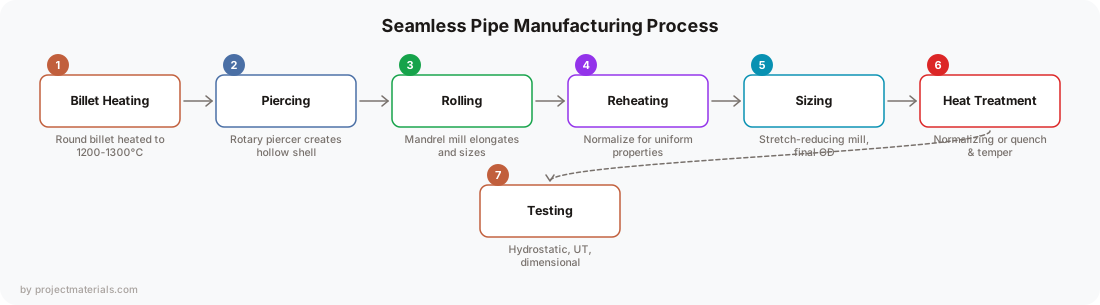
Seamless Pipe Manufacturing: Steel Billet → Heating → Piercing → Rolling & Sizing → Heat Treatment → Finishing → Testing & Inspection → Packaging & Shipping
| Step | Process | Details |
|---|---|---|
| 1. Billet Preparation | Starting material | Solid cylindrical bars of carbon or alloy steel, produced via continuous casting or hot rolling |
| 2. Heating | Furnace heating | Softens the steel, making it malleable for subsequent steps |
| 3. Piercing | Mandrel/rotary piercing mill | A rotating mandrel pierces through the center to create a hollow tube |
| 4. Rolling & Sizing | Rolling stands | Gradually reduces diameter and wall thickness to final specifications |
| 5. Heat Treatment | Annealing/quenching/tempering | Improves mechanical properties, relieves internal stresses, achieves desired metallurgical structure |
| 6. Finishing | Straightening, cutting, end finishing | Beveling, threading, surface treatment (coating, painting) |
| 7. Testing & Inspection | Quality control | NDT (ultrasonic, eddy current, visual) and destructive tests (tensile, impact) |
| 8. Packaging & Shipping | Final step | Pipes passing all checks are packaged for transit protection and shipped |
The manufacturing process demands precision and strict quality control at each stage. Manufacturers follow stringent testing protocols and use advanced production technologies to produce pipes that meet the requirements of demanding service conditions.
 Seamless steel pipes manufacturing process
Mandrell vs. Mannesmann Manufacturing Process
Two main methods exist for seamless pipe production:
 Mandrell mill process for seamless pipes
 Mannesmann process for seamless pipes (plug-mill)
| Aspect | Mandrel Mill Process | Mannesmann (Plug-Mill) Process |
|---|---|---|
| Piercing method | Rotating mandrel guides ID formation | Stationary plug pierces billet |
| Rolling | Multiple passes with mandrel support | Mandrelless rolling after piercing |
| Dimensional tolerance | Tighter tolerances | Standard tolerances |
| Surface finish | Smoother inner surface | Standard finish |
| Production volume | Moderate, high flexibility | High volume, mass production |
| Best for | Precision pipes, automotive, aerospace | Large diameter, heavy wall, oil & gas transmission |
| Cost efficiency | Higher cost per ton | More cost efficient |
Forged Seamless Pipes
 Forged Steel Pipes
Forged seamless pipes combine forging and machining to achieve superior mechanical properties compared to standard seamless pipes.
Manufacturing sequence: Billet heating → Forging under high pressure → Rough forming → Machining (turning, boring, threading) → Final dimensions
Why forged pipes are different:
| Property | Standard Seamless | Forged Seamless |
|---|---|---|
| Grain structure | Standard | Refined, uniform (controlled deformation) |
| Strength | High | Higher |
| Fatigue resistance | Good | Excellent |
| Customization | Standard sizes | Custom shapes and geometries possible |
| Cost | Standard | Premium |
Typical applications:
| Industry | Application |
|---|---|
| Oil & Gas | Drilling, high-pressure transport, refining |
| Aerospace & Defense | Aircraft components, missile systems |
| Power Generation | Boiler systems, heat exchangers, nuclear |
Learn more about forged steel pipes.
ERW & HFW Pipes (Electric Resistance Welding/High Frequency Welding)
 ERW pipes
ERW pipes are manufactured from steel coils: the coil is first uncoiled, then smoothed, cut and finally formed into a pipe shape by joining its two extremities electrically.
ERW pipes are available in sizes between 1/2 and 20 inches, in carbon steel (ASTM A53 is the most common specification) and stainless steel (ASTM A312). In terms of dimensions, American Standard B36.10 and American Standard B36.19 are the reference specifications (API 5L for welded ERW line pipes).
The American Standard and API dimensional charts show typical combinations of pipe nominal size and wall thickness (designated as “schedule”) and show ERW pipe weight in kg (or pounds).
In recent years, ERW pipes have become a practical alternative to seamless pipes, both in terms of price and performance, due to modern welding technologies such as HFI and HFW (high-frequency welding).
These advancements have narrowed the technical gap between seamless and ERW pipes, making them interchangeable for some applications (low/medium pressure and temperature). Seamless pipes still retain the inherent mechanical advantage of being produced from solid billets rather than coils and plates.
ERW Pipe Manufacturing Process
ERW pipes are manufactured from steel coils that are uncoiled, cut, processed, welded, and tested as shown in the picture below.
The most common welding technique for oil and gas pipes is “high-frequency induction technology” (ERW-HFI), which applies an induction current on the outer surface of the pipe to generate a reliable seam weld, joining the two sides of the steel coil tightly.
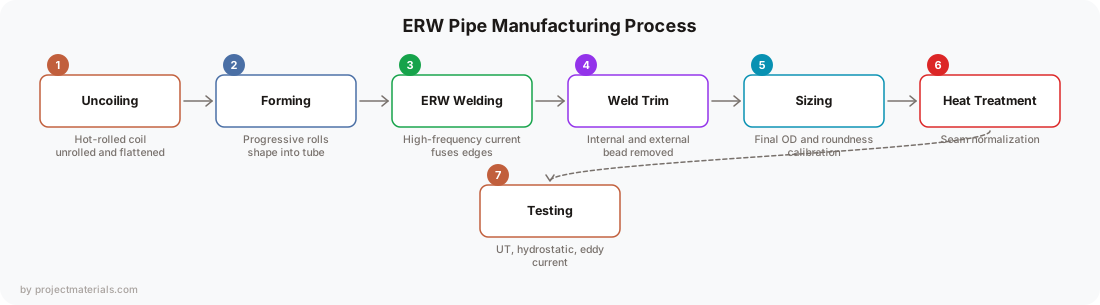
ERW Pipe Manufacturing: Steel Coil → Uncoiling → Forming → ERW Welding → Heat Treatment → Sizing → Cutting & Finishing → Testing → Packaging
| Step | Process | Details |
|---|---|---|
| 1. Coil Preparation | Starting material | Flat steel strips rolled into coils (carbon or low-alloy steel), surface treated (pickling or coating) |
| 2. Uncoiling & Straightening | Feeding | Coils pass through rollers and straightening machines for uniform alignment |
| 3. Forming & Edge Preparation | Shaping | Strip passes through forming rolls to create cylindrical shape; edges cleaned of burrs and oxides |
| 4. ERW Welding | Seam creation | Electrical resistance generates heat to fuse edges, using high-frequency induction or rotary contact welding |
| 5. Heat Treatment | Stress relief | Annealing or stress relieving improves mechanical properties and weld integrity |
| 6. Sizing & Shaping | Final dimensions | Tubes pass through sizing rolls to achieve final dimensions and tolerances |
| 7. Cutting & Finishing | End processing | Cut to length, beveling, threading, coating |
| 8. Testing & Inspection | Quality control | NDT (ultrasonic, eddy current) and destructive tests (tensile, hydrostatic) |
| 9. Packaging & Shipping | Final step | Packaged for protection during transit |

HFW Pipes
HFW (High-Frequency Welded) pipes are a type of welded steel pipe manufactured using high-frequency electric resistance welding (ERW) technology. The process passes a high-frequency electric current through the edges of rolled steel strips as they are formed into a pipe shape.
The high-frequency current heats the edges until they fuse together, forming a longitudinal weld seam. HFW manufacturing uses currents typically in the range of hundreds of kHz to several MHz, producing efficient welds with high quality.
 HFW Pipes
HFW Pipe Characteristics
| Characteristic | Details |
|---|---|
| Efficient Welding Process | High-frequency ERW allows faster welding speeds than lower-frequency methods, suitable for large-scale production |
| Strong Weld Seam | Narrow heat-affected zone (HAZ) enhances strength and durability; minimizes grain coarsening, preserving mechanical properties |
| Versatility | Applicable from low-pressure fluid transport to structural/mechanical uses; common in oil & gas line pipes and construction |
| Material & Size Range | Carbon steel, alloy steel, stainless steel; various diameters and wall thicknesses |
Manufacturing Process
| Step | Description |
|---|---|
| Uncoiling & Flattening | Steel coil is uncoiled and flattened into a strip |
| Edge Milling | Edges milled for clean, parallel surfaces that will form the weld seam |
| Forming | Strip gradually formed into a cylindrical shape through a series of rollers |
| Welding | High-frequency electric current applied to heat and fuse the edges, creating the longitudinal weld seam |
| Cooling, Sizing & Cutting | Pipe cooled, passed through sizing rollers for specified diameter/roundness, then cut to length |
Applications of HFW Pipes
| Industry | Applications |
|---|---|
| Oil and Gas | Crude oil, natural gas, and refined product transport |
| Water and Wastewater | Water mains, distribution pipelines, sewage systems |
| Construction and Infrastructure | Structural applications, scaffolding, fencing, electrical/communication cable conduits |
| Automotive and Mechanical | Structural components, precision mechanical parts |
HFW pipes are valued for their production efficiency and weld quality, making them a common choice across industries that use welded steel pipe.
ERW vs. Seamless Pipes
A common question: “Should I use ERW or seamless for my project?” Here is a direct comparison:
| Factor | Seamless | ERW (HFI) |
|---|---|---|
| Weld seam | None - uniform structure | Longitudinal seam (modern HFI is very strong) |
| Strength | Inherently uniform, no weak points | Seam slightly weaker than base metal |
| Cost | 20-30% higher | Lower cost per ton |
| Lead time | Longer (fewer manufacturers) | Shorter (larger manufacturing base) |
| Wall thickness tolerance | +/- 12.5% (variable) | Consistent (controlled coil thickness) |
| Roundness/ovality | More precise | Slightly less precise |
| Size range (overlap) | 2” to 24” | 1/2” to 20” |
When to Use Seamless
- High pressure, high temperature, cyclic loading
- Sour service (H2S environments)
- Critical applications where seam integrity concerns exist
When ERW Is Acceptable
- Process piping Class 600 and below
- Non-sour, moderate service conditions
- Cost-sensitive projects with standard requirements
Bottom line: Modern ERW-HFI pipes are a valid alternative to seamless for many applications, offering 20-25% cost and lead time savings. But for critical service, seamless remains the safer choice.
 ERW (Electric Resistance Welding) pipe
Pipes are, with valves, the most impactful piping cost element in plant construction (as a rule of thumb, piping covers 5-7% of the total plant cost, and pipes represent circa 60 to 70% of this cost, valves 15 to 25%). These figures are average values that refer to the oil & gas industry and refer to carbon steel materials (the weight of piping may be higher for stainless steel, duplex, and nickel-alloy piping classes).
The last point: pipes may have different colors (painted on the outer surface) to represent the type of fluid they carry.
LSAW Pipe (Longitudinal Submerged Arc Welding)
 LSAW pipes
An LSAW pipe (“submerged arc welding”) is manufactured by cutting, bending, and welding steel plates (JCOE process).
LSAW pipes compete with seamless and ERW pipes in the size range between 16 and 24 inches but are the only practical option for pipelines above 24 inches (as 24 inches is the maximum size for commercial seamless pipes).
The two main types of LSAW pipes are the longitudinal (with a single or double straight seam weld, DSAW) and the spiral type (called HSAW, SSAW, or SAWL pipe). The difference between DSAW and LSAW is that DSAW pipes have a seam weld on the inside and outside of the pipe, whereas LSAW pipes have a single seam weld on the outer surface.
The difference between LSAW and ERW pipes is that LSAW pipes are produced using steel plates, and ERW pipes are manufactured from steel coils.
In oil and gas, large-diameter API 5L LSAW pipes transport hydrocarbons over long distances efficiently.
HSAW/SSAW spiral weld pipes are used for non-critical applications, such as water transmission and distribution (not for oil & gas).
LSAW Pipe Manufacturing Process
LSAW pipes are manufactured using the JCOE process (J-ing, C-ing, O-ing, Expanding) starting from steel plates.
LSAW Manufacturing: Plate → Edge milling → Pre-bending → J-ing → C-ing → O-ing → SAW welding (ID + OD) → UT inspection → Expansion → Cutting → Beveling → Coating → Final testing
| Step | Description |
|---|---|
| Plate preparation | Cut to size, shot-blasted, edges milled |
| Pre-bending | Plate edges curved to facilitate forming |
| JCOE forming | Progressive bending: J-shape → C-shape → O-shape (closed cylinder) |
| SAW welding | Submerged arc weld on inside and outside (flux-shielded arc) |
| UT inspection | Ultrasonic testing of weld seam for defects |
| Expansion | Mechanical expansion to final diameter and roundness |
| Cutting & beveling | Cut to length, ends prepared for field welding |
| Surface treatment | Coating, painting, or galvanizing for corrosion protection |
| Final testing | Hydrostatic test, RT/UT, dimensional checks |
 LSAW pipes manufacturing process
SSAW/DSAW Types
Quick clarification: SSAW (Spiral Submerged Arc Welded) = HSAW (Helical Submerged Arc Welded). Same process, different names.
SSAW Pipes
SSAW pipes are manufactured by spirally welding hot-rolled steel coil under a flux layer (submerged arc). The spiral seam allows material efficiency and flexible sizing.
 SSAW pipe type
SSAW characteristics:
- Material efficient - various diameters from same coil width
- Large diameters and lengths possible
- Spiral distributes stress more evenly
- Requires thorough seam inspection
SSAW applications: Water mains, sewage, stormwater drainage, non-critical oil & gas pipelines, piling, structural.
DSAW Pipes
DSAW (Double Submerged Arc Welded) pipes are welded from both inside and outside surfaces, creating a stronger seam than single-pass welds.
 DSAW pipe
| SSAW vs DSAW Comparison | SSAW (Spiral) | DSAW (Double) |
|---|---|---|
| Weld orientation | Spiral/helical | Longitudinal |
| Weld passes | Single | Double (ID + OD) |
| Feedstock | Steel coil | Steel plate |
| Weld quality | Good | Superior (full penetration both sides) |
| Applications | Water, non-critical service | Oil & gas transmission, offshore, high-pressure |
| Roundness | May be affected by spiral seam | Better controlled |
DSAW applications: Oil & gas transmission, offshore/subsea pipelines, structural (bridges), water transmission (high-pressure).
EFW Pipes (Electric Fusion Welding)
EFW (Electric Fusion Welded) pipes use high-temperature electric arcs to fuse the seam, creating full-penetration welds. They are suited for large-diameter pipes in various materials.
 EFW pipes
| EFW vs ERW vs SAW | ERW | EFW | SAW (LSAW/DSAW) |
|---|---|---|---|
| Heat source | Electrical resistance | Electric arc | Submerged arc |
| Feedstock | Coil | Plate | Plate |
| Best for | Small-medium diameter, thin wall | Large diameter, various materials | Large diameter, thick wall |
| Weld quality | Good | High | High |
| Material versatility | Limited | Wide (CS, SS, alloys) | Good |
EFW Specifications
| Standard | Coverage |
|---|---|
| ASTM A358 | EFW austenitic stainless steel (corrosive/high-temp service) |
| ASTM A672 | EFW carbon steel for high-pressure, moderate temp |
| ASTM A691 | EFW carbon/alloy steel for high-pressure, high-temp |
| American Standard B36.10M | Dimensions for carbon/alloy welded pipe |
| American Standard B36.19M | Dimensions for stainless steel pipe |
| API 5L | Line pipe (can include EFW under certain conditions) |
| NACE MR0175 | Sour service material requirements |
EFW Pipes Manufacturing Process
EFW pipes are produced using high-temperature electric arcs to fuse metal together, creating a strong welded joint. The process is suited for producing large-diameter pipes from plate material and works with carbon steel, stainless steel, and alloy steel.
| Step | Process | Details |
|---|---|---|
| 1 | Material Selection & Preparation | Steel plate selected for required chemistry and mechanical properties; cut to size, cleaned of surface impurities and oxides |
| 2 | Forming | Plates formed into cylindrical shape using press or rolling machine; large-diameter plates may be pre-bent at edges for better alignment |
| 3 | Edge Preparation | Edges machined or ground to create a bevel for full penetration weld; clean and properly aligned |
| 4 | Welding | Electric arc heats edges to molten state; fused together under pressure. Filler material may be added. One or more passes depending on plate thickness |
| 5 | PWHT | Post-weld heat treatment relieves stresses; pipe or weld area heated to specified temperature and cooled under controlled conditions |
| 6 | Inspection & Testing | Visual inspection, dimensional checks, NDT (ultrasonic, radiographic), mechanical testing (tensile, impact) |
| 7 | Finishing | Cut to length, end beveling, surface treatments, marking (material grade, size, heat number) for traceability |
| 8 | Quality Assurance | Continuous QA throughout manufacturing ensures compliance with all relevant standards and customer requirements |
The EFW process requires precise control at each stage to produce pipes suitable for demanding applications in oil and gas, chemical processing, and utilities.
 EFW pipes manufacturing process
Structural Pipes
Structural pipes are steel pipes designed and used primarily for load-bearing and structural purposes rather than for conveying fluids. They are used in construction and engineering applications for their strength, durability, and adaptability to different configurations.
 Structural steel pipes
Features of Structural Pipes
| Feature | Details |
|---|---|
| Strength & Durability | High strength-to-weight ratio; efficient for supporting structures under load without excessive weight |
| Versatility | Various shapes, sizes, thicknesses; manufactured from carbon steel, alloy steel, or stainless steel for specific requirements |
| Cost-Effectiveness | Cost savings vs. concrete or solid steel bars due to strength, ease of installation, and lower maintenance |
| Ease of Fabrication | Easily cut, welded, and assembled into various configurations for quick, efficient construction |
Applications of Structural Pipes
| Sector | Applications |
|---|---|
| Building & Construction | Columns, trusses, frameworks for buildings, stadiums, bridges |
| Infrastructure | Piling for foundations, signposts, guardrails along roads and highways |
| Industrial & Mechanical | Machinery supports, conveyance systems, factory/plant structural frameworks |
| Agricultural | Frames for greenhouses, barns, fencing |
| Architectural | Handrails, balustrades, decorative features |
Piling Pipes
Piling pipes are structural pipes driven into the ground or seabed to provide foundational support for buildings, bridges, piers, and other structures. They transfer the load of the structure to stronger soil or rock layers deep below the surface, providing stability and support.
Piling pipes can be made of steel, concrete, or wood; steel is the most common due to its strength, durability, and resistance to environmental factors.
 piling pipes (source: Arntzen Pipe)
Piling Pipe Characteristics
| Characteristic | Details |
|---|---|
| High Strength | Designed to withstand high stress and loads for supporting heavy structures |
| Durability | Treated or manufactured for corrosion, wear, and environmental resistance; long-term structural integrity |
| Versatility | Various soil and environmental conditions; driven via impact hammering, vibration, or pressing |
| Customizability | Various sizes, lengths, materials; can be filled with concrete for enhanced load-bearing capacity |
Applications of Piling Pipes
| Application | Details |
|---|---|
| Building Foundations | Support for high-rise buildings, especially in areas with soft soil |
| Bridges and Piers | Anchoring into ground or seabed against environmental and operational loads |
| Retaining Structures | Retaining walls and quay walls to withstand lateral earth and water forces |
| Offshore Structures | Foundation for offshore platforms and wind turbines against waves, wind, and marine forces |
Manufacturing and Specifications
Piling pipes are manufactured according to specific standards that ensure their suitability for piling applications. Common specifications include ASTM A252 for welded and seamless steel pipe piles and EN 10219 for cold-formed welded structural hollow sections of non-alloy and fine-grain steels. These specifications cover the dimensions, mechanical properties, and other requirements for piling pipes.
Materials for Structural Pipes
ASTM Materials for Structural Pipes
ASTM International provides several specifications for structural pipes, covering chemical composition, mechanical properties, dimensions, and other requirements:
| Standard | Title | Description |
|---|---|---|
| ASTM A500 | Cold-Formed Welded and Seamless Carbon Steel Structural Tubing in Rounds and Shapes | Widely used for cold-formed welded and seamless carbon steel structural tubing in round, square, and rectangular shapes. Building frames, bridges, general structural supports. Grades A, B, C, or D. |
| ASTM A53 | Pipe, Steel, Black and Hot-Dipped, Zinc-Coated, Welded, and Seamless | Primarily for fluid conveyance, also applicable to structural applications. Seamless and welded, black and hot-dipped galvanized steel pipe. Structural supports and framing. |
| ASTM A252 | Welded and Seamless Steel Pipe Piles | Nominal wall steel pipe piles of cylindrical shape. Pipe acts as permanent load-carrying member or shell for cast-in-place concrete piles. Bridge construction, building foundations. |
| ASTM A572 | High-Strength Low-Alloy Columbium-Vanadium Structural Steel | Primarily covers structural steel plates; relevant to structural pipes made from plates rolled into cylindrical shapes and welded. High-stress structural applications. |
| ASTM A618 | Hot-Formed Welded and Seamless High-Strength Low-Alloy Structural Tubing | Square, rectangular, round, or special-shape structural tubing for welded, riveted, or bolted construction of bridges and buildings. Emphasis on grade, chemical composition, and tensile properties. |
EN Materials for Structural Pipes
European Norms (EN) standards define the specifications for materials used in structural pipes within Europe and many other parts of the world:
| Standard | Title | Description |
|---|---|---|
| EN 10210 | Hot Finished Structural Hollow Sections of Non-Alloy and Fine Grain Steels | Technical delivery conditions for hot-finished hollow sections (circular, square, rectangular). Dimensional tolerances, chemical composition, and mechanical properties. High strength and toughness. |
| EN 10219 | Cold-Formed Welded Structural Hollow Sections of Non-Alloy and Fine Grain Steels | Requirements for cold-formed welded structural hollow sections (circular, square, rectangular). No subsequent heat treatment. High strength and atmospheric corrosion resistance. |
| EN 10225 | Weldable Structural Steels for Fixed Offshore Structures | Primarily covers plates and sections; also relevant for structural pipes in offshore structures. Improved brittle fracture and corrosion resistance in offshore environments. |
| EN 10025 | Hot Rolled Products of Structural Steels | Broad standard for hot-rolled structural steel products, including sections and plates for structural pipe manufacturing. Includes enhanced atmospheric corrosion resistance (Part 5) and high yield strength quenched/tempered conditions (Part 6). |
Conclusion
The main differences between seamless, ERW, and LSAW pipes lie in their manufacturing processes, characteristics, and applications:
| Aspect | Seamless | ERW | LSAW |
|---|---|---|---|
| Manufacturing | Extruding/piercing solid steel billets into hollow tubes without welding seams. Heating, then rolling to desired dimensions. Hot or cold drawing. | Forming flat steel strips into cylindrical shape, welding edges with electric resistance. Strip passed through rollers, electric current generates heat to form the weld seam. | Forming and welding steel plates into cylindrical shape using longitudinal submerged arc welding. Plates bent and welded along longitudinal seam under granular flux. |
| Characteristics | Uniform composition and structure, no weld seams. Stronger and more reliable for high-pressure. Excellent corrosion resistance. Suitable where leakage is not acceptable. | Weld seam along longitudinal axis (slightly weaker than base metal). Good dimensional accuracy, surface finish. Cost-effective for construction, infrastructure, manufacturing. | Longitudinal seam weld. Higher strength and reliability than ERW. Suitable for larger diameters and thicker walls (oil & gas transmission, piling, structural). |
| Primary Applications | Oil & gas exploration/refining, petrochemicals, power generation, automotive, aerospace; high-pressure and critical leak-proof applications. | Construction, infrastructure, water distribution, plumbing, HVAC, fencing, agriculture; cost-effective and readily available solutions. | Oil & gas transmission pipelines, offshore platforms, structural/foundation piling, bulk material transport; large diameter, heavy wall applications. |
The choice between seamless, ERW, and LSAW pipes depends on the application requirements, budget, availability, and performance characteristics. Each type has distinct advantages and limitations, and selecting the right one affects performance and reliability in industrial and infrastructure projects.
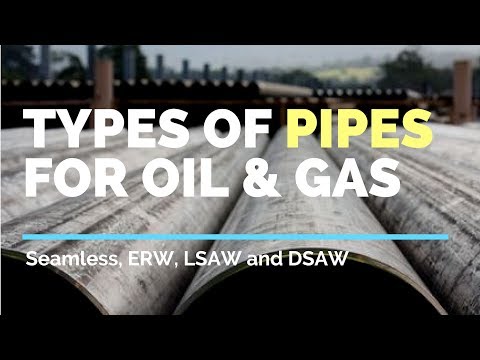
Watch the Video
Frequently Asked Questions
What is the difference between seamless and welded pipe?
Seamless pipe (SMLS) is manufactured without a weld seam by piercing a solid billet, providing uniform strength in all directions ; ideal for high-pressure applications. Welded pipe is made by rolling steel plate or coil into a tubular shape and welding the seam (ERW, LSAW, SSAW). Seamless is stronger and more reliable but more expensive; welded is economical for lower pressures and larger diameters.
What does ERW pipe mean?
ERW stands for Electric Resistance Welded. ERW pipe is made by rolling steel coils into a tubular shape and welding the longitudinal seam using high-frequency electrical current (no filler metal). It is used for moderate-pressure applications like water, oil, and gas distribution lines, typically in sizes up to NPS 24.
What is LSAW pipe?
LSAW stands for Longitudinal Submerged Arc Welded. LSAW pipe has a single longitudinal weld seam made by submerged arc welding (SAW) with filler metal. It is used for large-diameter (typically NPS 16-60) oil and gas transmission pipelines where seamless pipe is either not available or not cost-effective.
When should I use seamless pipe vs ERW?
Use seamless pipe for: high pressure (above Class 600), high temperature, critical/sour service, small bore (NPS 2 and below), and when the piping code requires it (American Standard B31.3 Class M). Use ERW pipe for: moderate pressure, water/gas distribution, structural applications, and cost-sensitive projects where welded pipe meets the design requirements.
What is pipe schedule?
Pipe schedule (SCH) indicates the wall thickness relative to the pipe's nominal size. Common schedules: SCH 5S, 10S (thin wall), SCH 40/STD (standard), SCH 80/XS (extra strong), SCH 160, XXS (double extra strong). Higher schedule = thicker wall = higher pressure rating. Schedules are defined in American Standard B36.10 (carbon/alloy steel) and B36.19 (stainless steel).
Leave a Comment
Have a question or feedback? Send us a message.
Previous Comments
Great, I really like it! Youre awesome
This is Karry from Hunan Great Steel Pipe Co., Ltd –Top 10 steel manufacturer in China, the exporting gateway of Hunan Shinestar Steel Group Co.,Ltd. We have been specialized in steel pipe's manufacturing and exporting more than 26 years. Our products have been exporting to more than 40 countries, including Middle East, South Asia, Africa and South American etc. Products: STAINLESS/CASING & TUBING/SMLS/SSAW/ERW/LSAW, if you have interest, please contact us!
Professional comparison from different steel pipes, thank you~ Roger here, working for Tianjin United Steel Pipe, producing ERW Steel Pipe since 1998, certifited by API/CE/JIS/ISO/CNAS. Any interest, please contact me via [email protected]
Like this post, blog is full of amazing information can you tell me which pipe will be more durable and convenient among oil and gas pipes. cpvc pipe fittings
Any body here manufacturing A335 P11 / P5 and A333 Gr.3 Pipes we have a requirement. Please contact us. [email protected] – Ms. Roba Madi