

Ball Valve: Floating & Trunnion Types
Ball Valves
What Is a Ball Valve
Definition: A ball valve is a quarter-turn shut-off device that uses a rotating spherical disc (ball) with a bore to control flow. Ball valves are the industry standard for pipeline shut-off due to their tight, leak-free sealing even after years of operation.
A ball valve controls flow with a spherical disc (the ball) that has a hole (port) through its center. When the port aligns with the pipe, flow passes through. Turn the handle 90 degrees and the solid side of the ball blocks the flow path completely.

Ball valves are quarter-turn devices: a simple 90-degree rotation opens or closes the valve. Full-port versions match the bore of the connecting pipe, so pressure drop is negligible. They seal tight without high torque, hold up well in high-pressure service, and work across a broad range of fluids: gas, liquid, and (with the right trim) corrosive chemicals.
The two main design families are floating ball (ball held by seat compression, moves slightly downstream under pressure) and trunnion mounted (ball anchored top and bottom, lower torque, handles larger sizes and higher pressures). Access can be side entry or top entry, affecting maintenance approach. Each type is covered in detail below.
Ball valves appear everywhere: water supply, gas distribution, oil and petrochemical plants, and general process piping. Their fast shut-off action makes them the default choice for emergency isolation.
Ball Valve Parts
The main components of a ball valve are:
| Part | Function |
|---|---|
| Body | Outer casing, cast or forged from carbon steel, stainless steel, brass, or alloy, depending on service. |
| Ball | Spherical disc with a through-bore that opens or blocks flow when rotated. |
| Seats | Sealing rings (soft or metal) that press against the ball to prevent leakage. |
| Stem | Connects the ball to the handle or actuator; includes anti-blowout retention in API designs. |
| Handle / Actuator | Manual lever, gear operator, or pneumatic/electric/hydraulic actuator for remote control. |
| Packing | Stem seal, typically PTFE for general service, graphite for high temperature or fire-safe duty. |
| O-Rings / Gaskets | Secondary seals at body joints, bonnet, and stem. |
| Bonnet | Cover plate for accessing internals (bolted, screwed, or welded to body). |
| End connections | Threaded, flanged (American Standard B16.5/B16.47), socket weld, or butt weld per American Standard B16.25. |
Ball Surface Treatments
| Treatment | Method | Typical Application |
|---|---|---|
| Chrome plating | Electroplating | Abrasive or mildly corrosive service |
| Nickel plating | Electroplating | Chemical resistance, harsh environments |
| Tungsten carbide | HVOF spray | Extreme wear and erosion |
| PTFE coating | Dip/spray | Low friction, chemical resistance |
| Electroless nickel (ENP) | Chemical deposition | Offshore, marine, corrosive fluids |
| Nitriding | Heat treatment (nitrogen diffusion) | High-pressure, high-velocity service |
| Cryogenic treatment | Deep cooling cycle | Cryogenic service; stabilizes microstructure |
| MoS₂ (moly) coating | Dry lubricant film | High-load or extreme-temperature service where lubrication is impractical |
| Fusion bonded epoxy | Powder coating | Water/wastewater pipelines, corrosive gas |
Seat Materials and Treatments
| Material / Treatment | Temperature Range | Notes |
|---|---|---|
| PTFE | -29 °C to 200 °C | General purpose, low friction, broad chemical resistance |
| RPTFE (reinforced) | -29 °C to 200 °C | Glass or carbon fillers for better wear and creep resistance |
| PEEK | Up to 260 °C | High mechanical strength, high pressure |
| Nylon | Up to 100 °C | Good for natural gas, oils, hydrocarbons |
| Viton / Buna-N | Varies | Elastomeric, lower-pressure soft sealing |
| Metal (Stellite, WC overlay) | Above 260 °C | Severe service: abrasive slurries, fire-safe, high temp |
| ENP surface treatment | - | Adds corrosion and hardness protection to metal seats |
| Live-loaded (spring-energized) | - | Compensates for wear and thermal cycling over valve life |
Ball Valve Advantages and Disadvantages
| Advantages | Disadvantages |
|---|---|
| Quick operation: quarter-turn movement for rapid open/close | Poor throttling: ball valves are shut-off devices, not regulators. Throttling erodes the seats and causes progressive leakage. Use globe valves for modulation. |
| Excellent sealing: tight seal without high torque | Not for slurries: suspended particles accumulate around ball/seats and cause leaks. Better for gases and clean liquids. |
| Compact design: smaller footprint than gate valves | Difficult to clean, except top-entry designs |
The lever position tells you the valve state at a glance: lever aligned with the pipe means open, perpendicular means closed, anything in between means partially open (and the valve is being abused; see “poor throttling” above).
Ball valves belong to the quarter-turn family alongside butterfly and plug valves. Key specifications: API 6D (pipeline), API 608 (petroleum/natural gas), BS 5351 (forged), American Standard B16.34 (pressure-temperature ratings), American Standard B16.5/B16.47 (flanged ends), and American Standard B16.25 (butt-weld ends).
How Does a Ball Valve Work?
The operating principle is straightforward. With the handle aligned to the pipe, the ball’s bore lines up with the flow path and fluid passes through with minimal resistance. Rotate the handle 90 degrees and the solid wall of the ball faces the flow, blocking it completely. The downstream seat is pressed against the ball by line pressure, so the higher the pressure, the tighter the seal. This self-energizing effect makes ball valves reliable at high pressures.
This quarter-turn action gives an immediate visual indication of valve state and allows fast emergency isolation, something a multi-turn gate valve cannot match.
Ball Valve Types
Ball valves can be classified according to multiple criteria:
| Classification | Options |
|---|---|
| Design | Floating, trunnion mounted, double block and bleed |
| Number of ports | 2-port (1 inlet, 1 outlet) or 3-way (1 inlet, 2 outlets or vice-versa) |
| Bore size | Full bore (FB), reduced bore (RB), V-notch |
| Body assembly | Unibody (single cast/forged piece), 2-piece, or 3-piece |
| Ball access | Side entry or top entry (for maintenance) |
| Seat type | Metal or soft (Teflon) |
Floating Ball Valve
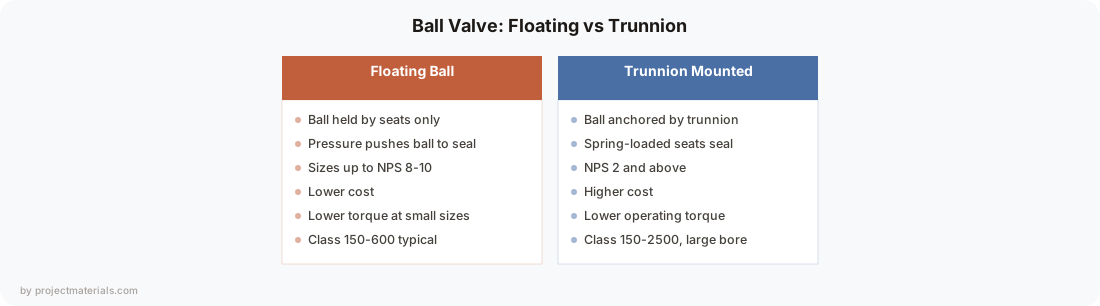
In a floating ball valve, the ball is not mechanically anchored. It sits between two elastomeric seats and is free to move (float) slightly along the valve axis. When the valve closes, line pressure pushes the ball downstream against the seat, creating a pressure-energized seal. The higher the upstream pressure, the tighter the seal gets.
This is the simplest and cheapest ball valve construction. Fewer parts, minimal maintenance, and a tight seal at low-to-medium pressures. The trade-off: above a certain size and pressure class, the ball becomes too heavy for the seats to support, and the force needed to push the ball against the downstream seat creates excessive torque and seat deformation.

The practical size limit for floating ball valves is around NPS 10. Beyond that, the ball weight overwhelms the seats and the valve becomes unreliable. Both floating and trunnion types provide bi-directional shut-off.

(Source: Walworth Valves Youtube Channel)
Trunnion Ball Valve
In a trunnion ball valve, the ball is mechanically anchored at the top and bottom by trunnion bearings. The ball rotates in place but does not float; the trunnions absorb the line thrust, so the seats see far less load than in a floating design.

The practical result: lower operating torque, longer seat life, and reliable sealing at high pressures where a floating ball would crush the seats. Trunnion valves also lend themselves to double block and bleed (DBB) configurations, where the upstream and downstream seats seal independently and a cavity vent between them lets you verify isolation integrity.
| Feature | Why It Matters |
|---|---|
| Low torque | Trunnion bearings carry the thrust, so the actuator only needs to overcome friction, not line pressure. Critical for large valves and high-pressure classes. |
| High pressure/temperature | The fixed ball absorbs thrust without transferring it to the seats, so the design handles Class 600+ and high temperatures without seat deformation. |
| DBB capability | Two independent sealing barriers plus a bleed cavity, standard for pipeline isolation and metering station maintenance. |
| Longer seat life | Seats are spring-loaded against the ball rather than crushed by line pressure, so wear is slower and more predictable. |
Trunnion ball valves are the default for large-bore pipeline service (API 6D), offshore platforms, refinery and petrochemical plants, and power-generation systems. They cost more than floating designs and weigh more, but above NPS 8 or Class 300 there is really no alternative.
(Source: Robert Cort, Wartsila Valves Youtube Channel)
Top Entry vs. Side Entry Ball Valves

The difference between top entry and side entry is purely about how you get to the internals.
A top entry ball valve has a one-piece body with a removable bonnet on top. Unbolt the bonnet, lift out the ball and seats, replace what needs replacing, and reassemble, all without pulling the valve out of the line. Both floating and trunnion designs are available in top entry.
A side entry ball valve (also called a split body valve) has a 2-piece or 3-piece body bolted together. The ball goes in from the side during assembly. To service it, you have to remove the entire valve from the pipeline.
| Top Entry | Side Entry | |
|---|---|---|
| Body | One-piece, removable bonnet | 2-piece or 3-piece split body |
| Inline maintenance | Yes, ball and seats accessible without removing valve | No, valve must come out of the line |
| Cost | Higher (precision one-piece body) | Lower (standard split-body construction) |
| Typical use | Critical isolation, hard-to-reach locations, offshore | General process, utility, non-critical service |
| Pressure capability | One-piece body handles high pressure well | Body joint seal can be a limiting factor at higher classes |
Both floating and trunnion ball valves are available in either configuration.

Specify top entry when you expect frequent inline maintenance or when the valve is in a location where removal would be costly (subsea, buried, elevated pipe racks, or any position where rigging a crane takes half a day).
3-Way Ball Valve (Multiport)
A 3-way ball valve has three ports and uses a ball with either an L-port or T-port bore to divert, mix, or split flow.

- L-Port: Connects the center port to one side port at a time. Rotate the ball and flow switches from one outlet to the other. Used for flow diversion.
- T-Port: Can connect all three ports simultaneously, or block one while connecting the other two. Used for mixing or splitting flow.

A single 3-way valve replaces two 2-way valves and a tee, cutting leak paths and saving space. Common in chemical processing (directing flow between stages), HVAC systems (hot/cold media switching), and water treatment (routing through alternate treatment paths). When specifying, the key decision is L-port vs. T-port. Get this wrong and the flow pattern will not work as intended.
Full Port vs. Reduced Port Ball Valves
The terms “port” and “bore” are interchangeable: full port = full bore (FB), reduced port = reduced bore (RB).

| Full Port (FB) | Reduced Port (RB) | |
|---|---|---|
| Bore | Same diameter as the pipe ID, no flow restriction | Typically one pipe size smaller than the nominal size |
| Pressure drop | Negligible when fully open | Higher; restricted bore creates turbulence |
| Pigging | Yes, pipeline pigs pass through | No, bore too small for pigs |
| Cost/size | Larger body, higher cost | Smaller, lighter, cheaper |
| Actuator | Larger torque (bigger ball) | Less torque (smaller ball, lower actuator cost) |
In pipeline service (API 6D), full bore is almost always specified because pigging is mandatory. In process piping, reduced bore is often acceptable; the extra pressure drop across a single valve is trivial compared to the total system losses, and the cost savings on hundreds of valves add up.
V-Port Ball Valve
Standard ball valves are on/off devices and should not be used for throttling. The V-port ball valve is the exception. A V-shaped notch cut into the ball (typically 15° to 90°) provides a gradual change in flow area as the valve rotates, giving a controllable, near-linear flow characteristic instead of the abrupt open/close of a conventional full-bore ball.
 v port ball valves
V-port valves combine the quarter-turn speed and tight shut-off of a ball valve with genuine throttling capability. The gradual area change also reduces cavitation and flashing risk compared to a standard ball in partial-open position. Common applications: chemical processing (corrosive fluids), water treatment, food and beverage, and pulp and paper (slurries).
Segmented Ball Valve
The segmented ball valve (also called a V-notch ball valve) takes the V-port concept further. Instead of a full sphere, only a segment of the ball is used, essentially a V-notched wedge that rotates within the valve body.
 segmented ball valve
The key advantage over a standard V-port: the V-notch edge produces a shearing action as it closes, cutting through fibrous slurries, viscous fluids, and entrained solids that would clog a conventional ball valve. This makes segmented ball valves the go-to choice for pulp and paper mills, wastewater with high particulate loads, and chemical plants handling viscous products. They offer high rangeability (from full open down to near-zero flow) and hold up well in harsh service.
Ball Control Valve
A ball control valve pairs the quarter-turn ball mechanism with a positioner and actuator (pneumatic, electric, or hydraulic) for automated flow modulation. Most use a V-port or characterized bore to achieve linear or equal-percentage flow characteristics.
 control ball valve
Unlike a standard on/off ball valve, a ball control valve is engineered to sit at any position between full open and full closed without destroying the seats. It retains tight shut-off when fully closed (something a globe-style control valve does not always achieve) while providing the rangeability needed for process control loops.
Ball control valves see heavy use in chemical, petrochemical, pharmaceutical, and water treatment plants where a single valve needs to both regulate flow and provide positive shut-off. Material selection (body, ball coating, seat) must match the process fluid; for aggressive media, hard-faced Stellite or tungsten-carbide-coated internals are typical.
Ball Valve vs. Other Types of Valves
The table below captures the practical differences that drive valve selection on most piping projects. For deeper coverage of each type, see the linked articles.

| Ball Valve | Gate Valve | Globe Valve | Butterfly Valve | |
|---|---|---|---|---|
| Operation | Quarter-turn (90°) | Multi-turn (handwheel) | Multi-turn (handwheel) | Quarter-turn (90°) |
| Primary function | On/off isolation | On/off isolation | Throttling / flow regulation | On/off and throttling |
| Sealing | Tight, self-energizing (pressure-assisted) | Good when fully open/closed; wears in partial position | Good, but seat wears from disc sliding | Good with elastomeric seats; less tight than ball at high pressure |
| Pressure drop (open) | Very low (straight-through bore) | Very low (straight-through gate) | High (tortuous Z-path) | Moderate (disc remains in flow path) |
| Throttling ability | Poor, erodes seats | Poor, erodes gate | Excellent | Good |
| Speed of operation | Fast (quarter-turn) | Slow (many turns) | Slow (many turns) | Fast (quarter-turn) |
| Cost at large sizes | Expensive (large ball + body) | Moderate | Moderate | Lowest (thin disc, wafer body) |
| Typical application | Pipeline shut-off, emergency isolation, gas service | Long-duration open/close service (water mains, fire protection) | Flow control loops, cooling water regulation | Large-diameter isolation and modulation (NPS 24+) |
Rules of thumb from the field:
- Need fast emergency shut-off with tight seal? Ball valve.
- Valve sits fully open 99% of the time? Gate valve works and costs less at large diameters.
- Need to modulate flow continuously? Globe valve (or V-port ball for quarter-turn preference).
- Large diameter (NPS 20+) and cost-sensitive? Butterfly valve. A ball valve at NPS 30 costs a fortune and weighs a ton.
Materials for Ball Valves
Cast vs. Forged Bodies
The dividing line is roughly NPS 2. Below NPS 2, ball valve bodies are forged in 2-piece or 3-piece split configurations. Above NPS 2, cast bodies are standard. Forged construction is also used for high-pressure valves at larger sizes (Class 600+, split body).

| Service | Forged Grades | Cast Grades |
|---|---|---|
| High temperature (carbon steel) | ASTM A105 | ASTM A216 WCB |
| Low temperature | ASTM A350 LF2, LF3 | ASTM A352 LCB, LCC |
| Stainless steel (304/316) | ASTM A182 F304, F316 | ASTM A351 CF8, CF8M |
| Duplex / Super Duplex | ASTM A182 F51, F53, F55 | - |
| Alloy (Inconel, Hastelloy) | - | ASTM A494 CW-6MC, CW-12MW |
| Bronze / Brass | - | ASTM B62, ASTM B16 |
API Material Standards
API 608 covers ball valves for petroleum and natural gas service and specifies material requirements by service class. API 6D covers pipeline valves (gate, plug, ball) and ties material selection to pressure-temperature class. Both reference American Standard B16.34 for pressure-temperature ratings.
Material Selection: Quick Guide
| Factor | Guidance |
|---|---|
| Corrosion resistance | Stainless steel or alloy for corrosive fluids; carbon steel is fine for water, steam, and hydrocarbons without H₂S or CO₂. |
| Temperature | Carbon steel to ~425 °C; above that, alloy steels (Cr-Mo) or nickel alloys. Below -29 °C, low-temperature grades (LF2/LF3, CF8) per American Standard B16.34 curve. |
| Sour service | NACE MR0175 / ISO 15156 compliance required; restricts hardness and material chemistry. |
Frequently Asked Questions
At what size should I switch from floating to trunnion-mounted ball valves?
The typical crossover point is NPS 6-8 (depending on pressure class). Below NPS 6, floating ball valves are standard ; the ball floats downstream against the seat to create a seal. Above NPS 8, trunnion-mounted designs are preferred because the ball is mechanically anchored, reducing the operating torque and the load on the downstream seat. For Class 600 and above, trunnion-mounted is often specified starting at NPS 4.
What is a double block and bleed (DBB) ball valve?
A DBB ball valve provides two independent sealing barriers (upstream and downstream seats) plus a bleed/vent cavity between them. When closed, the cavity can be drained or monitored to verify seal integrity. This arrangement is used for critical isolation in oil & gas, pipeline metering, and maintenance applications where positive isolation is required before breaking a flange joint downstream.
How do I specify a fire-safe ball valve?
Specify valves tested to API 607 (soft-seated valves) or API 6FA (for API 6D pipeline valves). Fire-safe design includes a secondary metal-to-metal seat that maintains a seal after the primary soft seat (PTFE or nylon) is damaged by fire. Additional features include a graphite stem packing backup and anti-blowout stem retention. Specify "fire-safe per API 607, 7th edition" on the valve datasheet.
What seat materials are available for ball valves and when to use each?
PTFE (standard, -29°C to 200°C) (general purpose, excellent chemical resistance. RPTFE (reinforced PTFE)) better wear resistance for abrasive service. PEEK ; high temperature up to 260°C, better mechanical strength. Nylon ; good for natural gas service. Metal seats (Stellite, Inconel overlay) ; for severe service: high temperature (above 260°C), abrasive slurries, or when fire safety requires metal-to-metal sealing without relying on soft seats.
Leave a Comment
Have a question or feedback? Send us a message.
Previous Comments
Dear Sir, We have a regular requirement of Trunnion Ball valves. Please contact us on https://www.kanchansales.com It will be a pleasure to work with a industry leader
what is the maximum allowable clearance between the valve flange and the flange of the pipe line to where the valve to connected. in case of a 3inch 2500 class valve operating at a pressure of 5000psi gas pressure @ a temperature of 60deg C
This blog is very usefull to understand the ball valves. “AMCO” Ball Valves are Manufactured with Full Port/Regular Port constructions. When a Ball Valve is chosen to replace a Gate Valve, the obvious choice is a Full Port Ball Valve. http://amcovalves.com/products/ball-valves/
For more information on trunnion ball valves for oil and gas project. Please visit http://www.trunnionballvalve.net
the best ball valve guide and i have never ever seen this type detailed information yet. Thank you so much for the sharing. also please check my content at https://www.airaindia.com/valve-automation/ball-valve-manufacturer-and-exporters/