

Steel Channels: UPN, UPE, C, MC Profiles
Steel Channels
What Are Steel Channels?
Steel channels are U-shaped structural sections that carry loads in frames, supports, and bracing systems. Their cross-sectional geometry (depth, flange width, and web thickness) determines bending resistance, shear capacity, and torsional behavior. Engineers select channel profiles based on load demands, connection geometry, and fabrication constraints.
Steel channels fall into two main families based on geographic standards. European channels include the UPN (tapered flanges, per EN 10279) and UPE (parallel flanges). Under American standards (AISC), the equivalents are C-channels (tapered flanges, used in general construction and engineering) and MC-channels (wider, variable-width flanges designed for heavier or more specialized structural demands).
European Channel Types (UPN/UPE)
UPN (U Channels with Tapered Flanges)
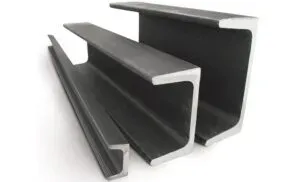 UPN channels
UPN channels have a U-shaped cross-section with tapered inner flanges and slightly outward flange tips. The taper distributes material efficiently, balancing weight against structural performance.
| Property | Detail |
|---|---|
| Cross-section | U-shaped with tapered inner flanges |
| Standard | EN 10279 (hot-rolled steel channels with tapered flanges) |
| Size range | UPN 50 to UPN 400 (number = depth in mm) |
| Typical uses | Building frames, load-bearing supports, vehicle frames, heavy machinery bases |
| Key dimensions | Depth, flange width, web thickness, flange thickness |
| Design data | Mass per meter, moment of inertia, and section modulus per EN 10279 |
The tapered flange geometry also gives UPN channels a slender profile that works well in architecturally exposed steelwork.
UPE (U Channels with Parallel Flanges)
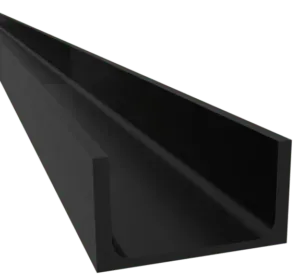 UPE channel
UPE channels share the same U-shaped cross-section as UPN profiles, but their flanges run parallel rather than tapering. The flat, uniform flange surfaces simplify bolted and welded connections.
| Property | Detail |
|---|---|
| Cross-section | U-shaped with parallel flanges |
| Standard | EN 10279 / EN 10365 |
| Size range | UPE 80 to UPE 400 (number = depth in mm) |
| Typical uses | Architectural frames, machinery frameworks, industrial supports, assemblies requiring precision fit-up |
| Key dimensions | Depth (h), flange width (b), web thickness (tw), flange thickness (tf) |
| Design data | Mass per meter, moment of inertia, and section modulus per EN 10365 |
Because the flanges are flat, UPE channels reduce fitting and welding time on site, a significant advantage in projects with many beam-to-channel connections.
UAP/UPA Channel (Specialty Types)
The “UAP” designation appears in specific regional markets (Switzerland, for example) and does not carry widespread standardization under major international codes. Dimensions, material properties, and applications may vary by manufacturer.
UPA channels are a distinct category with parallel flanges, manufactured per EN 10365 and held to the tolerances of EN 10279:2000. Unlike UPE profiles, UPA channels have flanges and webs of equal thickness. Their static values are lower than those of a UPE at the same profile height, but the favorable weight-per-meter ratio makes them a cost-effective alternative in lighter-duty applications.
General Considerations for Specialty Channels
When specifying a specialty profile such as a UAP section, keep three points in mind. First, always refer to the manufacturer’s data sheets or the project engineering specifications for exact dimensions, material grade, and mechanical properties. Second, specialty profiles exist because their unique geometry solves a specific structural or fabrication problem; understanding that intended function clarifies why one was chosen over a standard section. Third, availability can be limited and lead times longer than for standard UPN or UPE stock, which affects procurement planning and project cost.
Differences Between UPN and UPE EU Channels
UPN and UPE channels both serve as primary structural elements, but their flange geometry drives real differences in connection design, fabrication speed, and project cost. The comparison below covers the key distinctions.
Flange Shape
UPN flanges taper toward their tips. This taper improves material distribution under bending and torsional loads for certain configurations. UPE flanges are parallel, providing a consistent width along their length and a flat surface that simplifies bolting and welding to adjacent members.
Structural Efficiency
The tapered UPN flange can deliver slightly higher bending efficiency than a UPE of the same depth, depending on the load case and support conditions. UPE channels offset this with their uniform flange surface, which speeds up connections and reduces fabrication labor.
Aesthetic Considerations
UPN channels read as slender and tapered in exposed-steel applications. UPE channels present a clean, straight-edged profile that suits modern architectural detailing.
Availability and Market Preference
UPN profiles have been a standard catalogue item across European and international markets for decades, particularly where tapered flanges offer structural benefit. UPE profiles entered the market more recently but have gained ground quickly because of their manufacturing efficiency and connection-friendly geometry, especially on fast-track projects.
Applications
UPN channels appear most often in industrial and civil engineering work (supports, equipment bases, and bracing frames) where the tapered flange suits the loading. UPE channels dominate in projects with extensive bolted or welded flange connections, including building frames, equipment supports, and modular structures where parallel flanges speed up assembly.
American Channel Types (C/MC)
The American Institute of Steel Construction (AISC) defines two families of channel sections used in U.S. practice: C-channels (American Standard Channels) and MC-channels (Miscellaneous Channels). Both are C-shaped in cross-section but differ in flange proportions and intended use.
C Channels
C-channels have a C-shaped cross-section with tapered inner flanges. The profile delivers a strong strength-to-weight ratio and bolts or welds readily to other members. AISC lists depths from about 3 in to 15 in, covering light to medium structural applications: floor and wall framing, roof supports, and general bracing.
MC Channels (Miscellaneous Channels)
MC channels share the basic C shape but carry wider flanges and fall outside the standard C-channel dimensional rules. Flange widths and thicknesses vary across the range, and flanges can be parallel or tapered. The wider flanges give MC sections greater lateral stiffness and higher load capacity, so they appear in heavy-duty industrial construction, equipment manufacturing, and large infrastructure work. The AISC manual lists MC sections across a broad range of depths and weights to cover specialized structural needs.
Key Differences Between C and MC Channels
The primary distinction is flange width: MC channels have wider flanges than C channels at comparable depths, which increases lateral bending resistance and bearing area. MC sections also span a wider variety of sizes, giving engineers more flexibility in matching a section to a specific load case. While both families serve construction and engineering, MC channels are the go-to choice when higher strength and greater support area are required.
Selection Considerations
Engineers and architects weigh four factors when choosing a steel channel for a project:
| Factor | What to evaluate |
|---|---|
| Structural requirements | Applied loads (axial, bending, shear) and the stress state the channel must resist |
| Component compatibility | How the channel connects to adjacent beams, columns, and bracing (bolted, welded, or clipped) |
| Material efficiency | The trade-off between section weight and the strength/stiffness the profile delivers |
| Cost and availability | Unit price, mill lead time, and whether the profile is a standard stock item or a special order |
Channels Dimensions and Weights
UPN Channels
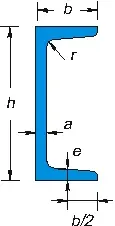
Dimensions are per Standard UNI 5680-73
| Designation | b (mm) | a (mm) | e (mm) | r (mm) | Weight (kg/m) | Area (cm²) | Jx (cm⁴) | Jy (cm⁴) | Wx (cm³) | Wy (cm³) | ix (cm) | iy (cm) |
|---|---|---|---|---|---|---|---|---|---|---|---|---|
| UPN 30 | 33 | 5,0 | 7,0 | 7,0 | 4.27 | 5,44 | 6,39 | 5,10 | 4,26 | 2,60 | 1,08 | 0,968 |
| UPN 40 | 35 | 5,0 | 7,0 | 7,0 | 4,88 | 6,21 | 14,1 | 6,68 | 7,07 | 3,08 | 1,51 | 1,04 |
| UPN 50 | 38 | 5,0 | 7,0 | 7,0 | 5,59 | 7,12 | 26,5 | 9,10 | 10,06 | 3,74 | 1,93 | 1,13 |
| UPN 65 | 42 | 5,5 | 7,5 | 7,5 | 7,09 | 9,03 | 57,5 | 14,0 | 17,7 | 5,05 | 2,52 | 1,25 |
| UPN 80 | 45 | 6,0 | 8,0 | 8,0 | 8,65 | 11,0 | 106 | 19,4 | 26,5 | 6,35 | 3,10 | 1,33 |
| UPN 100 | 50 | 6,0 | 8,5 | 8,5 | 10,6 | 13,5 | 205 | 29,1 | 41,1 | 8,45 | 3,91 | 1,47 |
| UPN 120 | 55 | 7,0 | 9,0 | 9,0 | 13,3 | 17,0 | 364 | 43,1 | 60,7 | 11,1 | 4,63 | 1,59 |
| UPN 140 | 60 | 7,0 | 10,0 | 10,0 | 16,0 | 20,4 | 605 | 62,5 | 86,4 | 14,7 | 5,45 | 1,75 |
| UPN 160 | 65 | 7,5 | 10,5 | 10,5 | 18,9 | 24,0 | 925 | 85,1 | 116 | 18,2 | 6,21 | 1,88 |
| UPN 180 | 70 | 8,0 | 11,0 | 11,0 | 22,0 | 28,0 | 1.354 | 114 | 150 | 22,4 | 6,96 | 2,01 |
| UPN 200 | 75 | 8,5 | 11,5 | 11,5 | 25,3 | 32,2 | 1.911 | 148 | 191 | 26,9 | 7,71 | 2,14 |
| UPN 220 | 80 | 9,0 | 12,5 | 12,5 | 29,4 | 37,4 | 2.691 | 196 | 245 | 33,5 | 8,48 | 2,29 |
| UPN 240 | 85 | 9,5 | 13,0 | 13,0 | 33,2 | 42,3 | 3.599 | 247 | 300 | 39,5 | 9,22 | 4,42 |
| UPN 260 | 90 | 10,0 | 14,0 | 14,0 | 37,9 | 48,3 | 4.824 | 317 | 371 | 47,8 | 10,0 | 2,56 |
| UPN 280 | 95 | 10,0 | 15,0 | 15,0 | 41,9 | 53,4 | 6.276 | 398 | 448 | 57,2 | 10,8 | 2,73 |
| UPN 300 | 100 | 10,0 | 16,0 | 16,0 | 46,1 | 58,8 | 8.028 | 493 | 535 | 67,6 | 11,7 | 2,90 |
UPE Channel Sizes
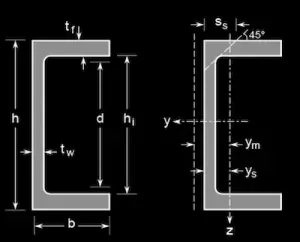
| Description | kg/m | h | b | tw | tf |
|---|---|---|---|---|---|
| UPE 80 | 7.7 | 80 | 50 | 4 | 7 |
| UPE 100 | 9.7 | 100 | 55 | 4.5 | 7.5 |
| UPE 120 | 11.9 | 120 | 60 | 5 | 8 |
| UPE 140 | 14.3 | 140 | 65 | 5 | 9 |
| UPE 160 | 16.9 | 160 | 70 | 5.5 | 9.5 |
| UPE 180 | 19.6 | 180 | 75 | 5.5 | 10.5 |
| UPE 200 | 22.6 | 200 | 80 | 6 | 11 |
| UPE 220 | 26.5 | 220 | 85 | 6.5 | 12 |
| UPE 240 | 30.1 | 240 | 90 | 7 | 12.5 |
| UPE 270 | 35.1 | 270 | 95 | 7.5 | 13.5 |
| UPE 300 | 44.5 | 300 | 100 | 9.5 | 15 |
| UPE 330 | 53.1 | 330 | 105 | 11 | 16 |
| UPE 360 | 61.2 | 360 | 110 | 12 | 17 |
| UPE 400 | 72.4 | 400 | 115 | 13.5 | 18 |
AISC C-Channel Sizes (inches/Lbs)
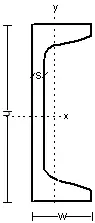 AISC C Channel Size
| Designation | h (in) | w (in) | s (in) | Area (in²) | Weight (lb/ft) | Ix (in⁴) | Iy (in⁴) | Sx (in³) | Sy (in³) |
|---|---|---|---|---|---|---|---|---|---|
| C 15 x 50 | 15 | 3.716 | 0.716 | 14.7 | 50 | 404 | 11 | 53.8 | 3.78 |
| C 15 x 40 | 15 | 3.52 | 0.52 | 11.8 | 40 | 349 | 9.23 | 46.5 | 3.37 |
| C 15 x 33.9 | 15 | 3.4 | 0.4 | 9.96 | 33.9 | 315 | 8.13 | 42 | 3.11 |
| C 12 x 30 | 12 | 3.17 | 0.51 | 8.82 | 30 | 162 | 5.14 | 27 | 2.06 |
| C 12 x 25 | 12 | 3.047 | 0.387 | 7.35 | 25 | 144 | 4.47 | 24.1 | 1.88 |
| C 12 x 20.7 | 12 | 2.942 | 0.282 | 6.09 | 20.7 | 129 | 3.88 | 21.5 | 1.73 |
| C 10 x 30 | 10 | 3.033 | 0.673 | 8.82 | 30 | 103 | 3.94 | 20.7 | 1.65 |
| C 10 x 25 | 10 | 2.886 | 0.526 | 7.35 | 25 | 91.2 | 3.36 | 18.2 | 1.48 |
| C 10 x 20 | 10 | 2.739 | 0.379 | 5.88 | 20 | 78.9 | 2.81 | 15.8 | 1.32 |
| C 10 x 15.3 | 10 | 2.6 | 0.24 | 4.49 | 15.3 | 67.4 | 2.28 | 13.5 | 1.16 |
| C 9 x 20 | 9 | 2.648 | 0.448 | 5.88 | 20 | 60.9 | 2.42 | 13.5 | 1.17 |
| C 9 x 15 | 9 | 2.485 | 0.285 | 4.41 | 15 | 51 | 1.93 | 11.3 | 1.01 |
| C 9 x 13.4 | 9 | 2.433 | 0.233 | 3.94 | 13.4 | 47.9 | 1.76 | 10.6 | 0.96 |
| C 8 x 18.75 | 8 | 2.527 | 0.487 | 5.51 | 18.75 | 44 | 1.98 | 11 | 1.01 |
| C 8 x 13.75 | 8 | 2.343 | 0.303 | 4.04 | 13.75 | 36.1 | 1.53 | 9.03 | 0.85 |
| C 8 x 11.5 | 8 | 2.26 | 0.22 | 3.38 | 11.5 | 32.6 | 1.32 | 8.14 | 0.78 |
| C 7 x 14.75 | 7 | 2.299 | 0.419 | 4.33 | 14.75 | 27.2 | 1.38 | 7.78 | 0.78 |
| C 7 x 12.25 | 7 | 2.194 | 0.314 | 3.6 | 12.25 | 24.2 | 1.17 | 6.93 | 0.7 |
| C 7 x 9.8 | 7 | 2.09 | 0.21 | 2.87 | 9.8 | 21.3 | 0.97 | 6.08 | 0.63 |
| C 6 x 13 | 6 | 2.157 | 0.437 | 3.83 | 13 | 17.4 | 1.05 | 5.8 | 0.64 |
| C 6 x 10.5 | 6 | 2.034 | 0.314 | 3.09 | 10.5 | 15.2 | 0.87 | 5.06 | 0.56 |
| C 6 x 8.2 | 6 | 1.92 | 0.2 | 2.4 | 8.2 | 13.1 | 0.69 | 4.38 | 0.49 |
| C 5 x 9 | 5 | 1.885 | 0.325 | 2.64 | 9 | 8.9 | 0.63 | 3.56 | 0.45 |
| C 5 x 6.7 | 5 | 1.75 | 0.19 | 1.97 | 6.7 | 7.49 | 0.48 | 3 | 0.38 |
| C 4 x 7.25 | 4 | 1.721 | 0.321 | 2.13 | 7.25 | 4.59 | 0.43 | 2.29 | 0.34 |
| C 4 x 5.4 | 4 | 1.584 | 0.184 | 1.59 | 5.4 | 3.85 | 0.32 | 1.93 | 0.28 |
| C 3 x 6 | 3 | 1.596 | 0.356 | 1.76 | 6 | 2.07 | 0.31 | 1.38 | 0.27 |
| C 3 x 5 | 3 | 1.498 | 0.258 | 1.47 | 5 | 1.85 | 0.25 | 1.24 | 0.23 |
| C 3 x 4.1 | 3 | 1.41 | 0.17 | 1.21 | 4.1 | 1.66 | 0.2 | 1.1 | 0.2 |
Leave a Comment
Have a question or feedback? Send us a message.
Previous Comments
Dear Sir, Kindly Send us Quotation of following Structural Steel. Kindly Confirm the availability of material after confirmation order. EN 10365 with tolerances according to EN 10279: 2000. UPE Channel Size : UPE 240……400 mtr UPE Channel Size : UPE 330…..400 Mtr
Is this requirement still alive ?
Dear Mr. Export Manager Hi, have a good day A. First; we are pleased to introduce ourselves as one of the largest and leading companies in the Kingdom of Saudi Arabia with over sixty years in existing. Our vast activities cover the whole kingdom through our more than seventy-three branches dealing with all kinds of building Material, Industry and Trade. B. Second; You are kindly requested to quote us your rock bottom prices and aerialist delivery time CFR Dammam of our requirements of the following products; its Assortment as follow : a. Angel: i. 100 Ton Size 25 x 25 x 2.5 mm x 6mtr ii. 050 Ton Size 30 x 30 x 2.5 mm x 6mtr iii. 100 Ton Size 30 x 30 x 3.0 mm x 6mtr b. UPE: i. 050 Ton Size 140 x 58 mm x 4.9 mm x 8.1 mm x 12 MTR – thersitical weight 12.3 kg/m ii. 050 Ton Size 160 x 64 mm x 5.0 mm x 8.4 mm x 12 MTR – thersitical weight 14.2 kg/m iii. 050 Ton Size 200 x 76 mm x 5.2 mm x 9.0 mm x 12 MTR – thersitical weight 18.4 kg/m c. U Channel ( Japanese Standard): i. 050 Ton Size 40 x 20 mm x 5.0 mm x 5.5 mm x 06 MTR thersitical weight 2.87 kg/m ii. 050 Ton Size 50 x 25 mm x 5.0 mm x 6.0 mm x 06 MTR thersitical weight 3.86 kg/m iii. 050 Ton Size 60 x 30 mm x 6.0 mm x 6.0 mm x 06 MTR thersitical weight 5.07 kg/m iv. 050 Ton Size 125 x 65 mm x 6.0 mm x 8.0 mm x 12 MTR thersitical weight 13.4 kg/m v. 100 Ton Size 150 x 75 mm x 5.7 mm x 10.0 mm x 06 MTR thersitical weight 16.8 kg/m vi. 150 Ton Size 150 x 75 mm x 5.7 mm x 10.0 mm x 12 MTR thersitical weight 16.8 kg/m C. Our payment : will be by LC 100% . D. Absolutely. We prefer to deal with you directly, but If you have any exclusive agent here in our region, please let us have their communication details to enable us to liaise with them to buy your products E. Quotation requirements: Please state all required terms & all conditions; specially the following: a. Specification in details; including Standards, Grade, and consider that ; the mill test certificate should be presented to our bank at proceed of the original shipping documents b. Your offer Validity : we need not less than 7 days from the date of your offer, to enable us to proceed with our purchasing committee & our principals c. SABER ( Saudi Platform) handling : Consider that ; after our confirmation, we need from you to select a surveyor and inspection party ( should be listed in our Saudi SABER platform) to check the materials in your premises and UPLOAD certificate of conformity (COC) for your account and also upload the shipment certificate before 15 days from the shipment date, also for your account. Please check this SABER Saudi platform, to recognize what about the requirement of every party turn ( your company – surveyor company – Our company) d. State eighter you have valid ISO certificate or similar, which you are kindly requested attach with your quotation. e. Your packing mode of every bundle, and its weight and number of sheets inside. f. Your shipping marks or logo printed on your ID card which will attach with every bundle. g. Shipment style. i. Maximum vessel age you intend to use; for insurance purpose ii. Separate Prices: we need separate prices for shipments by containers and break-bulk 1. In case by break-bulk shipments, we need the following: a. Packing mode in details of 6 sides. b. Exact schedule delivery time. 2. In case by containers shipments, we need the following : a. Packing mode in details of 6 sides b. Exact schedule delivery time. c. What about the maximum allotted time to return the containers back to the local of shipping line? We need 4 weeks free of detention F. Waiting your elaborated offer including all above-mentioned details will enable us to maintain and confirm our order promptly if it is satisfactory. G. Again; thanks a lot . B. Regards • Branch of AL Rajhi Endowment Co., for Industry & Trade • Mustafa Mohammad, Purchasing Manager; mobile No.: +966.(0)50.808.21.24 • Our direct fax: +966 11 455 7053; +966 11 454 7201 • Our direct Tel: + 966 11 20 49 790; + 966 2049 791; 794; 795 • Our Website: http://www.rajhibuild.com • Our e-mails: 1. [email protected] 2. [email protected]
Hi I have a question, is there any significant difference between UPE and UPN in application? They are both used in light purposes, is that correct?