

Nitrogen in Oil & Gas: Risks and Safety
Nitrogen (N2) in Oil and Gas Plants
Nitrogen Properties
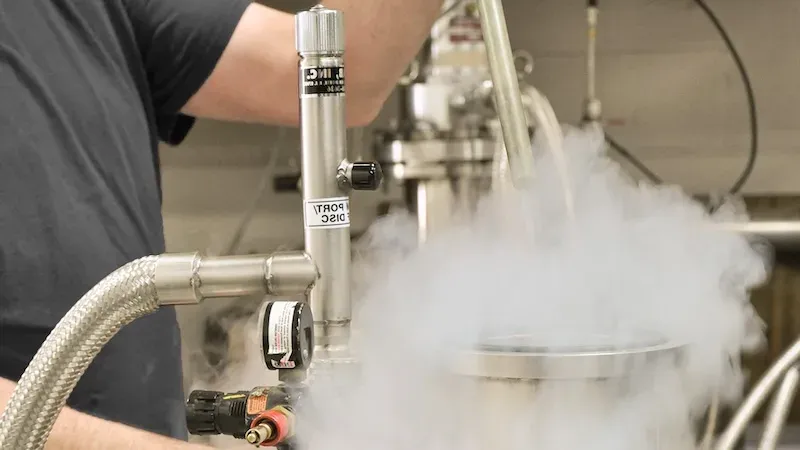 Nitrogen N2
Nitrogen (N) makes up 78% of Earth’s atmosphere. As a diatomic gas (N₂), it is chemically inert under normal conditions because of the strong triple bond between its two atoms. This inertness is exactly why the oil and gas industry uses it so extensively for purging, blanketing, and pressure testing — but it is also what makes it dangerous. Nitrogen displaces oxygen silently, with no smell, no color, and no physiological warning until the body is already shutting down.
At atmospheric pressure, N₂ is slightly lighter than air (density 1.165 kg/m³ vs. 1.225 kg/m³ for air at 20°C), so it tends to rise slightly in open areas. In enclosed or poorly ventilated spaces, however, this small density difference is irrelevant — the gas fills the entire volume through diffusion and convection currents.
| Property | Value |
|---|---|
| Symbol | N (as gas: N₂) |
| Molecular weight | 28.014 g/mol |
| Density (gas, 0°C, 1 atm) | 1.251 kg/m³ |
| Boiling point | -196°C (-320°F) |
| Critical pressure | 33.9 bar |
| Atmosphere content | 78.09% by volume |
| Appearance | Colorless, odorless, tasteless |
| Flammability | Non-flammable, non-toxic |
Nitrogen Applications in Oil & Gas
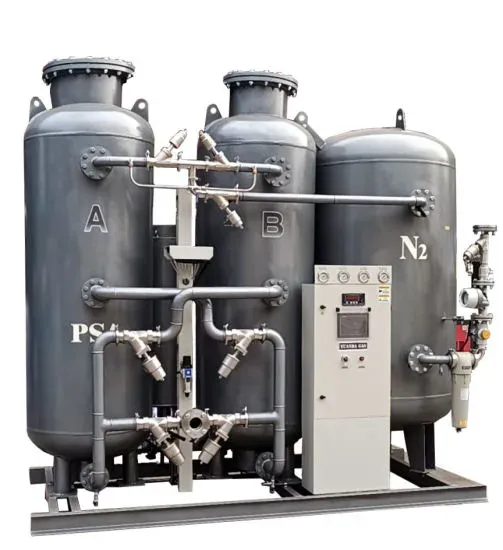 Nitrogen generators for oil & gas
Nitrogen is one of the most commonly used utility gases across every phase of an oil and gas project — from drilling through production, turnarounds, and decommissioning.
| Application | Purpose | Typical Pressure / Flow |
|---|---|---|
| Inerting and Purging | Displace oxygen and hydrocarbons from vessels, tanks, and piping before maintenance or hot work | 1—10 barg; high flow rates (hundreds of Nm³/hr for large vessels) |
| Gas Blanketing | Maintain positive N₂ pressure over liquid surfaces in storage tanks to prevent oxidation, moisture ingress, and vapor buildup | 5—50 mbar above atmospheric |
| Leak / Pressure Testing | Pressurize pipelines and vessels to identify leaks via pressure decay or bubble testing | Test pressure per design; hold times per code (typically 1—24 hours) |
| Enhanced Oil Recovery (EOR) | Inject N₂ into reservoir to maintain formation pressure and displace crude toward production wells | 200—400+ barg at injection wellhead |
| Pipeline Pre-commissioning | Cleaning, gauging, drying, and inerting new or repaired pipelines before introducing hydrocarbons | 5—80 barg depending on phase |
| Well Stimulation | Nitrogen foam fracturing; energized fluid systems to reduce water damage in water-sensitive formations | Variable; co-injected with fracturing fluid |
| Drilling Operations | Underbalanced drilling; foam drilling to minimize formation damage and lost circulation | Annular pressure managed by surface choke |
| Fire Suppression | Displace oxygen in enclosed areas to extinguish or prevent fire | Rapid dump systems; full volume displacement |
| Instrument Purging | Maintain positive pressure in instrument enclosures in hazardous areas to prevent ingress of flammable gas | 2—5 mbar above ambient |
Nitrogen Hazards
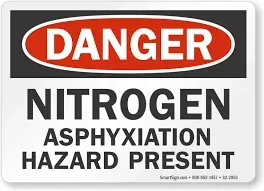 Danger of nitrogen
The hazards of nitrogen fall into three categories: asphyxiation (by far the most lethal), cryogenic exposure from liquid N₂, and over-pressurization of equipment.
| Hazard | Mechanism | Consequence |
|---|---|---|
| Asphyxiation | N₂ displaces O₂ to below 19.5%; completely undetectable without instruments | Rapid loss of consciousness and death |
| Cold Burns / Frostbite | Contact with liquid N₂ at -196°C or cold boil-off gas | Severe cryogenic burns; tissue destruction within seconds of contact |
| Vessel Over-pressurization | Trapped liquid N₂ vaporizes (1 liter liquid = ~700 liters gas); thermal expansion in blocked-in lines | Vessel or piping rupture; projectile hazards |
| Oxygen-Enriched Atmosphere | Liquid air condensation on LN₂ equipment surfaces concentrates O₂ (O₂ boils at -183°C, above N₂’s -196°C) | Increased fire and explosion risk near cryogenic equipment |
| Brittle Fracture | Cryogenic temperatures below the ductile-brittle transition of carbon steel | Equipment failure; loss of containment |
 Risk of explosion in oil & gas plants
Oxygen Depletion: Physiological Effects
The table below shows what happens as oxygen concentration drops. The critical point: there is no gradual warning. The transition from “feeling slightly off” to unconsciousness can happen in a single breath.
| O₂ Concentration | Effect on the Human Body |
|---|---|
| 20.9% | Normal atmospheric oxygen |
| 19.5% | OSHA minimum safe level for work; no noticeable symptoms in most people |
| 16—19% | Reduced coordination, increased breathing rate, impaired judgment; most people do not recognize danger |
| 12—16% | Tachycardia, poor coordination, difficulty breathing, headache; early loss of cognitive function |
| 10—12% | Nausea, vomiting, inability to move freely; risk of collapse |
| 8—10% | Unconsciousness within minutes; death without rescue |
| 6—8% | Unconsciousness in seconds (one or two breaths); fatal within 6—8 minutes |
| Below 6% | Unconsciousness in one breath; death within minutes |
Nitrogen is colorless, odorless, and tasteless; the human body cannot detect oxygen depletion until it is too late. Normal air contains 21% oxygen; symptoms begin at 19.5%, impaired judgment occurs below 16%, and unconsciousness within seconds below 10%. Always use oxygen monitoring devices and ensure proper ventilation when working near nitrogen-purged areas.
Nitrogen Purging Procedures
Purging is the process of displacing one gas (usually oxygen or hydrocarbons) with nitrogen to create an inert atmosphere. It is standard practice before hot work, before introducing hydrocarbons into new piping, and before opening equipment that has been in hydrocarbon service.
The choice of purging method depends on system geometry, volume, allowable time, and target purity. Three methods cover the vast majority of field situations.
Displacement Purging (Slug Purging)
Nitrogen is introduced at one end of a pipeline or vessel, pushing the existing atmosphere out at the other end like a piston. Works well on long-run pipelines and simple vessel geometries with a clear flow path from inlet to vent.
| Parameter | Typical Requirement |
|---|---|
| N₂ inlet | Low point or designated purge connection |
| Vent | High point or opposite end; sized to avoid over-pressurizing the system |
| Flow velocity | 1—3 m/s in pipes; slow enough to maintain the plug front |
| N₂ volume required | Approximately 1.0—1.5x the system volume |
| Monitoring | O₂ analyzer at the vent; continue until O₂ < 1% (or project specification) |
| Advantages | Uses the least nitrogen of any method |
| Limitations | Not effective on complex geometries with dead legs and branch connections |
Dilution Purging
Nitrogen is injected into the system and mixes with the existing atmosphere. The mixture is vented, then more N₂ is introduced. This continues until the target O₂ (or hydrocarbon) concentration is reached.
| Parameter | Typical Requirement |
|---|---|
| N₂ inlet | Any convenient connection |
| Vent | One or more vents; placed to ensure full circulation through the system |
| N₂ volume required | Approximately 4—5x the system volume to reach < 1% O₂ |
| Monitoring | O₂ or hydrocarbon analyzers at multiple points, including dead legs |
| Advantages | Works on any geometry, including complex vessels with internals and multiple nozzles |
| Limitations | Uses significantly more N₂ than displacement; slower |
Pressure-Vacuum Purging (Pressure Cycling)
The system is pressurized with nitrogen, held briefly, then vented to atmosphere. Each cycle reduces the O₂ or hydrocarbon concentration by a predictable ratio. Used on pressure vessels and reactors that can safely hold positive pressure.
| Parameter | Typical Requirement |
|---|---|
| Pressurization | Fill to a safe pressure (often 2—5 barg, well below MAWP) |
| Hold time | Brief — just enough for pressure equalization |
| Vent | Depressurize to near-atmospheric; repeat cycle |
| Number of cycles | 3—5 cycles typically reach < 1% O₂ |
| Advantages | Effective for sealed vessels; moderate N₂ consumption |
| Limitations | Requires a pressure-rated system; not practical for open-ended piping |
Purging Through the Flammable Range
Any hydrocarbon-containing system that is being purged to air (for maintenance) or from air to hydrocarbon service must pass through the flammable range (LEL to UEL). The safe procedure is to use nitrogen as an intermediate step:
- Hydrocarbon to N₂: Purge with nitrogen until hydrocarbon concentration is well below LEL (typically < 1% by volume)
- N₂ to air: Ventilate with air until O₂ reaches normal levels (> 20.5%)
Going directly from a hydrocarbon atmosphere to air (or vice versa) creates an explosive mixture during the transition. Nitrogen bridging eliminates this risk.
Confined Space Entry After Nitrogen Operations
Confined space incidents involving nitrogen account for a disproportionate share of fatalities in the oil and gas industry. The most common scenario: a worker enters a vessel or tank that was recently nitrogen-purged without verifying that the atmosphere has been restored to breathable levels.
Entry Requirements
| Requirement | Detail |
|---|---|
| Permit to work | Confined space entry permit with gas test results recorded before entry |
| Atmospheric testing | O₂ must be 19.5—23.5%; LEL < 10%; H₂S and CO below occupational exposure limits |
| Testing points | Top, middle, and bottom of the space (gases stratify by density and temperature) |
| Continuous monitoring | Personal 4-gas monitor (O₂, LEL, H₂S, CO) worn by every entrant throughout the work |
| Standby person | Trained attendant stationed at the entry point at all times; never enters the space |
| Rescue plan | Tripod and winch with full-body harness for vertical entry; SCBA or airline respirator immediately available |
| Ventilation | Forced mechanical ventilation maintaining safe atmosphere during work |
| Communication | Visual or voice contact between entrant and standby at all times |
| LOTO | All nitrogen supply lines to the space must be isolated, locked, and tagged before anyone enters |
Oxygen Monitoring Equipment
Reliable O₂ monitoring is the single most important safeguard when working around nitrogen. Two categories of monitor are used: personal (portable) and fixed (area).
Personal O₂ Monitors
| Feature | Requirement |
|---|---|
| Sensor type | Electrochemical cell (standard for portable instruments) |
| Range | 0—25% O₂ |
| Low alarm | 19.5% O₂ (OSHA minimum) |
| High alarm | 23.5% O₂ (oxygen-enriched atmosphere) |
| Response time | < 15 seconds (T90) |
| Bump test | Before every shift; expose to known calibration gas and verify alarm triggers |
| Full calibration | Per manufacturer schedule (typically monthly or after a failed bump test) |
| Sensor life | 12—24 months; replace proactively before expiry |
Fixed O₂ Monitors
Fixed monitors are installed in enclosed areas where nitrogen is routinely used: gas blanketing rooms, nitrogen generator buildings, cryogenic storage areas, and pump rooms adjacent to nitrogen-purged systems.
| Feature | Requirement |
|---|---|
| Sensor type | Paramagnetic or electrochemical |
| Mounting height | Breathing zone (1.2—1.5 m above floor; N₂ density is close to air, so it does not concentrate at a specific level) |
| Number of sensors | Per risk assessment; minimum one per enclosed room, more for larger or complex spaces |
| Alarm output | Audible and visual alarm locally; signal to control room DCS/ESD |
| Alarm setpoints | First alarm at 19.5% O₂; second alarm at 18% O₂ (triggers ventilation interlock or area evacuation) |
| Ventilation interlock | Low O₂ alarm starts emergency ventilation fans automatically |
Nitrogen Generation Methods
Large-scale N₂ operations — pipeline purging, EOR injection, plant blanketing — typically require on-site nitrogen generation rather than cylinder supply. Three technologies dominate.
| Method | Principle | Purity | Capacity Range | Best For |
|---|---|---|---|---|
| PSA (Pressure Swing Adsorption) | Carbon molecular sieve adsorbs O₂ from compressed air; N₂ passes through | 95—99.999% | 5—10,000 Nm³/hr | Continuous supply; blanketing; inerting |
| Membrane Separation | Hollow-fiber polymer membranes selectively permeate O₂ and H₂O; N₂ is retained | 95—99.5% | 5—5,000 Nm³/hr | Remote locations; moderate purity needs |
| Cryogenic Air Separation | Air is liquefied and distilled; N₂ and O₂ separated by boiling point difference | 99.999%+ | 1,000—100,000+ Nm³/hr | Very high purity; large-volume EOR; LN₂ production |
For EPC construction and pre-commissioning work, mobile nitrogen units (truck-mounted membrane or PSA systems, or cryogenic pump trucks carrying liquid N₂) are the standard. The choice depends on required purity, flow rate, duration, and site logistics.
| Consideration | PSA | Membrane | Cryogenic (LN₂ pump truck) |
|---|---|---|---|
| Mobilization | Medium (skid-mounted; needs power and instrument air) | Fast (compact; needs power and compressed air) | Fast (truck arrives ready to pump) |
| Operating cost | Low (electricity + compressed air) | Low (electricity + compressed air) | High (LN₂ supply cost; boil-off losses in transit) |
| Purity for pipeline purging | Sufficient (> 99% typical) | Sufficient (> 97% typical) | Excellent (> 99.99%) |
| Duration suitability | Weeks to permanent installation | Weeks to permanent installation | Hours to days |
Risk Mitigation
Control Measures
| Category | Measures |
|---|---|
| Training | Initial and annual refresher on asphyxiation hazards, O₂ monitoring, cryogenic handling, emergency response; practical exercises with detector bump testing |
| PPE | Portable multi-gas detector (O₂, LEL, H₂S, CO) for all personnel near N₂ operations; cryogenic gloves, face shield, and apron for liquid N₂ handling |
| Engineering controls | Mechanical ventilation in all enclosed areas where N₂ is used; O₂ depletion alarms with automatic ventilation interlocks; pressure relief on all trapped sections |
| Procedures | Written SOPs for every nitrogen operation (purging, blanketing, pressure testing, cryogenic transfer); permit-to-work system covering all N₂ work |
| Monitoring | Continuous O₂ monitoring with two independent alarm setpoints; gas test results recorded on every work permit |
| Signage and barriers | ”Danger — Nitrogen / Oxygen Deficient Atmosphere” signs at every access point to N₂-purged areas; physical barriers to prevent unauthorized entry |
| Communication | Toolbox talk before every N₂ operation; radio communication between purging crew, control room, and standby personnel |
Regulatory and Code References
| Standard | Scope |
|---|---|
| OSHA 29 CFR 1910.146 | Permit-required confined spaces — atmospheric testing, entry permits, attendant and rescue requirements |
| OSHA 29 CFR 1910.134 | Respiratory protection — required when O₂ < 19.5% or atmosphere is IDLH |
| API RP 2217A | Guidelines for safe work in inert confined spaces in the petroleum and petrochemical industries |
| NFPA 69 | Standard on explosion prevention systems — inerting, purging, and pressurization with inert gas |
| NFPA 55 | Compressed gases and cryogenic fluids code — storage, handling, and use |
| API RP 2016 | Guidelines and procedures for entering and cleaning petroleum storage tanks — N₂ purging and ventilation |
| CGA P-18 | Standard for bulk inert gas systems at consumer sites (Compressed Gas Association) |
| EN 14620 / BS EN ISO 21028 | Cryogenic vessels — safety requirements for storage and transportation |
Emergency Response for Nitrogen Incidents
| Situation | Response |
|---|---|
| O₂ alarm activation | Evacuate area immediately; do not re-enter without SCBA; ventilate the space; account for all personnel |
| Person collapsed in N₂ atmosphere | Do NOT enter without SCBA or airline respirator; call emergency services; use retrieval line or tripod if available; begin rescue only with proper respiratory protection |
| Cryogenic spill (liquid N₂) | Evacuate and ventilate; do not touch liquid or frosted surfaces barehanded; allow to evaporate naturally; monitor O₂ levels in the surrounding area |
| N₂ line rupture / uncontrolled release | Isolate supply at the nearest upstream valve; evacuate downwind and enclosed adjacent areas; monitor O₂; barricade the area until levels are confirmed safe |
| Over-pressurization alarm | Verify relief devices have lifted; isolate N₂ supply; do not approach equipment until pressure is confirmed safe |
Storage and Transportation
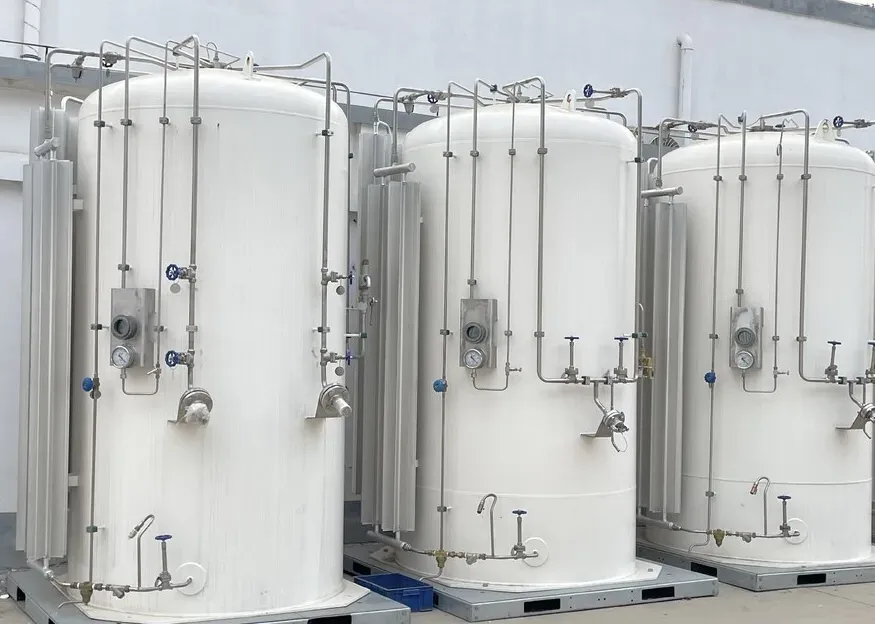 N2 Storage
| Form | Storage Requirements | Transport Requirements |
|---|---|---|
| Gas (high-pressure cylinders) | Stored upright, secured with chains or racks, in well-ventilated area; away from heat, direct sunlight, and combustibles; segregated from oxidizers; clearly labeled with contents and hazard class | Vertical position, secured against tipping; ventilated vehicle (never in sealed car trunk or unventilated compartment); valve protection caps in place; SDS available in cab |
| Liquid (cryogenic tanks) | Vacuum-insulated cryogenic vessels; pressure relief valves sized for fire case and blocked-in liquid expansion; adequate ullage (typically 5—10%); drip trays under transfer connections; restricted access area | Specialized cryogenic tankers per DOT/ADR regulations; emergency shutoff valves; pressure and temperature monitoring; drivers with HAZMAT certification |
| Gas (tube trailers) | High-pressure tubes on road trailer (200—300 barg); manifold with master shutoff valve; parked in ventilated area, wheels chocked and trailer grounded | Pressure tested and inspected per DOT/ADR schedule; route restrictions for tunnels and bridges; emergency shutoff accessible |
Pre-Commissioning with Nitrogen
New or repaired pipelines and vessels go through a series of pre-commissioning steps where nitrogen plays a central role. These operations are typically executed by a specialist contractor under the supervision of the commissioning team.
| Pre-commissioning Phase | N₂ Role | Key Parameters |
|---|---|---|
| Cleaning (pigging) | N₂ drives cleaning pigs through the pipeline to remove construction debris, mill scale, and water | Pig speed 1—3 m/s; N₂ pressure behind pig based on pipeline MAWP and pig friction |
| Gauging | N₂ propels a gauging pig to verify internal bore and detect dents or buckles | Gauge plate sized to 95—97% of nominal ID |
| Drying | N₂ sweep or vacuum drying to remove residual moisture; critical for sour service, cryogenic, and instrument air piping | Target dewpoint per specification (typically -20°C to -40°C) |
| Leak / Pressure Testing | Pneumatic test with N₂ when hydrostatic testing is not feasible (no water source, risk of water damage, or drying impractical) | Test pressure per American Standard B31.3 (typically 1.1x design pressure for pneumatic test); hold time per code |
| Inerting before hydrocarbon introduction | Final N₂ purge to displace air before introducing process gas or liquid | O₂ < 1% at all sample points; documented gas test records |
Nitrogen pre-commissioning records (purge logs, gas test certificates, pressure test charts) become part of the pipeline completion documentation, alongside hydrostatic test reports and mill test certificates.
Leave a Comment
Have a question or feedback? Send us a message.