

Safety & Pressure Relief Valves: Types, Sizing & Standards (API 520/526)
What Is a Safety Valve
A safety valve opens automatically and at full lift the moment system pressure exceeds the set pressure (in bars or psi). The disc lifts, fluid discharges, and pressure drops back to normal, all mechanically, with no actuators or external controls involved.
Once pressure falls below the reseat value, the valve snaps shut on its own.

Safety valves are installed on pressure vessels, boilers, gas storage tanks, and piping systems. The governing standards are API 526 and American Standard BPVC Section VIII.
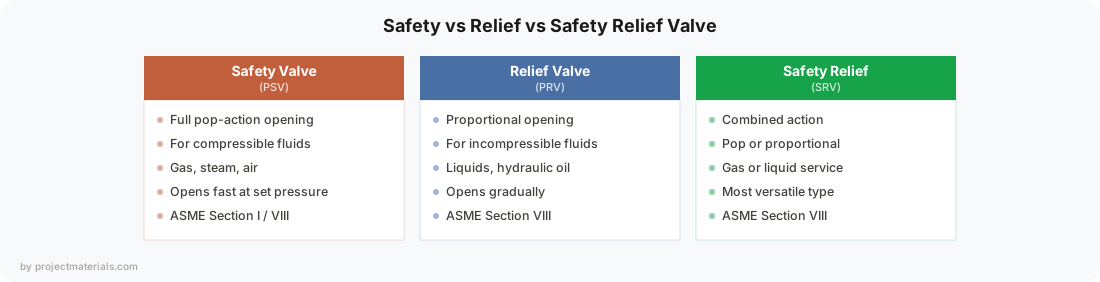
Safety Valve vs. Relief Valve vs. Safety Relief Valve
The terms get used interchangeably in the field, but the distinction matters for specification, sizing, and code compliance. American Standard and API define three separate device types:
A safety valve (SV) opens fully and suddenly at set pressure, with no controller or operator input. This is the snap-action behavior you see on steam boilers and gas systems. The pop action results from the expanding compressible fluid pushing against a larger disc area once the initial seal breaks.
By contrast, a pressure relief valve (PRV) opens gradually, proportional to the overpressure. A pressure controller and actuating mechanism modulate the disc lift based on the overpressure signal. PRVs typically protect liquid-filled pressure vessels where proportional relief prevents water hammer and system upsets.
 pressure relief valve
The safety relief valve (SRV) combines both behaviors: snap action on gas/steam, proportional on liquids. It is the most common device in refinery and petrochemical service.
| Feature | Safety Valve (SV) | Relief Valve (PRV) | Safety Relief Valve (SRV) |
|---|---|---|---|
| Opening action | Pop (full lift at set pressure) | Proportional (gradual) | Pop on gas, proportional on liquid |
| Media | Compressible (gas, steam, vapor) | Incompressible (liquid) | Gas or liquid |
| Closing action | Snap shut (blowdown 7-10%) | Gradual close | Depends on service media |
| P&ID tag | PSV | PSV (industry convention) | PSV |
| American Standard code symbol | V (safety) | UV (safety relief) | UV (safety relief) |
| Standards | API 526, American Standard Sec. VIII | API 526, American Standard Sec. VIII | API 526, American Standard Sec. VIII |
| Typical applications | Boilers, steam drums, gas systems | Liquid pipelines, pump discharge | General process vessels, refinery equipment |
Per API 521, the pressure in a vessel can exceed the design limit from multiple causes: blocked discharge, chemical reaction, tube rupture, fire case (external fire exposure), thermal expansion, or cooling system failure. Each event creates a different required relief rate: small mass flow for thermal expansion, enormous mass flow for a runaway chemical reaction. The engineering team must identify the worst-case governing scenario before sizing the relief device.
Safety vs. Relief: A safety valve opens fully and suddenly at set pressure (no controller needed), while a pressure relief valve (PRV) opens proportionally using a pressure controller and actuator. A safety relief valve (SRV) combines both functions and is the standard device in most process plant applications. The engineering team must determine the worst-case overpressure scenario per API 521 to size the correct relief device.
Key Terminology
These terms appear on every PSV datasheet and in API 520/521/526.
| Term | Definition | Typical Value |
|---|---|---|
| Set pressure | Inlet pressure at which the valve begins to open under service conditions | At or below MAWP of the protected equipment |
| Overpressure | Pressure increase above set pressure during full valve discharge | 10% (single valve), 16% (multiple valves), 21% (fire case) |
| Accumulation | Pressure increase above MAWP allowed during a relief event | Same percentages as overpressure (these terms are related but not identical) |
| Blowdown | Difference between set pressure and reseat pressure | 7-10% for gas/steam, up to 20% for liquids |
| Reseat pressure | Inlet pressure at which the valve closes after relieving | Set pressure minus blowdown |
| MAWP | Maximum Allowable Working Pressure of the protected equipment | Established per American Standard Section VIII calculations |
| CDTP | Cold Differential Test Pressure, the bench test pressure adjusted for backpressure and temperature | CDTP = Set Pressure - Backpressure Correction + Temperature Correction |
| Relieving pressure | Set pressure + overpressure allowance + atmospheric pressure | Used in API 520 sizing calculations |
| Superimposed backpressure | Pressure at the valve outlet before it opens | From other valves discharging into a shared header |
| Built-up backpressure | Pressure generated by flow through discharge piping after the valve opens | Calculated from discharge pipe friction losses |
| Simmer | Audible leakage before the valve fully opens | Occurs at approximately 90-95% of set pressure on spring-loaded valves |
| Chatter | Rapid opening and closing of the valve disc | Caused by excessive inlet pressure drop (> 3% of set pressure) or oversized valve |
How a Safety Valve Works
The operating principle is straightforward: a compression spring holds the disc on the seat. When system pressure acting on the disc area exceeds the spring force, the disc lifts and fluid discharges through the outlet. When pressure drops, the spring pushes the disc back down.
In practice, this happens in four stages:
- Normal operation: Spring force exceeds the pressure force on the disc. The valve is shut and leak-tight.
- Set pressure reached: Pressure force overcomes the spring. The disc lifts off the seat. On a gas/steam safety valve, this happens with a “pop” because the disc snaps to full lift almost instantly as the exposed disc area increases, creating a positive feedback loop.
- Discharge: Fluid vents through the outlet until system pressure drops below the reseat pressure.
- Reseat: Spring force wins again, the disc snaps shut. The valve resets automatically, ready for the next event with no manual intervention.
Parts of a Safety Valve
| Part | Function | Notes |
|---|---|---|
| Body | Houses all internals; provides the discharge flow path | Carbon steel, stainless steel, or alloy, chosen to match process conditions |
| Seat | Sealing surface the disc presses against | Seat finish quality directly determines leak tightness. Metal-to-metal or soft-seated (PTFE) |
| Disc | Lifts off seat to allow relief flow | Machined to match the seat. Can be ball, piston, or poppet type |
| Spring | Holds disc closed until set pressure | Spring steel for general service; Inconel for high-temp or corrosive environments |
| Bonnet | Covers the valve internals; secures to body | Open bonnet for atmospheric discharge; closed bonnet for toxic/flammable service |
| Spindle (Stem) | Connects disc to lever/actuator; transfers motion | Must be precision-machined; any binding here causes erratic set pressure |
| Lever | Manual lift device for in-situ testing | Not on all designs. Allows operators to verify the valve is not seized |
| Adjusting Screw | Sets spring compression to define set pressure | Located at the top of the spring; locked with a jam nut once set |
| Blowdown Ring | Adjusts the reseat pressure (blowdown) | Critical for preventing chatter. Field adjustment of the blowdown ring is one of the most common maintenance tasks on safety valves |
Types of Safety and Relief Valves
Conventional Spring-Loaded Safety Valve
The spring-loaded type accounts for the vast majority of safety valves in service. It is the workhorse of overpressure protection: simple, self-contained, and field-adjustable.

Set pressure is determined entirely by the spring compression, adjusted via the adjusting screw at the top. This makes spring-loaded valves straightforward to recalibrate on the bench (though field adjustment should only be done by qualified valve technicians with the proper test equipment).
Backpressure sensitivity is the main limitation. On a conventional spring-loaded valve, any superimposed backpressure acts on the disc in the closing direction, effectively raising the set pressure. If backpressure varies (as it does in a shared flare header), the actual opening pressure becomes unpredictable.
Best for: Atmospheric venting, dedicated discharge lines, constant backpressure systems, general utility service.
Limitations: Set pressure shifts with variable backpressure; bonnet spring exposed to process fluid in some configurations; limited to about 10% superimposed backpressure.

The image shows the spring holding the disc on the seat (closed position) and the disc lifted during discharge (open position).
Spring-loaded safety valves are the standard choice for boilers, pressure vessels, piping systems, and chemical plants. For deeper technical detail, consult Leser’s guide to spring-operated safety valves.
Balanced Bellows Safety Valve
A balanced bellows relief valve solves the backpressure problem of the conventional type. A metal bellows surrounds the disc stem, isolating the back side of the disc from discharge-side pressure. The set pressure stays constant regardless of backpressure fluctuations in a shared flare or vent header.
How the bellows works: The bellows creates a sealed chamber on the back of the disc. The effective area of the bellows equals the nozzle seat area, so backpressure pushing on the bellows exactly cancels backpressure pushing on the disc. The net force balance is independent of downstream conditions.
| Parameter | Conventional | Balanced Bellows |
|---|---|---|
| Backpressure tolerance | Max 10% of set pressure (variable) | Up to 40-50% of set pressure |
| Set pressure stability | Shifts with backpressure | Stable regardless of backpressure |
| Bellows element | None | Metal bellows on disc stem |
| Bonnet vent | Not required | Required (vents bellows leakage) |
| Cost | Lower | 20-40% higher |
| Maintenance | Simpler | Bellows integrity must be monitored |
| Failure mode | Set pressure drift if backpressure changes | If bellows ruptures, reverts to conventional behavior |
Best for: Shared flare headers, variable backpressure systems, corrosive service where process fluid must be isolated from the bonnet/spring area.
Pilot-Operated Safety Valve
A pilot-operated safety valve (POSV) uses the process pressure itself to hold the main valve shut, with a small pilot valve to trigger the opening. This is a fundamentally different approach from a spring-loaded valve.

How It Works
The main valve has a piston or diaphragm with process pressure applied on both sides. In the closed position, these forces balance and the valve stays shut, with a slight net closing force because the dome (top) area is larger than the nozzle (bottom) area.
When system pressure reaches the setpoint, the pilot valve (itself a small spring-loaded valve) opens, venting pressure from above the piston. The process pressure below now has an unbalanced upward force, and the main valve snaps open. When pressure drops, the pilot closes, pressure re-equalizes above the piston, and the main valve shuts.
Why Use a POSV Instead of Spring-Loaded
The practical advantages are significant:
- Tight shutoff near set pressure: a POSV operates at up to 98% of set pressure without any leakage. A spring-loaded valve starts to simmer at about 90-95%. This matters on systems that run close to MAWP.
- Higher capacity from a smaller valve: the full bore opens at once, giving a higher Kd (discharge coefficient) than a spring-loaded valve of the same orifice.
- Backpressure immunity: the main valve opening force comes from process pressure, not a spring, so downstream backpressure has no effect on set pressure.
- Modulating discharge: POSVs can open partially, which reduces process upset and minimizes flare load.
Complexity is the trade-off. The pilot has small internal passages that can plug in dirty service, and the additional tubing and fittings create more potential leak paths. POSVs are common on gas pipelines, large storage tanks, and high-pressure process systems where operating pressure runs close to MAWP.
Dead-Weight Safety Valve
A dead-weight safety valve uses stacked weights instead of a spring to hold the disc on the seat. The set pressure equals the total weight divided by the disc area: pure physics, no spring to fatigue or lose calibration.
The disc is typically gunmetal (corrosion-resistant), bolted to the top of a vertical steam pipe flanged to the boiler shell. When steam pressure creates an upward force exceeding the dead weights, the disc lifts and steam discharges.
You will mostly see dead-weight valves on low-pressure boilers and as calibration references for testing spring-loaded valves. They are not practical for high-pressure or variable-pressure service (you would need absurdly heavy weights). But their simplicity and inherent accuracy make them the reference standard for bench-testing set pressure.

Full Comparison of All Types
| Feature | Conventional Spring-Loaded | Balanced Bellows | Pilot-Operated | Dead-Weight |
|---|---|---|---|---|
| Operating mechanism | Compression spring | Spring + bellows | Process pressure + pilot | Gravity (stacked weights) |
| Set pressure range | Full API 526 range | Full API 526 range | Full API 526 range | Low pressure only (< 15 barg) |
| Backpressure tolerance | < 10% variable | Up to 40-50% | Immune | N/A |
| Shutoff near set pressure | 90-95% of set pressure | 90-95% of set pressure | Up to 98% of set pressure | N/A |
| Response time | Fast (snap action) | Fast (snap action) | Very fast | Slow (gradual) |
| Maintenance complexity | Low | Medium (bellows inspection) | High (pilot, tubing, fittings) | Very low |
| Dirty service suitability | Good | Good (bonnet isolated) | Poor (pilot clogs) | Poor |
| Relative cost | Base | 1.2-1.4x | 1.5-2.5x | Low (but limited use) |
| Typical applications | General process, utilities, boilers | Shared flare headers, corrosive service | Gas pipelines, high-pressure vessels, tanks | Calibration, low-pressure boilers |
Spring-Loaded vs. Pilot-Operated: Selection Guide
| Selection Criteria | Spring-Loaded (Conventional or Bellows) | Pilot-Operated (POSV) |
|---|---|---|
| Operating pressure > 90% of MAWP | Not recommended (simmer/leakage) | Preferred (tight shutoff to 98%) |
| Dirty or fouling service | Preferred (no pilot to clog) | Avoid unless strainers installed |
| Variable backpressure | Use balanced bellows type | Inherently immune |
| Large orifice requirement | Larger, heavier valve needed | Smaller valve, same capacity |
| Remote locations | Preferred (self-contained, no tubing) | Higher maintenance burden |
| Cryogenic service | Standard with appropriate materials | Requires special low-temp pilot seals |
| Two-phase flow | Suitable | May have erratic pilot behavior |
| Cost sensitivity | Lower initial cost | Higher initial cost, lower lifecycle cost in some cases |
API 526 Standard Orifice Designations
API 526 standardizes pressure relief valve orifice sizes using letter designations from D through T. After calculating the required effective discharge area per API 520 Part I, the engineer selects the next larger standard orifice letter.
| Orifice Letter | Effective Area (in2) | Effective Area (mm2) | Typical Inlet x Outlet | Common Applications |
|---|---|---|---|---|
| D | 0.110 | 71.0 | 1” x 2” | Small vessels, thermal relief |
| E | 0.196 | 126.5 | 1” x 2” | Small vessels, instrument air |
| F | 0.307 | 198.1 | 1.5” x 2.5” | Medium vessels, heat exchangers |
| G | 0.503 | 324.5 | 1.5” x 3” | Process columns, reactors |
| H | 0.785 | 506.5 | 2” x 3” | Drums, separators |
| J | 1.287 | 830.3 | 3” x 4” | Large vessels, compressor discharge |
| K | 1.838 | 1,186 | 3” x 4” | Large vessels, fire case scenarios |
| L | 2.853 | 1,841 | 4” x 6” | Storage tanks, large columns |
| M | 3.600 | 2,323 | 4” x 6” | High-capacity applications |
| N | 4.340 | 2,800 | 4” x 6” | High-capacity applications |
| P | 6.380 | 4,116 | 4” x 6” or 6” x 8” | Very large vessels, fire case |
| Q | 11.05 | 7,129 | 6” x 8” or 6” x 10” | Major relief scenarios |
| R | 16.00 | 10,323 | 6” x 10” or 8” x 10” | Large-scale emergency relief |
| T | 26.00 | 16,774 | 8” x 10” | Maximum capacity applications |
Sizing Methodology (API 520 Part I)
Sizing a safety or relief valve determines the minimum effective discharge area (orifice) needed to relieve the required flow rate at the governing overpressure scenario. The process follows API 520 Part I with input from API 521 (scenario identification) and API 526 (standard orifice selection).
Sizing Steps
- Identify all overpressure scenarios per API 521: fire case, blocked outlet, thermal expansion, tube rupture, control valve failure, chemical reaction, power failure, cooling water failure
- Calculate the required relieving rate (W in lb/hr for gas, Q in GPM for liquid) for each scenario
- Determine the governing scenario, which is the one requiring the largest orifice area
- Apply the appropriate API 520 formula (gas/vapor, liquid, steam, or two-phase)
- Select the smallest standard API 526 orifice letter that provides an effective area equal to or greater than the calculated area
- Verify inlet pressure drop does not exceed 3% of set pressure (API 520 Part II)
- Verify that backpressure is within the valve type’s allowable range
API 520 Sizing Formula (Gas/Vapor)
A = W / (C x K x P1 x Kb x Kc) x sqrt(T x Z / M)
| Symbol | Parameter | Unit |
|---|---|---|
| A | Required effective discharge area | in2 |
| W | Required relieving rate | lb/hr |
| C | Gas constant coefficient (function of k = Cp/Cv) | Dimensionless |
| K | Effective coefficient of discharge (0.975 for API-certified valves) | Dimensionless |
| P1 | Relieving pressure (set pressure x 1.10 + atmospheric) | psia |
| Kb | Backpressure correction factor (1.0 for conventional; < 1.0 for balanced bellows) | Dimensionless |
| Kc | Combination correction factor (1.0 without rupture disc; 0.9 with) | Dimensionless |
| T | Relieving temperature | Rankine (F + 460) |
| Z | Gas compressibility factor at relieving conditions | Dimensionless |
| M | Molecular weight of gas | lb/lb-mol |
API 520 Sizing Formula (Liquid)
A = Q / (38 x K x Kw x Kv) x sqrt(G / (P1 - P2))
Where Q is in US GPM, G is specific gravity, P1 is relieving pressure (psia), and P2 is total backpressure (psia).
Installation Requirements (API 520 Part II)
Proper installation is as critical as proper sizing. Many field failures are caused by installation errors, not valve defects. API 520 Part II and API 521 provide detailed guidance.
Inlet Piping
- 3% rule: The total non-recoverable pressure loss in the inlet piping must not exceed 3% of the valve set pressure. Violation of this rule is the single most common cause of valve chatter.
- Keep it short and direct: The inlet pipe should be as short as possible, with no unnecessary fittings or restrictions. Ideally, mount the valve directly on the vessel nozzle.
- Full-bore connections: The inlet pipe bore must be at least equal to the valve inlet connection size. Never reduce the bore between the vessel and the valve.
Outlet Piping
- Size for backpressure limits: Discharge piping must be sized so that built-up backpressure does not exceed the valve type’s tolerance (10% for conventional, 40-50% for balanced bellows).
- Support the discharge pipe independently: Never transmit reaction forces from the discharge pipe through the valve body. Use pipe supports and anchors.
- Drain provisions: Install a drain hole at the lowest point of the discharge piping to prevent liquid accumulation. Trapped liquid above a safety valve can cause hydraulic lock and prevent the valve from opening.
General Installation Rules
| Requirement | Details |
|---|---|
| Orientation | Vertical, with the spring housing pointing up |
| Isolation valves | Car-sealed open (CSO) or locked open (LO) if block valves are installed upstream or downstream per API 520 Part II |
| Discharge routing | To a safe location: flare header, atmospheric vent, or blowdown drum |
| Reaction force | Calculate per API 520 Part II; anchor the discharge pipe to absorb thrust |
| Accessibility | Make sure the valve is accessible for testing and removal without shutting down the entire unit |
| Tagging | Each valve must be tagged with PSV number matching the P&ID |
Safety Valve Materials
Safety valves are available in material grades from carbon steel through exotic nickel alloys, with hundreds of possible configurations when you factor in body material, trim material, spring material, seat type, and seal elastomers. The process datasheet drives the material selection; get it wrong and you get a valve that corrodes, seizes, or cracks in service.
Body and Bonnet Materials
| Material | Properties | Applications |
|---|---|---|
| Carbon Steel (WCB, WCC) | Good mechanical properties, cost-effective | General applications, moderate temps/pressures (-29 to 425 deg C) |
| Stainless Steel (CF8M/316, CF8/304) | Excellent corrosion resistance | Aggressive media, high cleanliness requirements |
| Alloy Steel (WC6, WC9, C5) | High strength at elevated temps | High-temperature, high-pressure applications (up to 600 deg C) |
| Bronze/Brass | Good corrosion resistance | Water, steam, gas at lower pressures |
| Nickel Alloys (Hastelloy, Monel, Inconel) | Exceptional corrosion resistance | Harsh environments, acidic/alkaline conditions |
| Titanium | Outstanding corrosion resistance, high strength-to-density | Seawater, chlorine, acidic environments |
| Low-temperature steel (LCB, LCC, LC3) | Impact-tested for cryogenic service | LNG, cryogenic air separation, cold climate |
Trim (Disc and Seat) Materials
| Material | Properties and Applications |
|---|---|
| Stainless Steel | Common for trim due to durability and corrosion resistance. Hardened stainless steel is often used for better wear resistance. |
| Stellite (cobalt-chromium alloy) | Used for seating surfaces to provide excellent wear and corrosion resistance, especially suitable for high-temperature steam applications. |
| Tungsten Carbide and Silicon Carbide | Utilized in abrasive media applications for their extreme hardness and resistance to wear and erosion. |
| PTFE and other Polymers | Used for seals and seating areas in lower temperature applications. Offers excellent chemical resistance and minimal friction. |
Spring Materials
| Material | Properties and Applications |
|---|---|
| Spring Steel (ASTM A228, A231) | Commonly used for springs in safety valves, chosen for its high strength and fatigue resistance. Standard for -29 to 260 deg C. |
| Inconel X-750 | A nickel-chromium alloy used for springs that require corrosion resistance and the ability to maintain strength at high temperatures (up to 540 deg C). |
| Hastelloy and other Nickel Alloys | Selected for springs in highly corrosive environments where conventional spring materials would fail. |
Material Selection by Service Condition
| Service Condition | Body Material | Trim Material | Spring Material | Special Requirements |
|---|---|---|---|---|
| General hydrocarbon | WCB carbon steel | 316 SS / Stellite | Carbon spring steel | Standard API 526 |
| Sour service (wet H2S) | WCB or WCC (NACE) | NACE-compliant SS | NACE-compliant | NACE MR0175 / ISO 15156 mandatory |
| High temperature (> 425 deg C) | WC6, WC9, C5 Cr-Mo | Stellite | Inconel X-750 | Creep considerations |
| Cryogenic (< -29 deg C) | LCB, LCC, LC3 | 316 SS | Low-temp spring steel | Impact testing per American Standard |
| Concentrated acids | Hastelloy C-276 | Hastelloy | Hastelloy C | Material compatibility critical |
| Chloride environments | CF8M (316 SS) or Duplex | 316 SS / Stellite | Inconel X-750 | Avoid 304 SS (SCC risk) |
| Steam service | WCB or CF8M | Stellite (standard) | Carbon spring steel | American Standard Section I requirements |
| Oxygen service | Monel or bronze | Monel | Monel or SS | Special cleaning, no hydrocarbons |
Material Selection Guidelines
Match body and bonnet material to the piping material class (per the project’s piping material specification). Trim material is driven by the process fluid: Stellite-faced seats are standard for steam; stainless steel or Inconel for most hydrocarbon service; Hastelloy for acid gas. Spring material must resist the bonnet-side environment. If the bonnet is vented to atmosphere, standard spring steel works; if exposed to process fluid (conventional valve in corrosive service), upgrade to Inconel X-750.
Cost escalation from carbon steel to exotic alloys is steep; a Hastelloy C-276 body can cost 8-10x the carbon steel equivalent. Specify only what the process demands.
Testing and Inspection Requirements
Safety valves must be tested periodically to verify they will open at the correct set pressure and reseat properly. A valve that fails to open on demand provides zero protection, and operators may not know it has failed until a catastrophic overpressure event occurs.
Bench Pop Test (Set Pressure Verification)
The bench pop test is the primary method for verifying set pressure accuracy:
- Mount the valve on a calibrated test bench
- Apply air/nitrogen (for gas valves) or hydraulic pressure (for liquid valves) gradually
- Record the pressure at which the valve pops open
- Verify the pop pressure is within tolerance: +/- 2 psi for set pressures up to 70 psi, or +/- 3% above 70 psi (per American Standard PTC 25)
- Adjust the spring if necessary and repeat until three consecutive pops are within tolerance
- Set the blowdown ring to achieve the specified blowdown percentage
- Seal all adjustments with lead seals or security wire
Seat Tightness Testing (API 527)
API 527 establishes acceptable seat leakage rates for pressure relief valves. The test applies pressure at 90% of set pressure and measures any leakage from the outlet:
| Set Pressure Range | Maximum Allowable Leakage (API 527) |
|---|---|
| Up to 1,000 psig | 40 SCFH air (gas valves) |
| Above 1,000 psig | 0.60 SCFH air per inch of orifice diameter |
| Soft-seated valves | Zero leakage at 90% of set pressure |
Inspection Intervals
| Standard/Program | Recommended Interval | Notes |
|---|---|---|
| API 510 | Not exceeding 5 years (or half remaining life) | External inspection; internal at turnaround |
| API 576 | Based on equipment history and RBI | Specific to pressure-relieving devices |
| American Standard Section VIII | Per jurisdictional requirements | Many jurisdictions require 3-5 year intervals |
| Risk-Based Inspection (RBI) | 1-10 years depending on risk ranking | Allows extended intervals for clean, non-corrosive service |
| Severe service | Annual or every turnaround | Corrosive, fouling, high-cycle, or sour service |
Selection Guide by Application
| Application | Recommended Type | Key Considerations |
|---|---|---|
| Steam boiler | Spring-loaded SV (conventional) | American Standard Section I; overpressure 3%; Stellite trim |
| Pressure vessel (general) | Spring-loaded SRV | American Standard Section VIII; API 526 orifice per API 520 sizing |
| Shared flare header | Balanced bellows SRV | Variable backpressure compensation |
| Gas pipeline | Pilot-operated SV | Tight shutoff near MAWP; large capacity |
| Large storage tank | Pilot-operated or weight-loaded | API 2000 for tank breathing; low set pressures |
| Thermal relief (liquid-filled pipe) | Small spring-loaded PRV | API 521; small orifice (D or E); liquid service sizing |
| Fire case on vessel | Spring-loaded SRV (sized for fire) | 21% accumulation; API 521 fire case calculations |
| Corrosive/toxic service | Bellows type with exotic trim | Closed bonnet; discharge to closed system |
| Pressure vessel with rupture disc | SRV downstream of rupture disc | Kc = 0.9 combination factor in API 520 sizing |
| Cryogenic service | Spring-loaded with low-temp materials | LCB/LC3 body; impact-tested trim and bolting |
| Compressor discharge | Spring-loaded or pilot-operated SV | API 521 blocked outlet scenario |
Advantages and Disadvantages of Safety Valves
| Advantages | Disadvantages |
|---|---|
| Last line of defense against catastrophic overpressure (vessel rupture, explosion, uncontrolled release) | Fail if not maintained; a seized valve is worse than no valve because operators assume protection exists |
| Simple, self-actuated, no external power needed | Spring relaxation over time shifts set pressure; requires periodic bench testing per API 510 intervals |
| Relatively low cost compared to rupture discs + replacement costs | Corrosion and fouling of seat/disc cause leakage or failure to open |
| Applicable to gas, steam, and liquid service across all pressure classes | Proper sizing requires rigorous API 520 calculations; undersized valves give a false sense of security |
| Reseatable, so no replacement needed after actuation (unlike rupture discs) | Chatter in oversized valves or with excessive inlet pressure drop causes seat damage |
| Code-mandated on all American Standard pressure vessels | Variable backpressure affects conventional type; requires bellows or pilot-operated alternative |
Safety Valve Specifications and Standards
The design, manufacture, and testing of safety valves are governed by American Standard and API codes. In oil and gas and petrochemical work, you will deal with these standards constantly:
| Standard | Scope | Key Content |
|---|---|---|
| API 520 Part I | Sizing and selection of pressure-relieving devices | Orifice area calculations for gas, liquid, steam, two-phase; correction factors |
| API 520 Part II | Installation of pressure-relieving devices | Inlet piping, outlet piping, reaction forces, 3% inlet pressure drop rule |
| API 521 | Pressure-relieving and depressuring systems | Relief scenarios (fire, blocked outlet, tube rupture, etc.); flare system design |
| API 526 | Flanged steel pressure relief valves | Standardized orifice designations (D through T), dimensions, materials, pressure-temperature ratings |
| API 527 | Seat tightness of pressure relief valves | Acceptable leakage rates and test methods |
| API 2000 | Venting atmospheric and low-pressure storage tanks | Tank breathing valves, emergency venting |
| API 510 | Pressure vessel inspection code | Inspection intervals; includes requirements for PSV testing |
| API 576 | Inspection of pressure-relieving devices | Specific guidance for PSV inspection, testing, and repair programs |
| American Standard BPVC Section VIII | Pressure vessel code | Div. 1 (general) and Div. 2 (alternative) overpressure protection requirements (UG-125 to UG-137) |
| American Standard Section I | Power boiler code | Safety valve requirements for steam boilers (set pressure, overpressure, blowdown) |
| American Standard PTC 25 | Pressure relief devices: performance test codes | Set pressure tolerance, capacity testing methodology |
| NACE MR0175 / ISO 15156 | Materials for sour (H2S) service | Mandatory material requirements for valves in wet H2S environments |
When specifying a PSV, the data sheet must capture: set pressure, MAWP, required orifice area per API 520, orifice letter per API 526, inlet/outlet flange ratings, body and trim materials, backpressure conditions (constant vs. variable), and the governing relief scenario from API 521.
How to Select a Safety Valve
Selection starts with the process data, not the valve catalog. Work through these factors in order:
| Selection Factor | What to Determine |
|---|---|
| Service fluid | Gas, steam, liquid, or two-phase? This determines snap-action (SV) vs. proportional (PRV) vs. combination (SRV) |
| Required capacity | Run API 520 Part 1 calculations for the governing relief scenario from API 521 |
| Set pressure | Must not exceed the MAWP. For multiple valves, the first valve sets at MAWP; additional valves can be set up to 105% MAWP |
| Backpressure | Constant backpressure → conventional valve. Variable backpressure → balanced bellows or pilot-operated |
| Operating pressure proximity to MAWP | If > 90% of MAWP, consider pilot-operated for tight shutoff |
| Bonnet type | Open bonnet for steam/air/non-toxic gas venting to atmosphere. Closed bonnet when atmospheric discharge is not acceptable |
| Nozzle construction | Semi-nozzle for clean, non-corrosive service at moderate pressures. Full nozzle for corrosive media or high pressures (standard in process plants) |
| Materials | Match body and trim to the process fluid and temperature. See the Materials section above |
| Overpressure allowance | Steam boilers: 3-5%. Fire case: up to 21%. Liquids: 10-25%. Blowdown up to 20% for liquid service |
| Discharge system | Atmospheric vent (open bonnet) or closed system (flare header, blowdown drum) |
Always install safety valves in a vertical position with the discharge pipe routed to a safe location (flare header, atmospheric vent, or blowdown drum). The inlet piping pressure drop must not exceed 3% of set pressure, a commonly violated rule that causes chatter and premature wear.
Frequently Asked Questions
What is the difference between a safety valve and a pressure relief valve?
A safety valve (SV) opens fully and rapidly (pop action) at set pressure and is designed for compressible fluids like gas, steam, and vapor. A pressure relief valve (PRV) opens gradually in proportion to the overpressure and is designed for incompressible fluids like liquids. A safety relief valve (SRV) combines both behaviors (pop action on gas, proportional on liquid) and is the most common type in refinery and petrochemical service. The correct selection depends on the service fluid and the overpressure scenario per API 521.
What is the difference between API 520 and API 526?
API 520 covers the sizing and selection (Part I) and installation (Part II) of pressure-relieving devices, including the orifice area calculation formulas for gas, liquid, steam, and two-phase service. API 526 standardizes flanged steel pressure relief valve dimensions, orifice letter designations (D through T), inlet/outlet sizes, materials, and pressure-temperature ratings. In practice, you use API 520 to calculate the required orifice area and API 526 to select the standard valve that meets or exceeds that area.
When should I use a pilot-operated relief valve instead of a spring-loaded type?
Use a pilot-operated safety valve (POSV) when: operating pressure is close to set pressure (above 90% of MAWP) and tight shutoff is needed; variable backpressure is present and a balanced bellows is not sufficient; a large orifice is required (POSVs achieve higher capacity from a smaller valve body); or modulating discharge is desired to minimize process upset. Avoid POSVs in dirty or fouling service where the small pilot passages may clog, and in applications where the added complexity of pilot tubing and fittings is a reliability concern.
What does the API 526 orifice letter designation mean?
API 526 assigns standard orifice letter designations (D through T) to pressure relief valves based on the effective discharge area. For example, orifice D has an area of 0.110 in2 with a typical 1" x 2" inlet/outlet, while orifice T has 26.00 in2 with an 8" x 10" configuration. Engineers calculate the required area per API 520 Part I, then select the smallest standard orifice letter that provides an area equal to or greater than the calculated value. This standardization allows interchangeability between manufacturers.
How often should safety relief valves be tested and inspected?
Testing intervals depend on the applicable code and plant inspection history. API 510 recommends intervals not exceeding 5 years for pressure vessels, with relief valve testing at each turnaround. API 576 provides specific guidance for PSV inspection programs. Many refineries test PSVs every 3-5 years based on risk-based inspection (RBI) programs. Valves in severe service (corrosive, fouling, high-cycle, or sour) may require annual testing. American Standard Section VIII and jurisdictional regulations may mandate more frequent testing. All test results must be documented as part of the plant's mechanical integrity program.
Leave a Comment
Have a question or feedback? Send us a message.
Previous Comments
Superb such wonderful information given keep sharing more thanks for it
Thank you for sharing such an informative article with us
I got good knowledge I using this website
Thanks For Sharing The Amazing content. I Will also share with my friends. Great Content thanks a lot. difference between safety valve and relief valve
I am mostly exposed to the spring-loaded type safety valves. I am not that familiar with the other types specially the dead-weight safety valves, thanks for this article. I have presented a Calibration Procedure for pressure safety valve with a simple demonstration specially for the spring-loaded type where I believe will supplement this well-written article. You may check it in this link >> https://calibrationawareness.com/a-simple-pressure-safety-valve-calibration-procedure Best regards, Edwin