

Carbon Steel Pipes: A53, A106, A333
ASTM A53 Pipe
General Info: ASTM A53 Pipes
ASTM A53 is a standard specification published by the American Society for Testing and Materials (ASTM) that covers seamless and welded black and hot-dipped galvanized steel pipe.
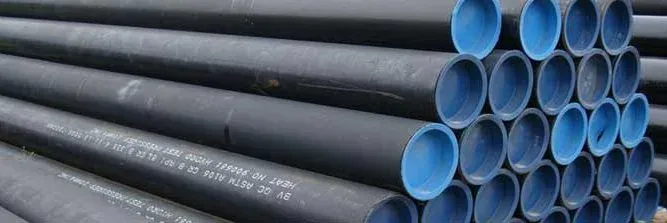 ASTM A53 PipesThis specification applies to pipe for conveying gas, water, oil, and other fluids. ASTM A53 pipes serve plumbing, HVAC, fire protection, and structural applications. The main characteristics of A53 pipe are described below.
Types
ASTM A53 specification covers two types of pipes:
| Type | Manufacturing Method |
|---|---|
| Type F | Furnace-butt welded pipe with a continuous weld along the length of the pipe |
| Type E | Electric-resistance-welded pipe with a longitudinal resistance weld |
| Type S | Seamless pipe, produced by hot-working the steel and then cold-finishing it to produce the desired shape, dimensions, and properties |
Grades
ASTM A53 pipes are available in three grades:
| Grade | Description |
|---|---|
| Grade A | Suitable for low-pressure and non-critical applications |
| Grade B | The most commonly used; suitable for general-purpose applications, including structural and mechanical applications |
| Grade C | Not commonly used; suitable for certain specific applications that require higher tensile strength or enhanced corrosion resistance |
Dimensions and Sizes
ASTM A53 pipes range from 1/8 inch to 26 inches in nominal diameter. Wall thickness varies by nominal pipe size and grade.
Coatings
ASTM A53 pipes can be supplied with black or hot-dipped galvanized coatings. Galvanized pipes receive a zinc layer that protects against corrosion and rust, which makes them a practical choice for outdoor and corrosive environments.
Applications
ASTM A53 pipes are used in the following applications:
- Plumbing and water distribution systems
- HVAC systems for heating and cooling
- Fire protection systems, including sprinkler and standpipe systems
- Structural applications, such as building frames, columns, and supports
- Oil and gas pipelines for conveying fluids and gases
Quality Control
The ASTM A53 specification sets requirements for chemical composition, mechanical properties, dimensions, tolerances, and testing. Manufacturers must meet these requirements to produce pipe that conforms to the standard.
A53 pipes handle low-to-medium pressure fluid service and mechanical applications. They can be welded, flanged, and formed as needed.
The ASME B36.10 specification covers A53 pipe dimensions (and weights per meter, in kg. and pounds).
ASTM A53 Chemical Composition
There are two ASTM A53 pipes grades, i.e. grades A and B. The two grades differ slightly in chemical composition (mainly Carbon and Manganese content) and mechanical properties, as detailed in the tables below:
| Max. values (%) | Type S Grade A | Type S Grade B | Type E Grade A | Type E Grade B | Type F Grade A |
|---|---|---|---|---|---|
| Carbon | 0.25 | 0.30 | 0.25 | 0.30 | 0.30 |
| Manganese | 0.95 | 1.20 | 0.95 | 1.20 | 1.20 |
| Phosphorous | 0.05 | 0.05 | 0.05 | 0.05 | 0.05 |
| Sulfur | 0.045 | 0.045 | 0.045 | 0.045 | 0.045 |
| Copper | 0.40 | 0.40 | 0.40 | 0.40 | 0.40 |
| Nickel | 0.40 | 0.40 | 0.40 | 0.40 | 0.40 |
| Chromium | 0.40 | 0.40 | 0.40 | 0.40 | 0.40 |
| Molybdenum | 0.15 | 0.15 | 0.15 | 0.15 | 0.15 |
| Vanadium | 0.08 | 0.08 | 0.08 | 0.08 | 0.08 |
A53 Gr. A/B Pipe Mechanical Properties
| Seamless and ERW | A53 Grade A | A53 Grade B |
|---|---|---|
| Tensile Strength, min, psi | 48,000 | 60,000 |
| Yield Strength | 30,000 | 35,000 |
A53 Pipe Physical Properties
| Property | Value |
|---|---|
| Density at 20°C | 7.85 kg/dm³ |
| Modulus of elasticity at 20°C | 210 kN/mm² |
| Modulus of elasticity at 300°C | 192 kN/mm² |
| Modulus of elasticity at 400°C | 184 kN/mm² |
| Modulus of elasticity at 450°C | 179 kN/mm² |
| Thermal conductivity at 20°C | 51 W/m·K |
| Spec. thermal capacity at 20°C | 461 J/kg·K |
| Spec. electrical resistivity at 20°C | 0.20 Ω·mm²/m |
Hot Forming and Heat Treatment
| Process | Temperature | Cooling |
|---|---|---|
| Hot forming | 1100-950°C | Air |
| Normalizing | 890-950°C | Air |
| Stress-relieving anneal | 600-650°C | Air |
Notes: 1) Normalizing: Holding time 1 minute per mm plate thickness, minimum 30 minutes. 2) Stress-relieving anneal: Holding time 1-2 minutes per mm plate thickness, minimum 30 minutes.
Tolerances
The tolerances for ASTM A53 - ASME SA53 pipes are:
- wall thickness: the thickness of the pipe (“WT”) shall be, at any point, not less than the nominal pipe size minus 12.5% (a wt of NPS -13% would not be, for instance, acceptable)
- weight per foot: + / - 10%
Testing Requirements
Below are the required physical strength requirements under ASTM A53 Type E for grades A and B.
| Test | ASTM A53 Grade A | ASTM A53 Grade B |
|---|---|---|
| Yield | 30,000 psi | 35,000 psi |
| Tensile | 48,000 psi | 60,000 psi |
| Elongation | Determined by formula | Determined by formula |
In addition to the chemical and physical analysis, the following tests are required under ASTM A53:
| Test | Test ASTM A53 - ASME SA53 |
|---|---|
| Flattening | Bend Test (Less than or equal to 2.375″ OD) * |
| Hydrostatic | Transverse Weld Tension (Equal to or greater than 8.625″ OD) |
Pipe End Types
- Pipe schedule below 0.500 inches and schedule STD / XS pipes: plain or beveled ends
- Pipe schedule above 0.500 inches and schedule XXS: Squared cut plain ends
If pipes are supplied with threaded ends, protection for threads is mandatory for pipes above 4 inches.
Marking
Each length of pipe (or bundle for smaller diameters) shall have the following markings applied:
- Manufacturer name
- A53 type (S, E, F)
- Diameter and schedule (from 10 to 160 and XXS)
- Designation “ASTM A53”
- Pipe length
- Heat number
It is frequent to find pipes on the market pipes that comply, at the same time, with multiple standards: A53, A106, API 5L Gr. B. Such compliance is shown as a mark on the pipe itself.
Galvanized Pipe (ASTM A53)
General Info: ASTM A53 Galvanized Pipes
What are galvanized pipes?
Galvanized pipes are steel pipes that have been hot-dipped in a protective zinc coating to prevent corrosion and rust (the process is called “hot-dip galvanization”). Galvanized pipes were introduced in the sixties as an alternative to lead pipes for water transmission and distribution. After that, they have been used also for sewerage applications, firefighting, and general plumbing systems.
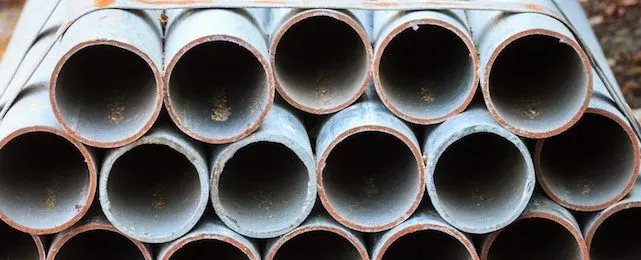
During the galvanization process, the zinc coating applies both to the outside and the inside of the pipe. The standard zinc coating is between 1.6 and 1.8 oz per square foot.
Galvanized pipes show long-lasting durability, improved resistance to corrosion compared to standard black steel, and are available at a relatively cheap price (and good toughness) compared to alternative metals (the price of galvanized pipe vs copper maybe, to give a general indication, 6 times lower per metric ton). As a rule of thumb, the galvanized price is between 40 and 50% higher than the price of black carbon pipes (the application of a zinc coating requires the transportation of the bare pipe to the galvanization plant, the application of zinc raw material on the pipe and other finishing activities).
On the other side, galvanized pipes are heavy, difficult to repair, and tend to develop blockages over time. The internal part of the pipe is subject to corrosion, and it’s not infrequent to find completely rusted galvanized pipes a few years after their installation.
ASTM A123, A153 and A53 Comparison
First and foremost, there is a difference between ASTM A53 and ASTM A153. Companies specialized in pipe galvanization are familiar with the ASTM A153 specification (“Standard Specification for Zinc Coating Hot-Dip) on Iron and Steel Hardware”.
Section 17 of the more general ASTM A53 specification, sets requirements for galvanized pipe, i.e. it requires the pipe to be hot-dip galvanized with a zinc grade by the B6 specification (Standard Specification for Zinc ) and specify the minimum weight per unit area of the coating.
The ASTM A53 specification does not set requirements related to the finishing, the appearance, or the adherence of the galvanized coating that is instead well defined in the ASTM A123 specification (Standard Specification for Zinc, Hot-Dip Galvanized, Coatings on Iron and Steel Product).
Further, the weight per unit area of the coating defined in the ASTM A53 specification corresponds to the minimum coating thickness requirements of ASTM A123. Therefore, the ASTM A123 specification is more stringent than ASTM A53 concerning the galvanized coating and whenever a pipe is galvanized according to ASTM A123, it meets the requirements of section 17 of ASTM A53 as well.
Conclusion: when a buyer requires galvanized pipes according to A53, a galvanization process in line with ASTM A123 meets the looser galvanization requirements set by ASTM A53.A
ASTM A106 Pipe
General Info: ASTM A106 Pipes
ASTM A106 is a standard specification for seamless carbon steel pipe for high-temperature service.
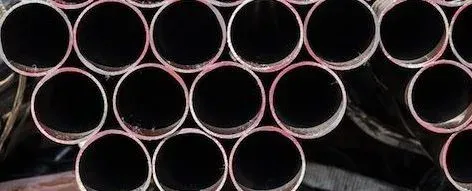
This specification covers pipe used in oil and gas, petrochemicals, power generation, and refineries. ASTM A106 pipes are suitable for bending, flanging, and similar forming operations, and for welding. The primary characteristics of A106 pipe are outlined below.
Types
ASTM A106 specification covers seamless carbon steel pipes for high-temperature service. There are three grades of ASTM A106 pipes:
| Grade | Description | Min. Tensile Strength |
|---|---|---|
| Grade A | Suitable for bending, flanging, and similar forming operations, and for welding | 48,000 psi (330 MPa) |
| Grade B | Suitable for bending, flanging, and similar forming operations, and for welding | 60,000 psi (415 MPa) |
| Grade C | Suitable for flanging and similar forming operations, and for welding | 70,000 psi (485 MPa) |
Chemical Composition (Overview)
The chemical composition of ASTM A106 pipes varies by grade. Typical composition ranges include:
| Element | Grade A | Grade B | Grade C |
|---|---|---|---|
| Carbon (C) | Max 0.30% | Max 0.35% | Max 0.35% |
| Manganese (Mn) | 0.29-1.06% | 0.29-1.06% | 0.29-1.06% |
| Phosphorus (P) | Max 0.035% | Max 0.035% | Max 0.035% |
| Sulfur (S) | Max 0.035% | Max 0.035% | Max 0.035% |
| Silicon (Si) | Min 0.10% | Min 0.10% | Min 0.10% |
Dimensions and Sizes
ASTM A106 pipes range from 1/8 inch to 26 inches in nominal diameter. Wall thickness varies by nominal pipe size and grade.
Applications
ASTM A106 pipes serve high-temperature applications such as:
- Oil and gas pipelines
- Power plants
- Refineries
- Petrochemical plants
- Boiler tubes
- Heat exchangers
- High-pressure applications
Testing and Inspection
ASTM A106 pipes undergo hydrostatic testing, non-destructive testing (NDT), dimensional inspection, tensile testing, hardness testing, and chemical analysis to verify conformance to the specification.
A106 is the go-to specification for high-temperature, high-pressure carbon steel piping. When specifying A106 pipe, select the appropriate grade, size, wall thickness, and end connection based on the service conditions.
The ASME B36.10 specification covers the ASTM A106 grade B pipe dimensions (and weights per meter, in kg. and pounds).
A106 Pipe Chemical Composition
ASTM A106 pipes are manufactured in grades A, B, and C.
NPS 1-1/2″ and below are available in the hot-finished or cold-drawn type. Pipes of NPS 2 inches and above are generally hot rolled. ASTM A106 pipes are produced out of killed steel and are suited for high-temperature service (for low temperatures, ASTM A333 pipes should be used instead).
The chemical composition of the three grades of ASTM A106 is listed in the table below:
| Element | C max | Mn | P max | S max | Si min | Cr max | Cu max | Mo max | Ni max | V max |
|---|---|---|---|---|---|---|---|---|---|---|
| ASTM A106 Grade A | 0.25 | 0.27-0.93 | 0.035 | 0.035 | 0.10 | 0.40 | 0.40 | 0.15 | 0.40 | 0.08 |
| ASTM A106 Grade B | 0.30 | 0.29-1.06 | 0.035 | 0.035 | 0.10 | 0.40 | 0.40 | 0.15 | 0.40 | 0.08 |
| ASTM A106 Grade C | 0.35 | 0.29-1.06 | 0.035 | 0.035 | 0.10 | 0.40 | 0.40 | 0.15 | 0.40 | 0.08 |
A106 Pipe Tolerance (ASTM)
The manufacturing tolerances of ASTM A106 pipes are shown in the tables below:
| Parameter | Tolerance |
|---|---|
| Diameter | See diameter tolerance table below |
| Wall thickness | Min. WT shall not be below nominal pipe size minus 12.5% at any point |
| Weight | -3.5% to +10% vs. specification |
The weight test can be executed on lots for smaller nominal pipe sizes (below 4 inches) but must be executed pipe by pipe for higher diameters (6 inches and above).
| Pipe Size (NPS) | Over (inch) | Over (mm) | Under (inch) | Under (mm) |
|---|---|---|---|---|
| 1/8 to 1-1/2 [6 to 40] incl | 1/64 (0.015) | 0.4 | 1/64 (0.015) | 0.4 |
| Over 1-1/2 to 4 [40 to 100] incl | 1/32 (0.031) | 0.8 | 1/32 (0.031) | 0.8 |
| Over 4 to 8 [100 to 200] incl | 1/16 (0.062) | 1.6 | 1/32 (0.031) | 0.8 |
| Over 8 to 18 [200 to 450] incl | 3/32 (0.093) | 2.4 | 1/32 (0.031) | 0.8 |
| Over 18 to 26 [450 to 650] incl | 1/8 (0.125) | 3.2 | 1/32 (0.031) | 0.8 |
| Over 26 to 34 [650 to 859] incl | 5/32 (0.156) | 4.0 | 1/32 (0.031) | 0.8 |
| Over 34 to 48 [850 to 1200] incl | 3/16 (0.187) | 4.8 | 1/32 (0.031) | 0.8 |
A106 Gr. A/B Mechanical Properties
| ASTM A106 pipe | A106 Grade A | A106 Grade B | A106 Grade C |
|---|---|---|---|
| Tensile Strength, min., psi | 48,000 | 60,000 | 70,000 |
| Yield Strength, min., psi | 30,000 | 35,000 | 40,000 |
Testing Requirements
| Test | NPS | Frequency |
|---|---|---|
| Tensile Test | 5 and smaller | One length from each lot |
| Tensile Test | Over 5 | One length from each lot of 500 or fraction |
ASTM A333 Pipe

ASTM A333 pipe for low-temperature service (Gr. 6)
ASTM A333 pipes are designed for low-temperature applications such as cryogenic storage tanks, LNG (liquefied natural gas) plants, and refrigeration systems. The main characteristics of A333 pipe are described below.
Types
ASTM A333 specification covers several grades of seamless and welded steel pipe:
| Grade | Description |
|---|---|
| Grade 1 | Seamless and welded carbon and alloy steel pipe intended for use at low temperatures |
| Grade 3 | Intended for low temperatures with the addition of 0.12-0.21% manganese and 0.9-1.1% nickel |
| Grade 4 | Intended for low temperatures with the addition of 0.46-0.70% manganese, 0.40-0.60% copper, and 0.20-0.30% nickel |
| Grade 6 | Intended for low temperatures with the addition of 0.30-0.60% manganese, 0.60-1.35% silicon, and 0.04% phosphorus and sulfur |
Chemical Composition (Overview)
The chemical composition of ASTM A333 pipes varies by grade, with controlled amounts of carbon, manganese, phosphorus, sulfur, silicon, nickel, and other alloying elements.
Maximum carbon content reaches 0.30% depending on grade, while maximum manganese content ranges from 0.40% to 1.35%. Other elements are present in smaller amounts to achieve the required low-temperature toughness.
Mechanical Properties (Overview)
ASTM A333 pipes undergo tensile, yield, elongation, and impact testing at low temperatures.
Each grade has specific mechanical property requirements, including minimum tensile strength, minimum yield strength, and minimum elongation.
Dimensions and Sizes
ASTM A333 pipes range from 1/8 inch to 26 inches in nominal diameter. Wall thickness varies by nominal pipe size and grade.
Applications
ASTM A333 pipes serve low-temperature applications, including:
- Cryogenic storage tanks
- LNG (liquefied natural gas) plants
- Refrigeration systems
- Low-temperature process piping
- Low-temperature service in pressure systems
Welding
ASTM A333 pipes are weldable with conventional methods. However, preheating and post-weld heat treatment may be necessary to prevent cracking and maintain proper mechanical properties, particularly for Grade 6 pipes.
A333 is the standard choice wherever cryogenic conditions or low-temperature process requirements apply. Select the appropriate grade, size, wall thickness, and end connection based on the minimum design temperature and pressure.
ASTM A333 Chemical Composition
| Element | Grade 1 | Grade 3 | Grade 4 | Grade 6 | Grade 7 | Grade 8 | Grade 9 | Grade 10 | Grade 11 |
|---|---|---|---|---|---|---|---|---|---|
| C | 0.30 | 0.19 | 0.12 | 0.30 | 0.19 | 0.13 | 0.20 | 0.20 | 0.10 |
| Mn | 0.40-1.06 | 0.31-0.64 | 0.50-1.05 | 0.29-1.06 | 0.90 | 0.90 | 0.40-1.06 | 1.15-1.50 | 0.60 |
| P | 0.025 | 0.025 | 0.025 | 0.025 | 0.025 | 0.025 | 0.025 | 0.035 | 0.025 |
| S | 0.025 | 0.025 | 0.025 | 0.025 | 0.025 | 0.025 | 0.025 | 0.015 | 0.025 |
| Si | … | 0.18-0.37 | 0.08-0.37 | 0.10 min | 0.13-0.32 | 0.13-0.32 | … | 0.10-0.35 | 0.35 |
| Ni | … | 3.18-3.82 | 0.47-0.98 | 0.40 | 2.03-2.57 | 8.40-9.60 | 1.60-2.24 | 0.25 | 35.0-37.0 |
| Cr | … | … | 0.44-1.01 | 0.30 | … | … | … | 0.15 | 0.50 |
| Cu | … | … | 0.40-0.75 | 0.40 | … | … | 0.75-1.25 | 0.15 | … |
| Al | … | … | 0.04-0.30 | … | … | … | … | 0.06 | … |
| V | … | … | … | 0.08 | … | … | … | 0.12 | … |
| Cb | … | … | … | 0.02 | … | … | … | 0.05 | … |
| Mo | … | … | … | 0.12 | … | … | … | 0.05 | 0.50 |
| Co | … | … | … | … | … | … | … | … | 0.50 |
*For Grade 1 and 6, each reduction of 0.01% C below 0.30%, an increase of 0.05 % Mn above 1.06 % would be permitted to a max. of 1.35%. *For Grade 6, the limit for columbium may be increased up to 0.05 % on heat analysis and 0.06 % on product analysis. *Generally, the carbon equivalent C.E = [C + Mn/6 + (Cr + Mo + V)/5 + (Ni + Cu)/15] shall not exceed 0.43% by heat analysis.
ASTM A333 Mechanical Properties
| Grade | Tensile (psi) | Tensile (MPa) | Yield (psi) | Yield (MPa) | Elong. Long. % | Elong. Trans. % |
|---|---|---|---|---|---|---|
| Grade 1 | 55 000 | 380 | 30 000 | 205 | 35 | 25 |
| Grade 3 | 65 000 | 450 | 35 000 | 240 | 30 | 20 |
| Grade 4 | 60 000 | 415 | 35 000 | 240 | 30 | 16.5 |
| Grade 6 | 60 000 | 415 | 35 000 | 240 | 30 | 16.5 |
| Grade 7 | 65 000 | 450 | 35 000 | 240 | 30 | 22 |
| Grade 8 | 100 000 | 690 | 75 000 | 515 | 22 | … |
| Grade 9 | 63 000 | 435 | 46 000 | 315 | 28 | … |
| Grade 10 | 80 000 | 550 | 65 000 | 450 | 22 | … |
| Grade 11 | 65 000 | 450 | 35 000 | 240 | 18 | … |
*The elongation values are furnished based on standard round 2-inch or 50 mm(or 4D) specimens. *Elongation of Grade 11 is for all walls and small sizes tested in full section.
Charpy V-notch Impact Tests A333 Pipes
| Specimen Size (mm) | Min. Avg. (ft·lbf) | Min. Avg. (J) | Min. Single (ft·lbf) | Min. Single (J) |
|---|---|---|---|---|
| 10 by 10 | 13 | 18 | 10 | 14 |
| 10 by 7.5 | 10 | 14 | 8 | 11 |
| 10 by 6.67 | 9 | 12 | 7 | 9 |
| 10 by 5 | 7 | 9 | 5 | 7 |
| 10 by 3.33 | 5 | 7 | 3 | 4 |
| 10 by 2.5 | 4 | 5 | 3 | 4 |
*A denotes minimum average notched bar impact value of each set of three specimens. *B denotes minimum notched bar impact value of one specimen only of a set.
| Grade | Min. Temp. (°F) | Min. Temp. (°C) |
|---|---|---|
| 1 | -50 | -45 |
| 3 | -150 | -100 |
| 4 | -150 | -100 |
| 6 | -50 | -45 |
| 7 | -100 | -75 |
| 8 | -320 | -195 |
| 9 | -100 | -75 |
| 10 | -75 | -60 |
| 11 | -320 | -195 |
- Impact tests specified for temperatures lower than 70 °F [20 °C] should be made with precautions.
Heat Treatment Pipes ASTM A333
Heat treatment of pipes manufactured to ASTM A333 controls their microstructure and enhances their mechanical properties. Below is an overview of the heat treatment requirements.
| Treatment | Applicable Grades | Temperature | Cooling Method |
|---|---|---|---|
| Normalization | All except Grades 8 and 11 | Min. 1500 °F [815 °C] | Air or controlled furnace cooling; optional re-heat to tempering temperature |
| Hot Finishing (seamless only) | As required | 1550-1750 °F [845-945 °C] | Air or controlled atmosphere furnace from min. 1550 °F [845 °C] |
| Quench and Temper | Grades 1, 6, 10 (seamless) | Min. 1500 °F [815 °C] | Quenching in liquid, then re-heat to tempering temperature |
| Quench/Temper or Double Normalization | Grade 8 | Per manufacturer | Per method selected |
| Annealing + Normalization | Grade 11 | 1400-1600 °F [760-870 °C] | Per specification |
Normalization
Pipes, both seamless and welded, except for Grades 8 and 11, must undergo normalization. This process involves heating the pipes to a uniform temperature of at least 1500 °F [815 °C]. After heating, the pipes are cooled either in the air or in the controlled cooling chamber of a furnace. Alternatively, the pipes can be re-heated to a suitable tempering temperature at the discretion of the manufacturer.
Hot Finishing (Seamless Pipes Only)
For seamless pipes, an additional step known as hot finishing may be required. This involves reheating the pipes to a finishing temperature range of 1550 to 1750 °F [845 to 945 °C]. Hot working and temperature control during the hot-finishing operation are carefully managed to achieve the target microstructure and properties.
Following hot finishing, the pipes are cooled either in air or in a controlled atmosphere furnace from an initial temperature of no less than 1550 °F [845 °C]. Alternatively, the pipes can be re-heated to a suitable tempering temperature.
Grade-Specific Treatments
Seamless pipes of Grades 1, 6, and 10 may undergo heat treatment by being heated to a uniform temperature of at least 1500 °F [815 °C], followed by quenching in a liquid and subsequent reheating to an appropriate tempering temperature.
Special Considerations for Grades 8 and 11
ASTM A333 Grade 8 pipes require heat treatment by either quenching and tempering or double normalization and tempering methods. Grade 11 pipes, when required, shall undergo annealing followed by normalization within the temperature range of 1400 to 1600 °F [760 to 870 °C].
Proper heat treatment is critical for ASTM A333 pipes to meet the specified tensile strength, yield strength, elongation, and impact toughness values, and to develop the correct microstructure for the intended low-temperature service.
Conclusion
ASTM A53 and ASTM A106 are both carbon steel pipe specifications, but they target different service conditions. A53 covers general-purpose, low-to-medium pressure applications and includes both seamless and welded types. A106 is limited to seamless pipe and is the standard choice for high-temperature, high-pressure service. ASTM A333 fills the opposite end of the temperature spectrum, covering low-temperature and cryogenic applications, with Grade 6 being the most commonly specified.
Leave a Comment
Have a question or feedback? Send us a message.
Previous Comments
Dear Manager, Good day ! We are from Shinestar Steel Pipe Corporation, a leading steel pipe manufacture in South of China. After some research of your company, may be you will interest in our following products which we could supply with the most competitive conditions. As an approved supplier of EIED,NIOC in Iran and PDVSA in Venezuela, we are specializing in processing SMLS/SSAW/LSAW/ERW to meet our customer requirement. Hope to find a way to cooperate with you. And waiting for your feedback.
sir i need pipe c.s sch 80 from size 1" to 10 " specification all the pipe pipe c.s smless (B- E ) outside & inside of PIPE BROTECTED AGINST RUST ASTM A106 GR B SCH 80 i need certificated and country name 1 – 1″ qty : 150 mtr 2- 2″ qty: 198 mtr 3- 3″ qty: 150 mtr 4- 4″ qty: 102 mtr 5- 6″ qty: 60 mtr 6- 8" qty 60 mtr 7- 10″ qty 42 mtr thank you pls reply Best Regards Diab M. Hassan [email protected] Iraq / Arbil/kasnisain./ozil city /House No.4/105 Mobil:+9647707543446 – +9647712324945Mr. 13 -6-2019
We are manufacturer of Hot Finished Pipe as per ASTM A 106 GR.B / A53 ALSO PLEASE SEND THE ENQUIRY.
Dear Manager, Hello! We are Tianjin Huayuan Xingye Company, a Chinese steel pipe manufacturer. After doing some research on your company, you may be interested in our following products, which we can supply at the most competitive terms. As an approved supplier of Iran EIED, NIOC and Venezuela PDVSA, we specialize in processing ASME/ASTM to meet customer requirements. Hope to find a way to cooperate with you. And waiting for your feedback.
This blog on ASTM carbon steel pipes is a great resource for anyone looking to understand the various grades like A53, A106, and A333, along with their specifications and applications. The clear explanation of how these materials are used in oil and gas pipelines, as well as in other industries, was exactly the kind of information I needed. It also covers their quality standards and manufacturing processes. If you're looking for detailed insights on carbon steel pipes, this is a must-read.