

Forged Flange Materials: A105-A182
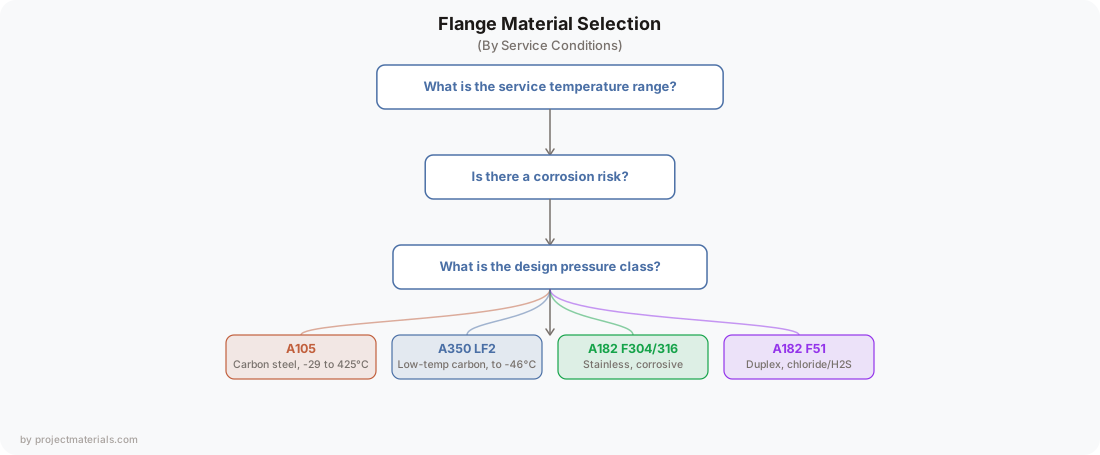
Carbon Steel Flanges
When to Use Carbon Steel

| Condition | CS Flanges Suitable? |
|---|---|
| Moderate to high pressure | Yes |
| Ambient to high temperature | Yes (to 425°C) |
| Non-corrosive/mildly corrosive | Yes |
| Highly corrosive (acids, chlorides) | No-use SS or alloy |
| Cost-sensitive projects | Yes (most economical) |
Applications: Oil & gas, petrochemical, water treatment, steam/gas distribution, structural.
Carbon Steel Grades
Chemical Composition ASTM A105, A350, A694
ASTM A105 (High-temperature carbon steel flange material)
| Grade | C | Mn | P | S | Si | Cu | Ni | Cr | Mo | V |
|---|---|---|---|---|---|---|---|---|---|---|
| A105 | 0.35 | 0.60-1.05 | 0.035 | 0.040 | 0.10-0.35 | 0.40 | 0.40 | 0.30 | 0.12 | 0.08 |
ASTM A350 (Low-Temperature carbon steel flange material)
| C% | Mn% | Si% | S% | P% | Cr% | Ni% | |
|---|---|---|---|---|---|---|---|
| A350 LF1 | 0.30 max | 0.6/1.35 | .15/.30 | .040 max | .035 max | 0.30 max | 0.40 max |
| A350 LF2 | 0.30 max | 0.6/1.35 | .15/.30 | .040 max | .035 max | 0.30 max | 0.40 max |
| A350 LF3 | 0.20 max | 0.9 | .20/.35 | .040 max | .035 max | 0.30 max | 3.3/3.7 |
ASTM A694 (High-yield carbon steel flanges)
| C | Mn | P | S | Si | |
|---|---|---|---|---|---|
| ASTM A694 F42 | 0.26-0.265 | 1.60-1.64 | 0.025-0.030 | 0.025-0.030 | 0.15-0.35 |
| ASTM A694 F52 | 0.26-0.265 | 1.60-1.64 | 0.025-0.030 | 0.025-0.030 | 0.15-0.35 |
| ASTM A694 F60 | 0.26-0.265 | 1.60-1.64 | 0.025-0.030 | 0.025-0.030 | 0.15-0.35 |
| ASTM A694 F65 | 0.26-0.265 | 1.60-1.64 | 0.025-0.030 | 0.025-0.030 | 0.15-0.35 |
Mechanical Properties A105, A350, A694
ASTM A105 (High-temperature carbon steel flange material)
| Property | ASTM A105 | ASTM A350-LF2 |
|---|---|---|
| Tensile Strength Min, psi | 70,000 | 70,000-95,000 |
| Tensile Strength Min, N/mm² | 485 | 485-655 |
| Yield Strength Min, psi | 36,000 | 36,000 |
| Yield Strength Min, N/mm² | 250 | 250 |
| Elongation (%) | 22 | 22 |
| Reduction of Area (%) | 30 | 30 |
| Hardness, maximum | 187 | - |
| CVN at -50℉ | - | 15/12 ft-lbs (20/16 joules) |
ASTM A694 (High-yield carbon steel flanges)
| Grade | Min Yield Strength ksi [MPa] | Min Tensile Strength ksi [MPa] | Elongation min % |
|---|---|---|---|
| A694 F42 | 42 [290] | 60 [415] | 20 |
| A694 F46 | 46 [315] | 60 [415] | 20 |
| A694 F48 | 48 [330] | 62 [425] | 20 |
| A694 F50 | 50 [345] | 64 [440] | 20 |
| A694 F52 | 52 [360] | 66 [455] | 20 |
| A694 F56 | 56 [385] | 68 [470] | 20 |
| A694 F60 | 60 [415] | 75 [515] | 20 |
| A694 F65 | 65 [450] | 77 [530] | 20 |
| A694 F70 | 70 [485] | 82 [565] | 18 |
Alloy Steel Flanges
When to Use Alloy Steel (Chrome-Moly)

Chrome-moly flanges (A182 F1, F5, F9, F11, F22, F91) match A335 alloy pipes. They offer high-temperature strength, oxidation resistance, and better corrosion resistance than carbon steel.
| Application | Why Alloy Steel |
|---|---|
| High temperature (to 650°C) | Cr/Mo improves creep resistance |
| High pressure | Enhanced mechanical strength |
| Refineries/chemical plants | Resists thermal stress |
| Power generation | Boilers, turbines, heat exchangers |
| Mildly corrosive | Better oxidation resistance than CS |
Chemical Composition ASTM A182 F5, F9, F11, F22
| Element | F11 CL2 | F22 CL3 | F5 | F9 |
|---|---|---|---|---|
| Carbon | 0.10-0.20 | 0.05-0.15 | 0.15 max | 0.15 max |
| Manganese | 0.30-0.80 | 0.30-0.60 | 0.30-0.60 | 0.30-0.60 |
| Phosphorus max | 0.040 | 0.040 | 0.03 | 0.030 |
| Sulfur max | 0.040 | 0.040 | 0.03 | 0.030 |
| Silicon | 0.50-1.00 | 0.50 max | 0.50 max | 0.50-1.00 |
| Nickel max | - | - | 0.50 | - |
| Chromium | 1.00-1.50 | 2.00-2.50 | 4.00-6.00 | 8.0-10.0 |
| Molybdenum | 0.44-0.65 | 0.87-1.13 | 0.44-0.65 | 0.90-1.10 |
| Copper max | - | - | - | - |
| Columbium max | - | - | - | - |
| Vanadium max | - | - | - | - |
Mechanical Properties A182
| Property | F11 CL2 | F22 CL3 | F5 | F9 |
|---|---|---|---|---|
| Tensile Strength psi (MPa) | 70,000 (485) | 75,000 (515) | 70,000 (485) | 85,000 (585) |
| Yield Strength psi min | 40,000 (275) | 45,000 (310) | 40,000 (275) | 55,000 (380) |
| Elongation 2” % min | 20 | 20 | 20 | 20 |
| Reduction Area % min | 30 | 30 | 35 | 40 |
| Hardness (HB) max | 143-207 | 156-207 | 143-217 | 179-217 |
Recommended service for alloy steel flange material grades ASTM A182:
| ASTM A182 ALLOY STEEL FLANGE | TRADE DESIGNATION | RECOMMENDED SERVICE |
|---|---|---|
| A182 F1 | C-1/2 Mo Low Alloy Steel | Non-corrosive applications Including water, oil, and gases at temperatures between -29 ~ 593ºC* (Not prolonged use > 470ºC). |
| A182 F2 | 0.75% Ni; Mo; 0.75% Cr Low Alloy Steel | Non-corrosive applications including water, oil, and gases at temperatures F2:-29ºC ~ 538ºC, WC5: -29ºC ~ 575ºC |
| A182 F11 | 1 1/4% Chrome; 1/2% Moly Low Alloy Steel | Non-corrosive applications inclusive of water, oil, and gases at temperatures between -30ºC (-20ºF) and +593ºC (+1100ºF). |
| A182 F22 | 2 1/4% Chrome Low Alloy Steel | Non-corrosive applications inclusive of water, oil, and gases at temperatures between -30ºC (-20ºF) and +593ºC (+1100ºF). |
| A182 F5/F5a | 5% Chrome; 1/2% Moly, Medium Alloy Steel | Mild corrosive or erosive applications as well as non-corrosive applications at temperatures between -30ºC (-20ºF) and +650ºC (+1200ºF). |
| A182 F9 | 9% Chrome; 1% Moly, Medium Alloy Steel | Mild corrosive or erosive applications as well as non-corrosive applications at temperatures between -30ºC (-20ºF) and +650ºC (+1200ºF). |
| A182 F91 | 9% Chrome; 1% Moly; V-N, Medium Alloy Steel | Mild corrosive or erosive applications as well as non-corrosive applications at temperatures between -30ºC (-20ºF) and +650ºC (+1200ºF). |
Stainless Steel Flanges
When to Use Stainless Steel

Stainless steel flanges (A182 F304/316/321) match A312 SS pipes. High chromium content provides excellent corrosion resistance.
| Application | Why Stainless Steel |
|---|---|
| Corrosive environments | Resists acids, alkalis, salts |
| Food & beverage | Non-reactive, easy to clean/sterilize |
| Pharmaceutical/biotech | Maintains purity, no contamination |
| High temperature | 316/310/321 resist scaling |
| Cryogenic (LNG) | Austenitic grades retain toughness |
| Marine/coastal | Saltwater corrosion resistance |
Grade selection:
- 304/304L: General purpose, good corrosion resistance
- 316/316L: Better resistance (Mo content), chloride environments
- 321: Stabilized for high-temperature service
Cost factors: SS prices depend on Ni, Cr, Mo content fluctuating on the LME.
Chemical Composition ASTM A182 F304/F316/F321
ASTM A182 Stainless Steel Flanges Materials Composition, %
| Grade | C | Mn | P | S | Si | Ni | Cr | Mo | Nb | Ti | Others |
|---|---|---|---|---|---|---|---|---|---|---|---|
| F304(1) | 0.08 | 2.0 | 0.045 | 0.030 | 1.0 | 8.0-11.0 | 18.0-20.0 | ||||
| F304H | 0.04-0.10 | 2.0 | 0.045 | 0.030 | 1.0 | 8.0-11.0 | 18.0-20.0 | ||||
| F304L(1) | 0.030 | 2.0 | 0.045 | 0.030 | 1.0 | 8.0-13.0 | 18.0-20.0 | ||||
| F304N(2) | 0.08 | 2.0 | 0.045 | 0.030 | 1.0 | 8.0-10.5 | 18.0-20.0 | ||||
| F304LN(2) | 0.030 | 2.0 | 0.045 | 0.030 | 1.0 | 8.0-10.5 | 18.0-20.0 | ||||
| F309H | 0.04-0.10 | 2.0 | 0.045 | 0.030 | 1.0 | 12.0-15.0 | 22.0-24.0 | ||||
| F310 | 0.25 | 2.0 | 0.045 | 0.030 | 1.0 | 19.0-22.0 | 24.0-26.0 | ||||
| F310H | 0.04-0.10 | 2.0 | 0.045 | 0.030 | 1.0 | 19.0-22.0 | 24.0-26.0 | ||||
| F310MoLN | 0.030 | 2.0 | 0.030 | 0.015 | 0.40 | 21.0-23.0 | 24.0-26.0 | 2.0-3.0 | N 0.10-0.16 | ||
| F316 | 0.08 | 2.0 | 0.045 | 0.030 | 1.0 | 10.0-14.0 | 16.0-18.0 | 2.0-3.0 | |||
| F316H | 0.04-0.10 | 2.0 | 0.045 | 0.030 | 1.0 | 10.0-14.0 | 16.0-18.0 | 2.0-3.0 | |||
| F316L(1) | 0.030 | 2.0 | 0.045 | 0.030 | 1.0 | 10.0-15.0 | 16.0-18.0 | 2.0-3.0 | |||
| F316N(2) | 0.08 | 2.0 | 0.045 | 0.030 | 1.0 | 11.0-14.0 | 16.0-18.0 | 2.0-3.0 | |||
| F316LN(2) | 0.030 | 2.0 | 0.045 | 0.030 | 1.0 | 11.0-14.0 | 16.0-18.0 | 2.0-3.0 | |||
| F316Ti | 0.08 | 2.0 | 0.045 | 0.030 | 1.0 | 10.0-14.0 | 16.0-18.0 | 2.0-3.0 | (3) | N 0.10 max | |
| F317 | 0.08 | 2.0 | 0.045 | 0.030 | 1.0 | 11.0-15.0 | 18.0-20.0 | 3.0-4.0 | |||
| F317L | 0.030 | 2.0 | 0.045 | 0.030 | 1.0 | 11.0-15.0 | 18.0-20.0 | 3.0-4.0 | |||
| F321 | 0.08 | 2.0 | 0.045 | 0.030 | 1.0 | 9.0-12.0 | 17.0-19.0 | (4) | |||
| F321H | 0.04-0.10 | 2.0 | 0.045 | 0.030 | 1.0 | 9.0-12.0 | 17.0-19.0 | (5) | |||
| F347 | 0.08 | 2.0 | 0.045 | 0.030 | 1.0 | 9.0-13.0 | 17.0-20.0 | (6) | |||
| F347H | 0.04-0.10 | 2.0 | 0.045 | 0.030 | 1.0 | 9.0-13.0 | 17.0-20.0 | (7) | |||
| F348 | 0.08 | 2.0 | 0.045 | 0.030 | 1.0 | 9.0-13.0 | 17.0-20.0 | (6) | Co 0.20 Ta 0.10 | ||
| F348H | 0.04-0.10 | 2.0 | 0.045 | 0.030 | 1.0 | 9.0-13.0 | 17.0-20.0 | (7) | Co 0.20 Ta 0.10 |
Notes:
- Grades F304, F304L, F316, and F316L shall have a maximum Nitrogen of 0.10%.
- Grades F304N, F316N, F304LN, and F316LN shall have a Nitrogen of 0.10 to 0.16%.
- Grade F316Ti shall have a Titanium content five times above the Carbon plus Nitrogen and not more than 0.70%.
- Grade F321 shall have a Titanium content five times above the Carbon and not more than 0.70%.
- Grade F321H shall have a Titanium content four times above the Carbon and not more than 0.70%.
- Grades F347 and F348 shall have a Niobium content ten times above the Carbon and not more than 1.10%.
- Grades F347H and F348H shall have a Niobium content above than eight times the Carbon and not more than 1.10%.
Mechanical Properties A182 F304/F316/F321
| ASTM A182 Grade | Minimum Tensile Strengthin MPa | Minimum Yield pointin Mpa | Minimum Elongationin % | Minimum Reduction of inmin, % |
|---|---|---|---|---|
| ASTM A182 F304 | 515 | 205 | 30 | 50 |
| ASTM A182 F304L | 485 | 170 | 30 | 50 |
| ASTM A182 F316 | 515 | 205 | 30 | 50 |
| ASTM A182 F316L | 485 | 170 | 30 | 50 |
| ASTM A182 F321 | 515 | 205 | 30 | 50 |
Recommended service for stainless steel flange materials:
| MATERIAL | MATERIAL GROUP | RECOMMENDED SERVICE |
|---|---|---|
| A182-F304 | 18% Cr, 8% Ni Stainless Steel | Corrosive services and atmospheres from -450°F to 1000°F (-268°C to 537°C) |
| A182-F316 | 18% Cr, 8% Ni, 2% Mo Stainless Steel | High resistance to corrosion from -450°F to 1000°F (-268°C to 537°C). |
ASTM vs. EN Stainless Steel Flange Materials
Flanges Material Grades: Comparison of European and American Standards
| Material Number | EN | ASTM |
|---|---|---|
| 1.4541 X 6 CrNiTi 18 10 | X6CrNiTi18-10 | A 182 Grade F321 |
| 1.4571 X 6 CrNiMoTi 17 12 2 | X6CrNiMoTi17-12-2 | A 182 Grade F316Ti |
| 1.4301 X 5 CrNi 18 10 | X5CrNi18-10 | A 182 Grade F304 |
| 1.4306 X 2 CrNi 19 11 | - | A 182 Grade F304L |
| 1.4307 | X2CrNi18-9 | A 182 Grade F304L |
| 1.4401 X 5 CrNiMo 17 12 2 | X5CrNiMo17-12-2 | A 182 Grade F316 |
| 1.4404 X 2 CrNiMo 17 13 2 | X2CrNiMo17-12-2 | A 182 Grade F316L |
| 1.4462 X 2 CrNiMoN 22 5 3 | X2CrNiMoN22-5-3 | A 182 Grade F51 (Duplex) |
| 1.4529 X 1 NiCrMoCuN 25 20 6 | X1NiCrMoCuN25-20-7 | UNS N 08926 |
| 1.4539 X 1 NiCrMoCuN 25 20 5 | X1NiCrMoCu25-20-5 | A 182 Grade F904L |
| 1.4547 | X1CrNiMoCuN20-18-7 | UNS S 31254 |
Duplex Flanges
When to Use Duplex/Super Duplex

Duplex flanges (A182 F51/F53/F55) match A790/A928 pipes. The austenite + ferrite microstructure provides:
- 2× strength of austenitic SS (304/316)
- Superior corrosion resistance to chlorides/sulfides
- Magnetic properties (unlike austenitic SS)
| Application | Why Duplex/Super Duplex |
|---|---|
| Chloride environments | Excellent pitting/crevice corrosion resistance |
| High-pressure systems | Mechanical strength >> standard SS |
| Offshore/marine | Seawater and H₂S resistance |
| Chemical processing | Handles aggressive chemicals |
| Desalination | Chloride corrosion resistance |
| Pollution control | Resists acidic flue gases |
| Grade | UNS | Cr | Mo | Ni | Cu |
|---|---|---|---|---|---|
| Duplex 2205 | S31803/S32205 | 21-23% | 2.5-3.5% | 4.5-6.5% | - |
| Super Duplex | S32750/S32760 | 24-26% | 3-5% | 5.5-8% | 0.5-3% |
Chemical Composition ASTM A182 Duplex and Super Duplex
| % | Duplex 2205(ASTM A182 UNS S31803 - UNS S32205) | Super DuplexASTM A182 UNS S32750 - 32760) |
|---|---|---|
| C | 0-0.03 | 0.03 max |
| Mn | 2.0 | 1.5 |
| Si | 1.0 | 0.8 |
| P | 0-0.03 | 0.035 |
| S | 0-0.02 | 0.02 |
| Cr | 21-23 | 24-26 |
| Mo | 2.5-3.5 | 3.0-5.0 |
| Ni | 4.5-6.5 | 5.5-8.0 |
| N | 0.08-0.2 | 0.2-0.35 |
| Cu | - | 0.5-3.0 |
The most widely used duplex flange grade is 2205, due to its superior corrosion resistance and mechanical strength. The designation “2205” refers to the chemical composition: 22% Chromium and 5% Nickel.
Super Duplex flanges offer even higher strength and corrosion resistance than standard duplex steel. The main difference is the addition of copper to the alloy (along with increased Chromium, Molybdenum, and Nickel). Copper gives Super Duplex improved resistance to hot chlorides and strong reducing acids such as sulphuric acid.
While UNS S31803/S32205 (duplex) and UNS S32750/S32760 (super duplex) are standard designations, most superalloy manufacturers use proprietary trade names (e.g., UR52N+ by Usinor/Arcelor, Ferralium, Zeron, Sandvik SAF 2205 22Cr).
Mechanical Properties A182 Duplex and Super Duplex
| Mechanical Properties | Duplex 2205(ASTM A182 UNS S31803 - UNS S32205) | Super DuplexASTM A182 UNS S32750 - 32760) |
|---|---|---|
| Tensile Strength (in MPa) | 620 | 770 |
| Proof Stress 0.2% (in MPa) | 450 | 550 |
| A5 Elongation (in %) | 25 | 25 |
| Physical Attribute | Duplex 2205(ASTM A182 UNS S31803 - UNS S32205) | Super DuplexASTM A182 UNS S32750 - 32760) |
|---|---|---|
| Density (g.cm3) | 7.805 | 7.810 |
| Modulus of Elasticity (GPa) | 200 | 205 |
| Electrical Resistivity (Ω.m) | 0.085×10⁻⁶ | 0.085×10⁻⁶ |
| Thermal Conductivity (W/m.K) | 19 at 100°C | 17 at 100°C |
| Thermal Expansion (m/m.K) | 13.7×10⁻⁶ to 100°C | 13.5×10⁻⁶ to 200°C |
Nickel Alloy Flanges
When to Use Nickel Alloys
Nickel alloy flanges (Inconel, Hastelloy, Monel, Alloy 20) are specified when other materials cannot withstand the corrosion, temperature, or pressure demands.
| Application | Why Nickel Alloy |
|---|---|
| Extreme corrosion | Resists acids, alkalis, chlorides |
| High temperature | Maintains strength at elevated temps |
| Cryogenic (LNG) | Retains toughness at low temps |
| Marine/offshore | Seawater corrosion resistance |
| Nuclear reactors | Withstands radioactive environments |
| Pollution control | Resists acidic flue gases |
ASTM Specifications for Nickel Alloy Flanges
| ASTM Specification | Flange Type |
|---|---|
| ASTM B160 | Nickel 200 Flange |
| ASTM B166 | Inconel 600 Flange |
| ASTM B564 | Inconel 625 Flange |
| ASTM B425 | Incoloy 800 Flange |
| ASTM B564 | Incoloy 825 Flange |
| ASTM B564 | Monel K400 Flange |
| ASTM B564 | Hastelloy C276 Flange |
Chemical Composition Nickel-Alloy Flanges
| Superalloy Grade | UNS | C | Mn | S | Si | Cr | Ni | Mo | Cu | Ti | Fe |
|---|---|---|---|---|---|---|---|---|---|---|---|
| Nickel 200 | N02200 | 0.08 | 0.18 | 0.005 | 0.18 | - | 99.5(a) | - | 0.13 | - | 0.2 |
| Nickel 201 | N02201 | 0.01 | 0.18 | 0.005 | 0.18 | - | 99.6(a) | - | 0.13 | - | 0.2 |
| Monel 400 | N04400 | 0.15 | 1 | 0.012 | 0.25 | - | 66.5(a) | - | 31.5 | - | 1.25 |
| Monel K-500 | N05500 | 0.13 | 0.75 | 0.005 | 0.25 | - | 66.5(a) | - | 29.5 | 0.6 | 1 |
| Hastelloy B | N10665 | 0.05 max | 1 | - | 1 | 1 | 61 | 28 | - | - | 5 |
| Hastelloy D | - | 0.12 | 0.9 | - | 9.25 | 1 | 82 | - | 3 | - | 2 |
| Inconel 600 | N06600 | 0.08 | 0.5 | 0.008 | 0.25 | 15.5 | 76.0(a) | - | 0.25 | - | 8 |
| Inconel 800 | N08800 | 0.05 | 0.75 | 0.008 | 0.5 | 21 | 32.5 | - | 0.38 | 0.38 | 46 |
| Hastelloy C-276 | N10276 | 0.01 | 0.5 | 0.02 | 0.03 | 15.5 | 57 | 16 | - | - | 5.5 |
| Inconel 625 | N06025 | 0.05 | 0.25 | 0.008 | 0.25 | 21.5 | 61.0(a) | 9 | - | 0.2 | 2.5 |
| Incoloy 825 | N08825 | 0.03 | 0.5 | 0.015 | 0.25 | 21.5 | 42 | 3 | 2.25 | 0.9 | 30 |
| Hastelloy G | N06030 | 0.03 | 1.5 | 0.02 | 0.5 | 22.25 | 44 | 6.5 | 2 | - | 19.5 |
| 20Cb-3 | N08020 | 0.04 | 1 | 0.02 | 0.5 | 20 | 34 | 2.5 | 3.5 | - | - |
Mechanical Properties Nickel-Alloy Flanges
| Superalloy grade | UNS Equivalent | Yield Strength (in ksi) | Tensile Strength (in ksi) | Elongation % | Rockwell | Brinell |
|---|---|---|---|---|---|---|
| Nickel 200 | N02200 | 15 | 55 | 35 | - | 90-120 |
| Nickel 201 | N02201 | 12 | 50 | 35 | - | 90-120 |
| Monel 400 | N04400 | 25 | 70 | 35 | - | 110-149 |
| Monel K-500 | N05500 | 100 | 140 | 17 | - | 265-346 |
| Hastelloy B-2 | N10665 | 51 | 110 | 40 | C22 | - |
| Hastelloy D-205 | - | 49 | 114 | 57 | C30-39 | - |
| Inconel 600 | N06600 | 30 | 80 | 35 | - | 120-170 |
| Inconel 800 | N08800 | 30 | 75 | 30 | - | 120-184 |
| Hastelloy C-276 | N10276 | 60 | 115 | 50 | - | 184 |
| Inconel 625 | N06025 | 39 | 98 | 30 | - | 180 |
| Incoloy 825 | N08825 | 35 | 85 | 30 | - | 120-180 |
| Hastelloy G-30 | N06030 | 51 | 100 | 56 | - | - |
| 20Cb-3 | N08020 | 35 | 80 | 30 | B84-90 | 160 |
Leave a Comment
Have a question or feedback? Send us a message.
Previous Comments
Such a great blog because this content is really very informative.
i would like to thanks for such an informative blog on flanges We Deep Steel Alloys Are Stockist of Inconel Flanges which are available on order as requirements please contact us for more deatils – [email protected]
Its really helpful data sir whoever poating this thanks and keep it up
Took me time to read all the comments, but I really enjoyed the article. It proved to be Very helpful to me and I am sure to all the commenters here! It’s always nice when you can not only be informed, but also entertained! Knife Edge Gate Valve
can you please tell me equivalent material for A694 F60 (which should have almost similar is chemical composition and yield strength.) Thank you.